
THE NARRATIVE ARC
When People Ask Where I’m ‘Really’ From, I Finally Have an Answer
All it took was a trip to a remote Chinese village and a DNA test
“Where are you from?”
Here we go again.
“The Bay Area.”
“No, where are you really from? You know, China, Japan?”
I stare at my questioner. Standing on the sidewalk, she cradles a baby doll and wears a dingy blanket draped over her head. While hardly a child, the woman studies me with an air of innocence.
“I was born in the United States. I am American.”
As she furrows her brow and begins to protest, I abruptly turn and walk away. My dismissiveness toward the homeless woman may have been unkind, but feelings of exclusion have left me in an unforgiving mood. Was she asking out loud what others privately wondered about me?
The encounter is a reminder of my own state of “homelessness,” the result of a lifelong, lonely journey juggling two cultures. My immigrant parents prioritized assimilation, believing we’d achieve more security by speaking English and adopting Western practices.
But maintaining an American identity while suppressing my Asian heritage was akin to writing with my opposite hand. The result was messy, like the time when I had to inform my first-grade teacher I had a bloody nose but in the frenzy spoke in Cantonese, much to my embarrassment and my classmates’ confusion.
Despite my efforts to blend in, acquaintances and strangers alike would insist on asking me, Where are you from? No matter how well intended, the question reinforced the notion that I wasn’t from here, an outsider in my own homeland.
With age, I learned to embrace my multicultural identity and handle queries about my ethnicity with more finesse. But the topic brought a different kind of discomfort, coinciding with my children’s growing interest in their history and my own midlife introspection. After decades of struggling to claim my space in America — and of turning and walking away from those who pointed out my Asian-ness — I had to grapple with an uncomfortable reality.
I didn’t know where I was from. Where I was really from.
Busy with performing my cultural two-step, I never questioned my Chinese roots. My father had immigrated from Taishan, a region in Guangdong, in the early 1950s; my mother, from Hong Kong a decade later. I certainly looked the part: with my jet-black hair, broad nose, and short stature, I myself could easily pass as an immigrant from southern China.
When tasked in elementary school to draw my family tree, I could only go as far back as my grandparents. My mother and father were unwilling to help, so I topped my tree with an impressive canopy of fake ancestors with Chinese-sounding names. Even the name that floated down to the trunk of my tree — my surname, Yee — was questionable. My father’s brother and family, for example, had a different last name. When I pointed out this discrepancy, I was promptly shooed away.
It was not until I had children of my own — a generation removed from the immigrant experience and its challenges — when I started to realize the depth of my ignorance. Curious about their ancestry, my sons peppered me with question after question that I couldn’t credibly answer.
Recognizing the holes in our family history and my fondness for facts, my kids gave me a DNA test for Christmas. After I spit into the tube and mailed it off for processing, I fantasized about the exotic secrets that the analysis would soon unlock.
Questions from my children inspired me to try to extract stories from my parents. It often played out like a bad ping pong match, with them speaking in Cantonese and me volleying back in English. Any meaningful conversation would soon get stuck in the net of misunderstanding and cultural divide.
What I was able to glean was intriguing. My mother’s father, who died before I was born, was a Chinese diplomat who had multiple wives at the same time, including a Caucasian woman in Britain. My father’s grandfather worked as a farmer in Canada, sending home his earnings, only to have them squandered away by his son-in-law on failed business schemes.
Details, however, didn’t always add up. One weekend I visited Angel Island, the immigration station through which I thought my father had passed. I was moved by stories of travelers imprisoned for months, even finding a poem etched on the wall by a Yee from Taishan. But I also learned from a placard that the facility had closed a decade before my father’s arrival in the U.S.
When I confronted him about this fact, he denied ever claiming that he had come through Angel Island. I began to wonder what other pieces of my family history were simply manifestations of my desires to understand my past.
While frustrated, I held no ill will toward my parents. The metaphor likening my cross-cultural struggles to writing with my opposite hand was a reality for my father: he was a natural lefty forced to grow up right-handed. His penmanship was atrocious, but as he did his entire life, he persevered. As a teenager he endured a two-week voyage across the Pacific, arriving on American shores not knowing a word of English or having a single friend.
Four years later, my father enrolled in UC Berkeley.
When my older son was fourteen — close to the age of my father was when he immigrated — we traveled as a family, three generations in all, to our ancestral village in Taishan. It was the first time my father returned since leaving, closing a gap of 65 years.
Our journey began in my mother’s place of birth: Hong Kong, a futuristic city of neon and skyscrapers. Here, Western and Chinese influences came together in a display of beauty and strength, in contrast to the visions of cultural mishmash in my head.
As we drove in a minivan across the border to mainland China, the traffic became more chaotic, the buildings more utilitarian. As urbanity gave way to rural terrain, we could witness the reversal of time, in years at first, then decades.
The driver had a difficult time locating the village; it wasn’t listed on any map. We only knew its name: Three Eight. As a finance guy, I secretly loved that the village was a number — a feat of marketing no less, as its residents welcomed others in the region on the 3rd, 8th, 13th, 18th, etc., days of each month to visit and buy the fruits of their harvest.
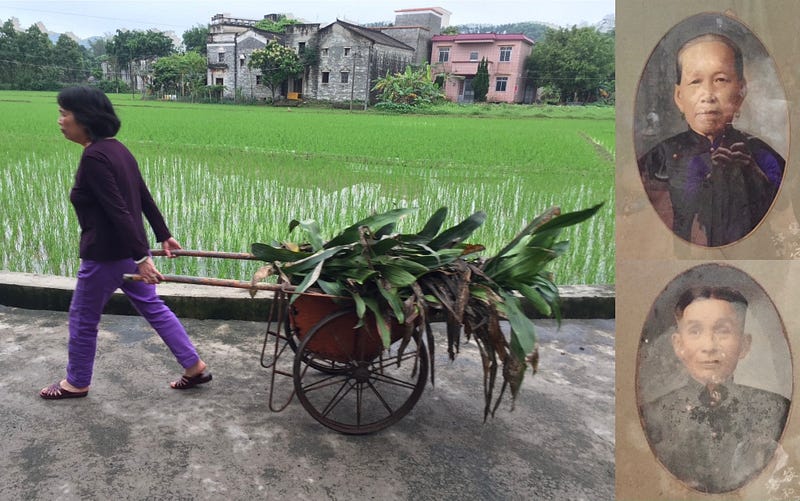
With the aid of passersby, we finally arrived at a cluster of brick buildings arranged along a massive rice paddy. As I gazed across the field of green shoots, I found comfort that I could finally see my roots and that they were thriving.
A kind man greeted us; he turned out to be my father’s cousin and, amazingly, the two recognized one another. He gave us a tour of my father’s former home, leading us through the rooms where they had slept, cooked meals, and bowed to their ancestors. I noted that the space was tidy but had no running water.
Hanging on the wall of the house were fading photographs of a man and a woman. Scrutinizing their faces closely, I saw that I shared his nose and her eyes. They are your great-great-grandparents, my father told me. In these pictures, I saw myself.
After waiting a month, I receive an email proclaiming, “Your DNA results are in!” I eagerly click on the link and navigate to the page with my ancestry report.
97% Southern China.
While I didn’t have expectations, I feel a wave of disappointment. Despite the lack of new information, I concede at least a few fragments — 3 percent — of my DNA point to another origin, the final missing piece that will complete the puzzle of my life.
3% Central & Eastern China.
I smile. While the findings are far from revelatory, I am grateful for the truth that I had spent years searching. The numbers add up to 100%.
The next time a person asks me where I’m from, I will talk about the village, the rice paddy, and the family shrine. I will retrace my father’s journey to America, how he and my mother meet and create a life together, and how they enable prosperity for me and for my sons. I will share what I know, what I feel, and what I love.
I will tell them everything.
Thank you for reading.