
THE NARRATIVE ARC
After Years of Living in My Grandparents’ House, I Finally Find My Way Home
The steps were right in front of me
As the gray paint on my front steps has chipped away from years of weather and use, a vivid layer of red has begun to peek through.
When we moved into our house two decades ago, one of my first projects was to cover up the red concrete, which I found garish. I wanted our house to blend in with the rest of the neighborhood, echoing my childhood desire to fit in as an Asian American growing up in a nearly all-white community.
But rather than reach for the touch-up kit, I find myself drawn to the patches of red. The past—that of this house and that of the generations of occupants before me—is making itself be seen, and this time I resolve to scratch beneath the surface.
On one of my runs around nearby Lake Merritt, I take a short detour to the county records office. Poring through documents on microfiche, I piece together the list of owners of my 102-year-old house:
John & Dora Gatgens Marie Gatgens & Emma Gatgens Fred & Margaret Hartley Thomas & Joan Doss Poy & Toy Sin Yee Paul & Margaret Yee
According to the deed on file, Poy and Toy Sin Yee—or Gong Gong and Ngin Ngin, as I affectionately called them—purchased the house from the Doss family on June 19, 1964. To fund the transaction, they took out a $22,000 mortgage.
Located in Oakland’s stately Crocker Highlands, the two-story, three-bedroom house was literally a world away from the rural Chinese village where they had subsisted in the not-too-distant past.
Upon moving in, to invite prosperity and good fortune, my grandparents had the walkway leading up to the front door painted a lucky shade of red.
When I recall my childhood visits to Gong Gong and Ngin Ngin’s home, I see not a house but rather a kaleidoscope of rooms.
There’s the kitchen, all clatter and steam, where my Ngin Ngin—by herself, at her insistence—chops, stir-fries, and roasts what the rest of us will later moan is too much food.
In the foyer, wedged between the front door and stairs, my mother and aunts sit around a mahjong table, rapidly slinging tiles and tidbits of gossip across the green felt.
The living room, by contrast, is a refuge, the silence interrupted only by the snores of Gong Gong, my father, and my uncle, who all somehow manage to nap upright on the orange wraparound couch.
In the master bedroom upstairs, my cousins furtively inspect the menagerie of knickknacks and vintage photos atop Ngin Ngin’s vanity dresser, daring one another to slide open the drawers.
And finally, there’s the back room, so called because of its rearmost position in the house. Standing alone in the doorframe, I can barely make out the stacks of discarded items that fill the darkened space. Above the fireplace hangs a framed painting of an illuminated pagoda set against a night sky. Too cautious to step forward yet too curious to turn away, I simply stand there, staring, until my mother calls out for me.
With its classically designed homes and tree-lined streets, Crocker Highlands was the 1920s precursor to the suburban tract neighborhood. Built around the Key train system, it offered easy access across the bay to San Francisco.
To preserve the integrity of the community, the home association had strict bylaws. Buried amongst the rules was the following: No person of African, Japanese, Chinese, or of any Mongolian descent, shall be allowed to purchase, own, or lease said property…except in the capacity of domestic servants of the occupant thereof.
While not enforced in later years, these bylaws remained on the books until the late 1970s.
I wonder about the day when Gong Gong and Ngin Ngin moved into their new house. Did they encounter stares? Given they spoke little English, I doubt they introduced themselves to their neighbors.
But within the four walls of their house, they created a hive of activity. Ngin Ngin was particularly industrious, not only operating a bustling sewing shop in Chinatown but also working into the wee hours at her sewing machine set up in the coat closet, surrounded by piles of cut fabric.
My extended family—numbering more than 20 people—would congregate at their house nearly every weekend, with someone’s birthday or a holiday on the lunar calendar always providing us a reason to celebrate.
When Margaret became pregnant in 2001, we launched an expedited search for a house, as our rented in-law apartment was far too small for a family of three. The shock of September 11th further stoked urgency to find a place to cocoon.
After our quest proved fruitless, my father made an enticing offer: Margaret and I could purchase my grandparents’ house from him and his brothers. Ngin Ngin had succumbed to liver cancer the year before, exactly a decade after Gong Gong had died quietly in the corner of the living room. Following Chinese tradition, the house was passed down to their three sons.
Years since my last visit, I ascended the red steps and unlocked the front door. The condition of the interior shocked me; the house was unrecognizable. The renters had installed locks on the bedroom doors, drilled gaping holes in the walls, and carelessly stained the floors.
Depleting our remaining funds, we performed a deep cleaning and made small upgrades to the kitchen and bathroom. We ripped out the carpet, delighted to discover hardwood floors in near-perfect condition. And mindful of making a good impression, we repainted the house’s exterior, including the front steps.
In time for our son’s arrival a month later, we had a place to call home.
Being a century old, our house was in constant need of upkeep, particularly the back room. Constructed shoddily, it leaned to one side. The room was always cold; it had no heating, which explained the fireplace. Upon closer inspection, I determined that the back room had once stood separately, with its own entrance.
It finally dawned on me that the back room was intended to be the servant’s quarters. I wondered who lived here, their names no doubt excluded from the property records. Given this history, the room took on poignancy: my father’s first job when he arrived in the U.S. at age 15 was as a houseboy for a local family.
We eventually saved enough money to remodel the house. Our architect ambitiously proposed shoring up the back room and building a second story on top of it. The structural engineer vetoed these plans, concluding that the foundation was too weak. So instead we cleaved the back room from the rest of the house and tore down its walls, carting away the debris along with any memories it held.
In its place, we built a sun-filled room with easy access to the backyard. We affixed a bathroom; ever the planner, I envisioned this space to be where Margaret and I would spend our later years once climbing the stairs became too arduous.
While still called the back room, it became our de facto family room and the site of much leisure and laughter; the video game sessions, Uno matches, and Netflix binges were too many to count. We particularly cherished the space as we hunkered down as a family during the pandemic.
For years, my grandparents’ house and the house in which my wife, children, and I forged our lives remained separate places in my mind. The former was steeped in Chinese tradition, the latter decidedly American. In one, I was a child with no sense of time or its preciousness; in the other, I was a father desperately holding onto each day as the boys grew rapidly and prepared for life beyond our home.
But as I learned more about my family’s past and the history of this house, the rooms in my memories began to align with those in my present day. Each room now not only had depth, width, and height but also the dimension of time.
For the final phase of the remodel, we repainted the exterior of the house. Remaining conservative, we opted to keep the same blue-and-white walls and gray front steps, though our architect convinced us to inject a little pizzazz.
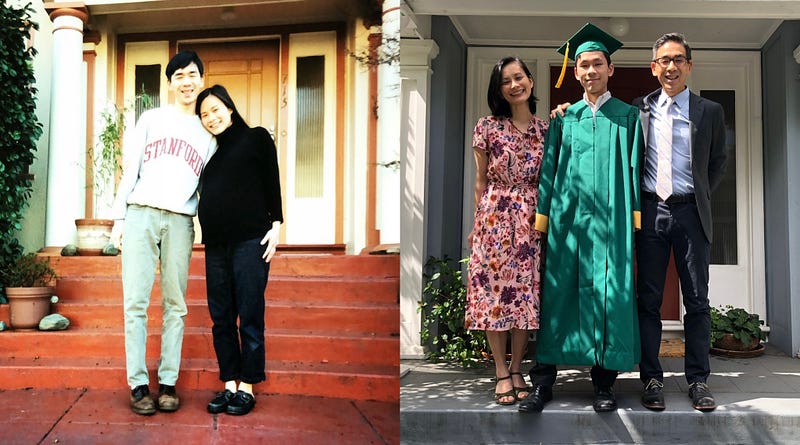
So if you look closely at our family photos commemorating special events, like our sons’ high school graduations, you’ll see us lined up on the front steps. Appropriately, we’re framed by our home—the constant presence in our lives and the beloved provider of comfort for us and so many others.
Beaming, we stand together as a family in front of a bright red door.


