
Writer’s Rights | Copyright
When Love is a Pain in the ‘But’
my pre-emptive, retrospective admission to inadvertent plagiarism and copyright infringement — or not

I wrote a poem last week, called Love Is But A Whisper. You can find it here in Paper Poetry.
I’m really pleased with the poem especially as it was a bit of an experiment. It came together with surprising ease. Writer’s dream, right?
Before I knew it, I had a poem that was begging to be published, but I didn’t know what label to give it — as in, what style of poem to call it. That sent me on an expedition to Googleland.
What I didn’t think to do while I was poking around on the internet was to search my poem’s title which, incidentally, is also its opening line. In fact it was only after the poem was published and I went to check if the Googlebots had done their SEO-ing that I discovered I wasn’t the first person to publish the sentence, Love is but a whisper. According to Google, there’s evidence of Amazon having had an e-book of poems and short stories with the same title but, curiously, it’s been taken down. Could that have something to do with the fact that Love Is but a Whisper is the title of third person’s song? 😳
Yikes! Does that mean I’ve inadvertently plagiarized someone’s lyrics? Or infringed copyright? Or both?
Oh, crap!
I swear I never knew the song existed, and I suspect not too many others know about it either. That, in itself is a shame because the song is quite sweet but the YouTube stats indicate it has only scored 14 views since August 2015 (one of them being mine) and the performer has just one subscriber to his channel (and that’s not me). You can check it out for yourself here.
I told myself not to fret about the issue. After all, what are the chances of someone making the connection between my poem and a song that hasn’t attracted much attention? I pushed it to the back of my mind and went about my business. Then I read Stephen Romei’s front-page article, Poetic justice for ‘borrowing’ words, in last weekend’s The Australian newspaper.
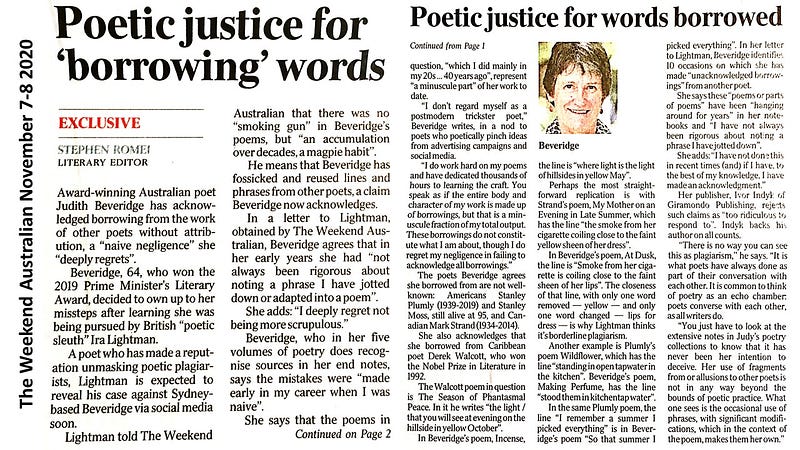
In summary, the article alerts us to the imminent ‘outing’ of Judith Beveridge, an award-winning Australian poet who has effectively been forced to confess ‘unacknowledged borrowings’ from other poets. She describes having, over many years, collected — and used — other writers’ words but, to her detriment, being lax in referencing her sources.
She says these ‘poems or parts of poems’ have been ‘hanging around for years’ in her notebooks but ‘I have not always been rigorous about noting a phrase I have jotted down.’
The journalist provides several examples of the alleged plagiarism, the most damning one being —
‘the smoke from her cigarette coiling close to the faint yellow sheen of her dress’ (My Mother on an Evening in Late Summer, by Mark Strand in Selected Poems, 1979)
compared to —
‘Smoke from her cigarette is coiling close to the faint sheen of her lips.’ ( At Dusk , by Judith Beveridge in Wolf Notes, 2003)
Ms Beveridge’s publisher, at this stage of proceedings, remains staunchly supportive of his talented client, taking the view that it is accepted practice for poets to re-engineer another writer’s words and ‘make them her own.’
‘It is common to think of poetry as an echo chamber: poets converse with each other as all writers do.’
I don’t know about you, but I don’t buy his over-generalization, ‘as all writers do’. It sounds like he’s throwing the issue to the wind hoping it will blow away, but I suppose, when your back is up against the wall, you find yourself saying anything to save your own skin. Deflect, deflect, deflect.
That aside, where does this leave me? And, for that matter, any other writer who doesn’t have the security of a publishing house to back them up or the money in the bank to fight a legal challenge? To be honest, I’m feeling a tad bit exposed here.
I think back to Alison Acheson’s very helpful article, What You Must Know to Include Song Lyrics in Your Story, which I read a couple of months ago and can highly recommend.
As this screenshot shows, I even highlighted some key sentences.
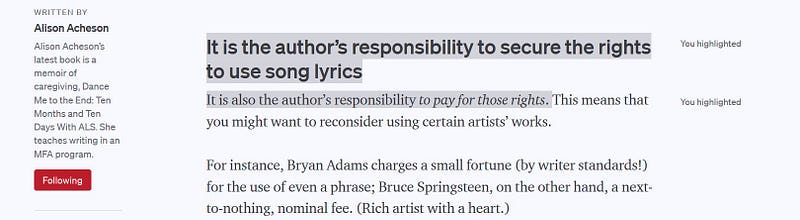
‘It is the author’s responsibility to secure the rights to use song lyrics.’
and
‘It is also the author’s responsibility to pay for those rights.’
Gulp. This is not looking good for me.
A little further along in Alison’s article, I’ve highlighted ‘titles are not copyrighted’. Well, that’s handy for future reference, but it’s not enough to get me off the hook I’m on right now. Sure, the song’s title is, Love Is but a Whisper, but the same lyric is repeated a bazillion times in the song.
Alison’s article is primarily pitched to writers who intend to sell their books i.e. to make money on the back of someone else’s words, albeit a tiny fraction of the full manuscript. Alison provides some helpful advice and links to licensing services. But how does that translate to a 78-word poem published on an online blogging platform with the first five of those 78 words being in the shadow of a plagiarism-copyright cloud? Yes, my poem’s metered on Medium’s Partner Program but we’re not talking mega bucks of profit here. In fact, at the time of writing, my poem has netted me a paltry 24 cents!
I move onto the comments section of Alison’s article; specifically to Joydwip Mohajon’s query about quoting movie dialogue. You see, I butted in on that conversation and, sparing you the detail, ended up posting a link to Jane Friedman’s blog post article, A Writer’s Guide to Fair Use and Permissions + Sample Permissions Letter. It’s a super helpful article.
Jane’s opening sentence gets straight to the point -
‘Whenever you decide to directly quote, excerpt, or reproduce someone else’s work in your own — whether that’s a book, blog, magazine article, or something else — you have to consider, for each use, whether or not it’s necessary to seek explicit, legal permission from the work’s creator or owner.’
Jane explains that from there, the issue becomes quite murky with no hard and fast rules about what qualifies as a permission-required word borrowing.
‘Some people say 300 words. Some say one line. Some say 10% of the word count.’
Holy, moly! This isn’t getting any easier.
Before we go too much further, it’s worth noting that both Alison and Jane are talking copyright infringement more than plagiarism. What’s the difference?
Plagiarism vs Copyright Infringement
Plagiarism is using someone else’s work without giving proper credit — a failure to cite adequately. Copyright infringement is using someone else’s creative work, which can include a song, a video, a movie clip, a piece of visual art, a photograph, and other creative works, without authorization or compensation, if compensation is appropriate. Schools enforce plagiarism. The courts enforce copyright infringement.
Quoted from Plagiarism Checker . com which in turn cited The Council Chronicle which quite likely sourced it from elsewhere and so on until at some point a dictionary was involved which, thank God, is public domain — common use — free for the taking. How far do you have to go back with this citing sources thing? But let’s not waste time on that now. I have a predicament to sort out.
The definitions have confirmed the worst. My unintentional, uncited use of the lyric, Love is but a whisper, would be considered both plagiarism and copyright infringement. Oh, woe is me! 😨
Scrolling down Jane’s article, she talks about public domain and the criteria for fair use whereby permission is not required. She includes a flowchart info-graphic that only serves to reinforce the precarious state I’m in.
‘Are you quoting a song lyric or poem?’ ➡️ ‘Yes’ ➡️ ‘Your use likely requires permission, especially when your use is commercial.’
Jane continues with a listicle on how to identify the owner of the copyright, your options if you don’t get a response, as well as mentioning Creative Commons, the user-friendly version of copyright.
She concludes her article with a warning. She might as well have been speaking directly to me because it goes like this -
But: be very careful when quoting song lyrics and poetry
Because songs and poems are so short, it’s dangerous to use even 1 line without asking for permission, even if you think the use could be considered fair.
‘Even if you think the use could be considered fair.’ Bloody oath, I consider it fair that I should be allowed to freely use the sentence, Love is but a whisper, as the title and opening line of my poem! Five ordinary words — a, but, is, love, whisper — that reside in all English-speakers’ vocabularies but somehow when they’re assembled in a particular way and published they become someone’s exclusive property. Am I the only one who thinks that’s ridiculous?
But the law is the law and I’m not one to deliberately and belligerently break it. So, what to do?
The only safe thing I can do. Seek permission. Without delay.
Seek permission.
Seeking Permission
Despite Jane’s well-intentioned listicle, it doesn’t really help me. My efforts to identify the copyright holder of the song, Love Is but a Whisper, lead me to believe that it must be the songwriter/singer himself, Matt Gallatin. Trying to find a way to contact him turns out to be a series of dead ends. Until I turn to Facebook, that is! A bit of digging around in that monolith of social media, uncovers a match. I’ve now messaged an otherwise total stranger to whom, and unbeknownst to him, I share a common creative interest in a five-word sentence. I await his response with more curiosity than apprehension. I’m really not anticipating any problems but just in case it does go pear-shaped and I end up having to pull down my poem, this might be your last chance to read it, so here it is again — for now. 😏
Declaration
In the event that I don’t receive a response to my message, I, Carolyn Hastings, hereby declare that posting this article online is an admission that I retrospectively became aware that I may have unknowingly exposed myself to claims of plagiarism and copyright infringement when I used the sentence, Love is but a whisper, in a poem with the same title without acknowledgement or seeking permission from the assumed copyright owner, Matt Gallatin.
What about Judith Beveridge?
With a bit of luck, I’ve covered my ass — and given Matt’s song a bit of free publicity along the way 😃 — but what about Judith Beveridge?
If my reckonings are correct and I’ve unwittingly been snared by the plagiarism-copyright-infringement trap, then that must surely mean Judith is in the trap with me. It’s not enough to admit to plagiarism without also admitting copyright infringement when the creative works in question form part of commercially published volumes of poems. Furthermore, Jane Friedman will have us know, that simply admitting to plagiarism and copyright violations is not sufficient protection against being sued.
Some Further Thoughts
As I’ve been writing this article, it’s occurred to me that the issue is not limited to the first line of the poem entitled, Love Is But A Whisper. Potentially the issue could apply to each one of the poem’s 17 lines of carefully crafted words — well, maybe not the last line, Love is ….
This raises the question, How far does a writer have to go to be sure the words they write are authentically their own? This is particularly relevant for short creative manuscripts like poems, song lyrics and children’s picture books where each and every word is prey to scrutiny — and potential legal challenge.
While it’s fair and reasonable to expect writers to act responsibly in citing sources and seeking the necessary permissions required to safely ‘borrow’ another writer’s words, it’s bordering on oppression to have writers feel they must run their words through a proof-of-authenticity test.
I accept that laws governing intellectual property, licensing agreements and copyright are there to protect all parties, but at the same time I suspect that much of the anxiety around these issues has come about since the advent of the internet and the globalization of the marketplace. With all due respect to Matt Gallatin, I find it hard to believe that he was the first person in history to sequence the words, a, but, is, love, whisper, into the sentence, Love is but a whisper. Just because we don’t have ready access to proof that the sentence existed prior to Matt penning the words in 2015, doesn’t mean they should belong to him, should it? The notion of fair use really needs clarification — and a huge dollop of common sense. And while I can’t speak for Matt, I can say with all sincerity that I don’t care two hoots who else uses the sentence, Love is but a whisper. As far as I’m concerned it’s freedom of speech.
I’d love to know your thoughts on the matter. Please feel free to share them in the comments below.


