
When ‘Jim Crow’ Got Blown Out On The Basketball Court
A forgotten 1950 basketball game and America’s struggle against racism
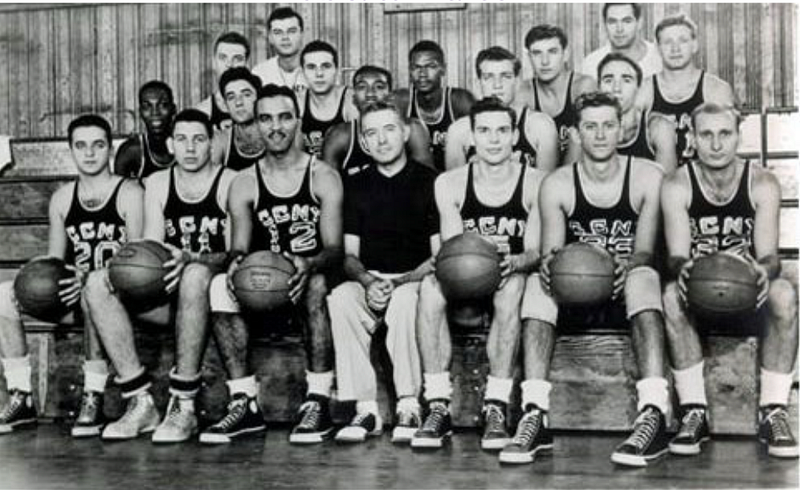
In 1950, City College of New York’s (CCNY) Men’s Basketball team accomplished a feat that will never be accomplished again. The team, led by their coach Nat Holman, won both the National Invitation Tournament (NIT) and the NCAA Men’s Basketball championship.
Back in those days, both tournaments were lucrative and there were no such things as ESPN or March Madness. CCNY was able to play in both and to win both, and become forever one of the greatest college basketball teams of all time.
Yet, one game CCNY won in the N.I.T. against Kentucky stands out more than the others. It was, in effect, the “Jim Crow” game. Long before college sports were integrated in the South, CCNY made a firm statement against Adolph Rupp’s Kentucky Wildcats and Rupp’s racially exclusionary roster (no Black players). The win was personal.
CCNY had a racially diverse team in 1950 and it was one of the best in the country, though no one believed it. In the 1940s, the team was made up of Jewish and African American players.
These New York kids played basketball as Pete Axthelm described in his famous book about New York City basketball — The City Game. Axthelm calls basketball in New York at the time, the very “fabric of life,” and a game nurtured on “strips of asphalt between tattered wire fences and crumbling buildings…”
In 1950, CCNY’s starting lineup was two African Americans and three Jewish players. Kentucky was a dominant program at the time. Adolph Rupp had an all-white team in the Jim Crow tradition of the South and Kentucky dominated college basketball. Rupp didn’t recruit Black players and Kentucky’s program would suffer big losses because of this decision.
While they had been champs in 1949, the CCNY players took the Kentucky game personally. Kentucky represented Jim Crow and racism; CCNY represented the future — a diverse nation where all could attend any school they wanted.
New York City had a large working-class Jewish population at the time and a significant African American population. They were very proud of their college and what it represented for them.
The New York Times, in 1950, described the b-ball massacre as follows:
Never in all his glorious twenty years as head man at Kentucky had a team tutored by Rupp been so humiliated. Run into the boards by the speedy Beavers, the Wildcats were virtually beaten in the first four and a half minutes. At this stage, C.C.N.Y. enjoyed a 13–1 spread, as Ed Warner, Ed Roman and Floyd Layne — the first with his amazing shooting and feeding accuracy, the second with his flawless defense against the 7-foot Bill Spivey, and the third with his incredibly successful handling of rebounds — completely dominated the struggle.
The final score was 89–50. No contest. It was the worse defeat in the history of Kentucky basketball up until that time. For CCNY’s Jewish players, to beat a coach down with a name like Adolph in the post-war era was magic. For the CCNY Black players, to smash Rupp and the segregated policies of the South, Kentucky, and the SEC (Southeastern Conference) was even more powerful.
A team of New York City b-ballers had taken it to Kentucky on the highest stage and before the sports world. It was the beginning of the end of racial segregation in collegiate sports even though most did not necessarily see it as much at the time.
In 1966, the University of Texas El Paso, with an all-Black starting lineup would beat Kentucky in the NCAA championship in College Park, Maryland. That victory was the true dagger into racial segregation in athletics in schools in the South.
Rupp was still coaching and his team was still all white. In 1969, Adolph Rupp finally signed his first Black player, 19 years after the blowout by CCNY in the N.I.T. Championship of 1950.


