
When it’s Time to Start Taking Care of Ourselves It Might be Wise to Have a Piece of Earth With Access to Growing Things
Plants can help us survive in this changing environment
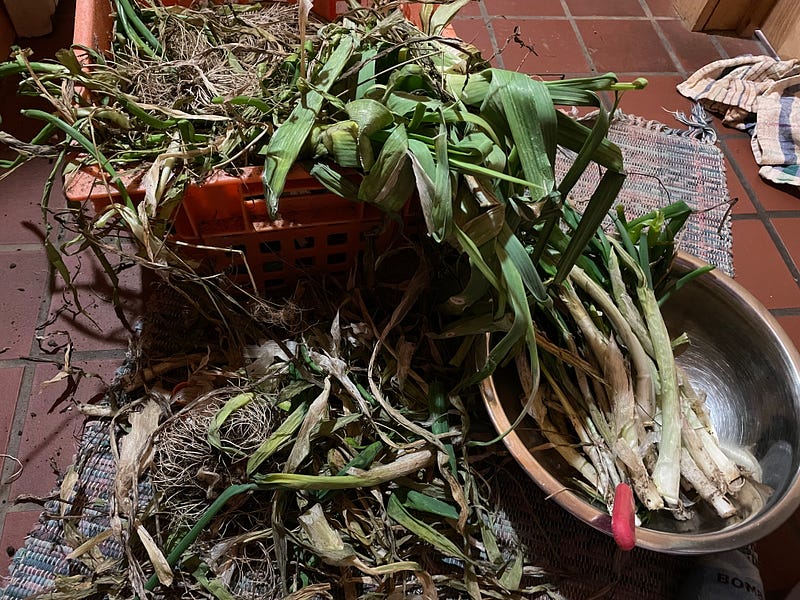
This is me cutting the dirty and dead parts off a crate full of leeks and scallions. I live in Maine, and one night last week, before the ground had frozen and just before we were expecting a significant snowfall, my husband went out into the garden after dark and dug up a crate full of leeks and scallions. They sat in the breezeway for a few days, we covered them with old coats on the nights when the temperatures were going to get into the teens. Finally, this morning, I got around to cleaning them up and putting them in the crisper drawer of the refrigerator.
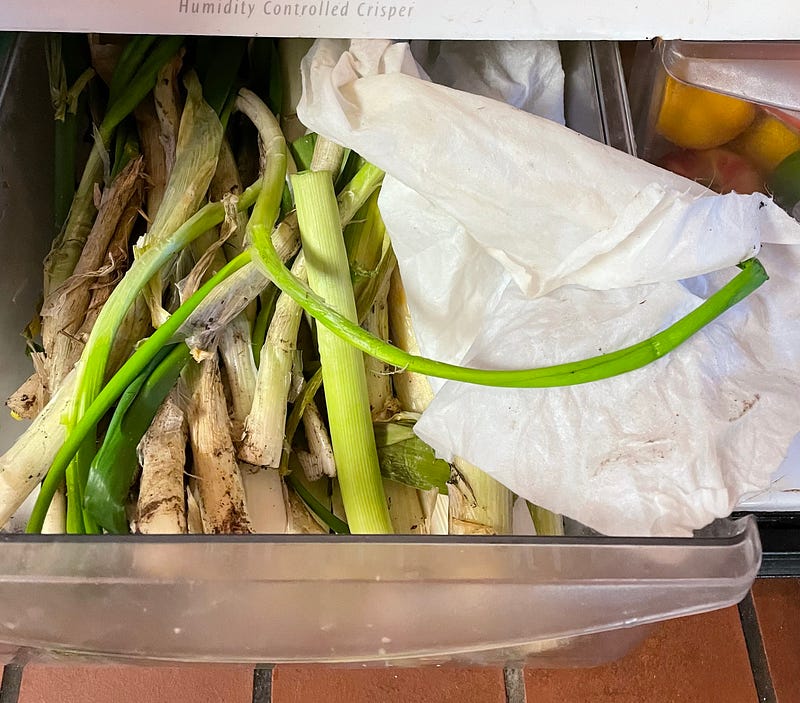
There is nothing I find more annoying than to want some leeks or scallions for a recipe and know they are out in the frozen garden under a foot of snow and ice. So, hopefully, I’ll be able to keep these for a month or so. I left all the outer leaves on them, cut them small enough to fit into the drawer, and put a damp paper towel over them.
One of the things I love about living in a rural area is that I know I have resources. It may be that I have wanted this all of my life. In my childhood, we never had much growing around us. There were bayberry bushes with berries which we were told were used to make candles, but there weren’t enough for that. I knew not to eat them but used them for decoration on baked goods in my sandpile bakery. Our woods had poison ivy and pokeberries, briars, and trees. We had weeds but never any flowers beyond tiny violets and other wildflowers that grew out of the “grass” which was really just weeds cut short with the lawnmower.
I never even knew how to use the few plants that were available. But, here in Maine, I have been learning about the weeds, herbs, and edible plants that grow all over the property. I have learned about yarrow. A little feathery leafed plant (don’t confuse it with wild carrot which looks similar) that you place under your band-aid to stop bleeding. Or St John’s Wort which is a different plant with antibacterial properties you might want to put there as well, to prevent infection. ( I am allergic to Neosporin and similar antibiotic creams so this is a good replacement for me). These plants tend to grow near the house in gravely rocky soil, almost as if they know you might want to be able to find them even when most of the ground is covered with snow. I learned early on to make a paper bag with leaves of each to have available all winter.
Then there is plantain which grows along the side of the road. You can chew that up and put it on insect bites and stings for an instant pain reliever. These old herbal remedies really work. I don’t want to replace our 21st-century medical system — well really I do, but for different reasons — but when you live far from the hospital, it just seems wise to know some alternative ways of taking care of minor things.
Then, there are the edible greens. You really need a handbook with precise pictures that describe these things, before you eat them. But, once you learn what they are you can eat dandelion greens (before the flower buds appear), violet leaves, purslane, lambs quarters, and many other plants that grow wild in the yard. We have lots of garden space plus a greenhouse, so we don’t need to eat weeds. But if we did, there would be options.
I like that — having options. If all the truckers go on strike, we can still eat. If we run out of fossil fuels and the government hasn’t gotten around to agreeing on a solution to help with important things like housing, food, and medical care, it seems wise to have our own plans in place. That’s why the first thing I did when I had to make a withdrawal from my IRA at age 70 was to invest in a greenhouse. It has been a real blessing to be able to grow our own green food in many more seasons.
In fact, I would encourage everyone to start making some preparations for doing things on their own. Make a small garden, and even if it’s not a success this year, try again and get better at it. Learn about the plants that are already growing in your area. Some of them may be edible and have use as medicine.
These homegrown or homemade things, the foods and medicines our ancestors survived on, are often healthier for us. Though not available in massive quantities, they are not filled with plastics or dangerous chemicals. We don’t need to be concerned with shelf life or shipping qualities. Our goods don’t have to survive transport from across the country. We can grow plants that haven’t been bred for sugar content so that they resemble candy more than fruit.
In other words, many of us are relearning the skills our grandmothers and fathers knew in order to take better care of ourselves now. I am not a wackadoodle stocking up on beans or bullets for Y3K, and I don’t subscribe to conspiracy theories. But, it just makes sense to me to remember and reuse the skills our ancestors learned for surviving on this heating planet. I’m betting they will come in handy one day.
I remember reading about the sailor, Sir Francis Chichester, who circumnavigated the globe in a small sailboat, growing watercress to give himself access to fresh greens. If he can do it on a sailboat, so can a person who lives in an apartment or even a room with some sunlight. There are many programs now teaching school children how to grow food and the value of knowing where your food originated. Even if you live in a small place you could grow microgreens or keep chickens. In the cities, there are rooftop gardens and community gardens options.
In preparation for this new era of climate change and pandemics, it is smart to teach children some of the skills they might need to survive in a very different society than they have become accustomed to. Growing or finding food, treating minor injuries with available resources, getting along with others, planning, strategizing, thinking for themselves. These will likely be necessary skills in earth’s uncertain future. There are several movements encouraging more people to begin growing gardens again.
For instance, Green America is a company working on bringing back Victory Gardens. Reminiscent of World Wars I and II efforts, this new movement is named a Climate Victory Garden and is based online. You can add your garden, or learn gardening techniques that help to preserve resources here.
For a program for school children, look here for further information.
As I put the scallions and leeks away, I am thinking of the leek and potato soup I can make, or using a few leeks as a bed for baking a piece of haddock. The scallions will be handy for scallion pancakes for a Chinese New Years' feast we are planning for next week. I have potatoes and garlic and onions in the cellar. There are herbs in bottles in my pantry, some of which I grew and dried myself. I have a freezer full of soups and broths, vegetables and fruits, and several kinds of meats. I’d like to learn to grow ginger and mushrooms and some of the other things I have to buy at the store. But I know we won’t starve and can help feed other people, too.
You may enjoy these other stories
follow me on jeanfeldeisen.com


