
When I’m Feeling Hopeless and Lost, I Go to the River for Nourishment
A 5 things photo essay
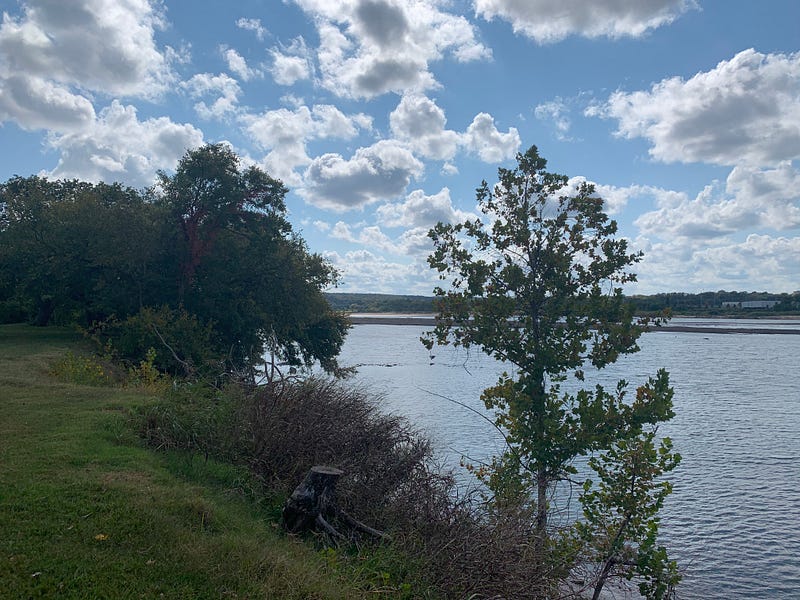
It was a humid, October day. I’d been telling myself for weeks that a walk by the river would do my heart, head, and body a lot of good but hadn’t gone on one yet.
We’d been basically self-quarantined since Mid-March, with a smattering of visits to close family members on special occasions, like birthdays — all masked up.
The kids, ages 10 and 12, had been going to school — virtually — since March, with a strange summer break in between. Now, we were almost at the 9-week mark. David had returned to his closed door office at his graphic design firm.
I continued my freelance writing work from home. Our home is not large. All six of us (two dogs included) are stubborn and have strong personalities.
We were getting sick of each other. The kids’ bickering was escalating. David and I had mostly thrown down a white flag and just wove in and out of each other’s lives without much comment. We all needed a break from each other.
I got in the car Friday afternoon and drove to the Arkansas River, not far from our home. I had hand sanitizer in the car and a mask in my pocket. I’d brought a journal with me, but realized I didn’t want to sit on publicly shared property, so left it in the car.
The clouds rolled. It was 80 degrees and stifling. After only a couple blocks — or less — I could feel my heart start pumping harder. These past months have been awfully sedentary, especially for someone, who used to work a manual labor job at a botanic garden.
I did use a handsaw a couple of weeks ago to remove a large limb from a volunteer mulberry tree. That was more of a muscle workout — it felt hard — and good.
Still, life has become very sedentary for me in 2020.
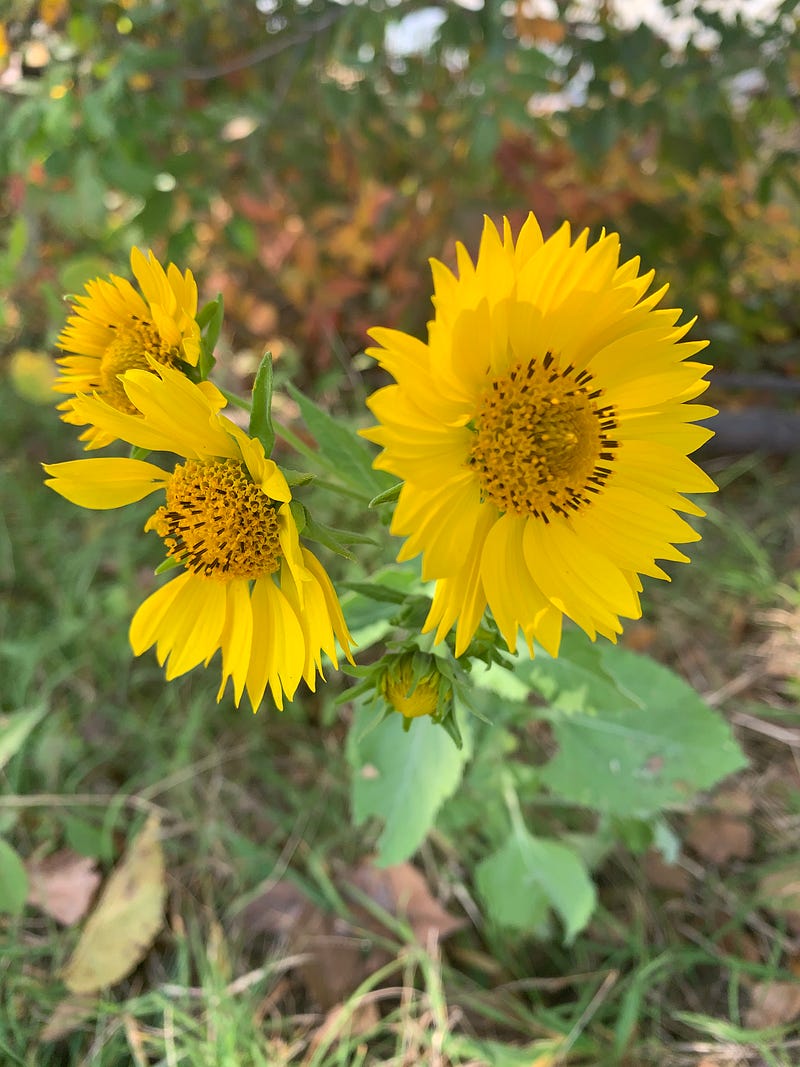
The truth is, I wasn’t really sure how I’d feel when I got to the river. Everything is different now. I don’t feel like I’ve had time to process 2020. I feel like it will take years for myself — and the collective consciousness — to process 2020.
That’s okay. It is what it is, as they say. There weren’t many people there. A few workers seemed to be taking apart the playground equipment. A lone woman sat on a low retaining wall and gazed out over the river.
A few cyclists made their way up and down the bicycle path. I walked southward, knowing that would be my best chance for peeking through trees and shrubs and finding trimmed back openings for seeing the water.
Our river is not the most beautiful. The water level is often low; the current often weak. It is surrounded by highways and refineries. Wild trees, weeds, and wildflowers grow along the edge. Renegade fisher-people sometimes fish in it, but it’s said to be heavily polluted. There’s not much beach to wander down to. There’s a feeling of separation between humans and the river.
The pedestrian and bike paths are on one side of grass and trees and the river on the other.
I like to stray from the paved path. I like to walk the edge. I stray close to the trees and water, looking out for poison ivy, homeless people, couples, and litter. Once, I first smelt and then saw, a dead guar on the sandy shore below.
This is not a pristine Hawaii beach. This is nature, in its complicated truth, surviving amidst the arguably most dangerous species — humans.
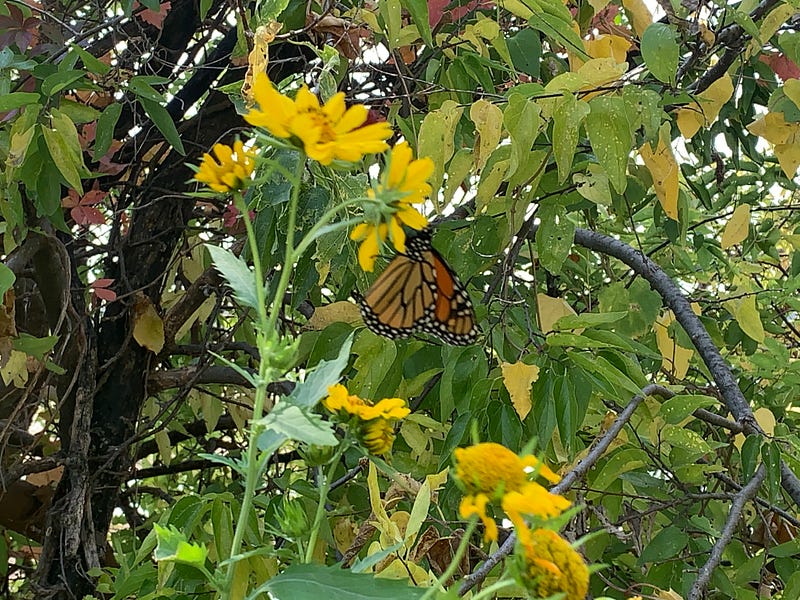
In October, 2018 (it’s now October, 2020), there was the largest migration I’ve ever witnessed of monarch butterflies through Tulsa. There were far fewer in 2019 and even fewer this year to my non-trained eye. I thought perhaps the population would thrive with more humans staying inside, but it doesn’t appear to be the case — anecdotally at least.
I felt relief when I continued meandering along the river’s edge and began seeing one, two, three, and more monarchs floating around the patches of yellow wildflowers. I’m 99.9% sure park maintenance sprays herbicide to knock back poison ivy on the river’s edge. I was grateful they chose to leave large swaths of wildflowers undisturbed as Tulsa serves as part of the migratory corridor for the monarchs.
This has been a low-count butterfly year in my backyard, too. Every butterfly I see, I’m grateful for. At the river, there were several monarchs, a yellow sulfur, a few skippers, and at least one swallowtail. They are coping with 2020, too.
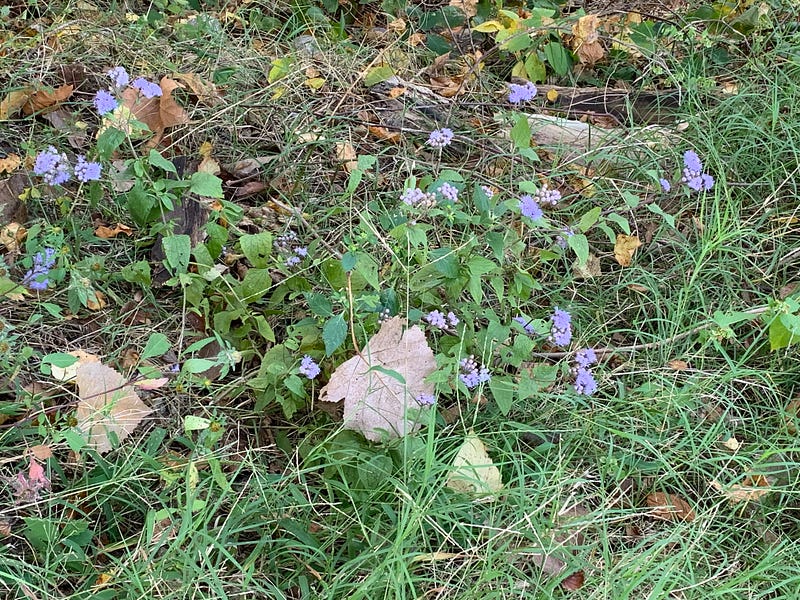
This pop of purple was striking amidst patches of yellow wildflowers in a few spots on the path. I also found a flower or grass (?) with little pink blossoms I didn’t recognize.
Going out into nature always feels like an open-ended scavenger hunt to me. What will I find? What animals — flora or fauna — will want to interact with me on my journey?
This time, I got to see a few waterbirds, a couple blue damselflies, a pair of bluejays high in a treetop, and turtles in the distance.
There was a water bird strategically, rhythmically walking against the currents on a high sandbar, feet underwater. The bird didn’t seem upset at the extra work — only extra focused.
It was being still while working against the current and taking the necessary steps.
That is what it feels like we are doing in life much of the time, especially with things that are out of our control.
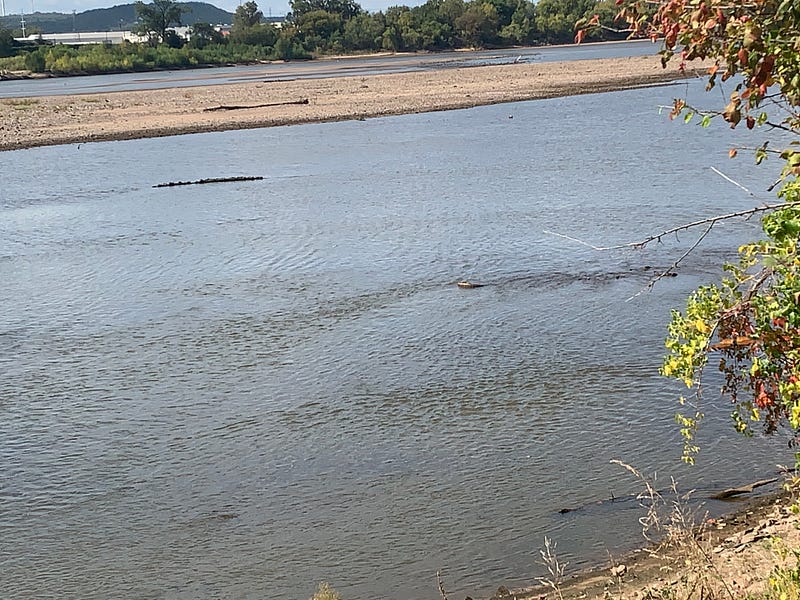
This last photo is the lowest quality of them all, but I am compelled to share it with you anyway.
To look out over the river and see a log full of turtles sunbathing is a sight that fills my heart every time I see it. My iPhone camera is no good for capturing the moment, but I can still tell you — this moment was nourishment for my soul.
Wild animals know how to meditate. They know how to just be. They know how to still there minds. There’s so much domesticated humans can learn from wild species with which share the earth.
I turned around to head back to the parking lot.
Looking at the monarchs flying over the large yellow wildflower patch, I felt a wave of loss wash over me. I remembered the Pedestrian Bridge — a wave of nostalgia hit me. It was removed a few years ago.
I remembered the years before 2020.
It was a moment of discombobulation. A moment of confusion. As hard as 2020 is — hello pandemic, police shootings, ugly election, etc, etc, it’s also a year that has potential for catalyzing great change.
I felt nostalgia for how things were in the past. I felt grief for how things were in the past — how they are in the present.
I felt hope for our future.
Maybe the human species will choose to become less dangerous.
As the collective consciousness shifts, grows, and evolves, we can go to nature when we feel hopeless and lost. Nature is a divine source of nourishment for all living beings. Let’s not forget that.
Thank you, Nikki Tate, for the prompt tag. Check out Nikkis’ photo essay here: