
On Anxiety in Times of Uncertainty
Reflections on the Arkansas River
MAY 19, 2020
I woke up my twelve-year-old son this morning at 9:30 and said, “I’m just letting you know that you are going for a River Walk with me today. You can sleep until 10:00, but then you need to get ready.” I left his room and shut the door.
Our son has been experiencing increased anxiety and depression during the coronavirus shelter-at-home and has noticed his social anxiety increasing since school was dismissed for the year after spring break back in mid-March. Yesterday, my husband pointed out that leaving the house would do our son (and me) some good. I knew he was right and was determined to make a walk happen today.
Much to my surprise, our son didn’t put up a fight when I set forth my declaration. He did express his concern that wearing masks would make us stand out. I told him too bad. It is how it is.
We ate our breakfast, got dressed, and headed out. Not a block away from our house I realized it would be nice to have binoculars for bird watching. I turned around and had our son run in to retrieve my binoculars. He came out with my Bushnell binoculars and my Birds of Oklahoma guide. And, off we went on the half-mile drive to the Arkansas River trails.
This was my second spring walk along the Arkansas River in Tulsa, Oklahoma during the time of COVID-19. I went last week for the first time this spring with our dog, Juno. Today, while my son and I headed out the door Juno showed me the disappointment of being left behind in her big brown eyes. She loved last week’s River jaunt. Next time Juno. Next time.
The River parking lot was packed. It was a sunny morning with a slight breeze and a temperature in the 70s Fahrenheit. No one except us was wearing a mask. I took a breath and we got out of the car, heading to the walking trails. I’d be lying if I said I didn’t feel self-conscious about our masks, but I knew we were doing the responsible thing. I also felt proud of both of us for pushing past our anxiety and moving through our self-conscious feelings.
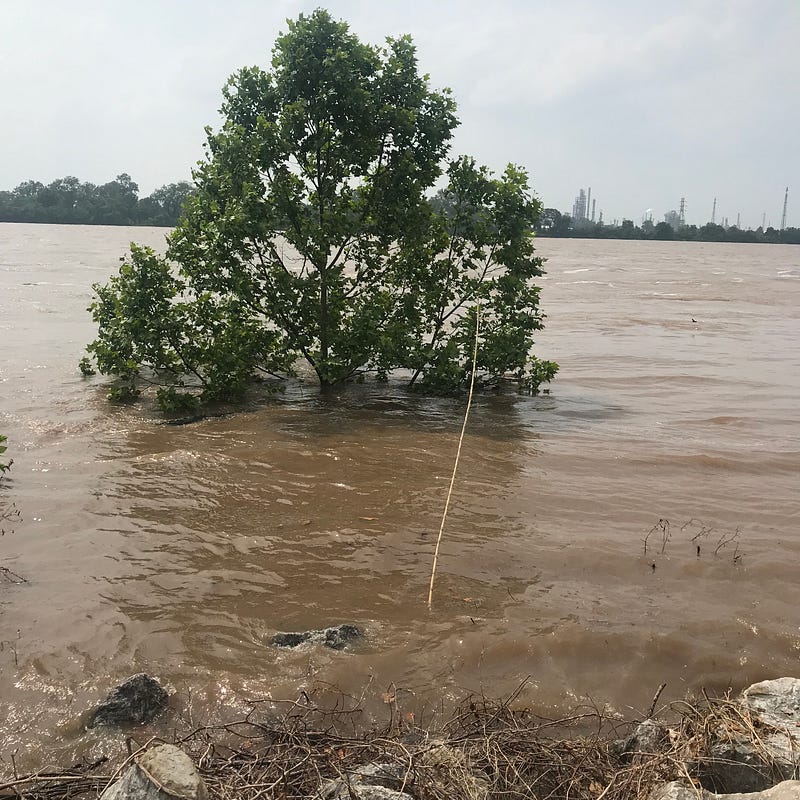
Last year, the Arkansas River rose almost to the point of flooding Riverside Drive, the major thoroughfare that runs through Downtown Tulsa and all the way south into the suburbs. Some of the water did make it into the road last year and the trails were closed down for a while in May.
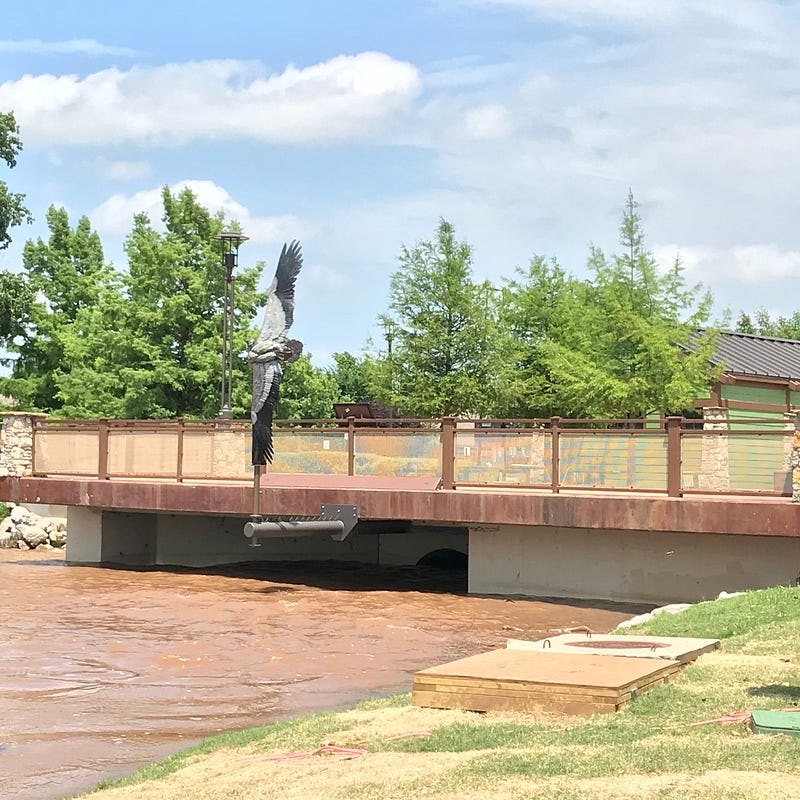
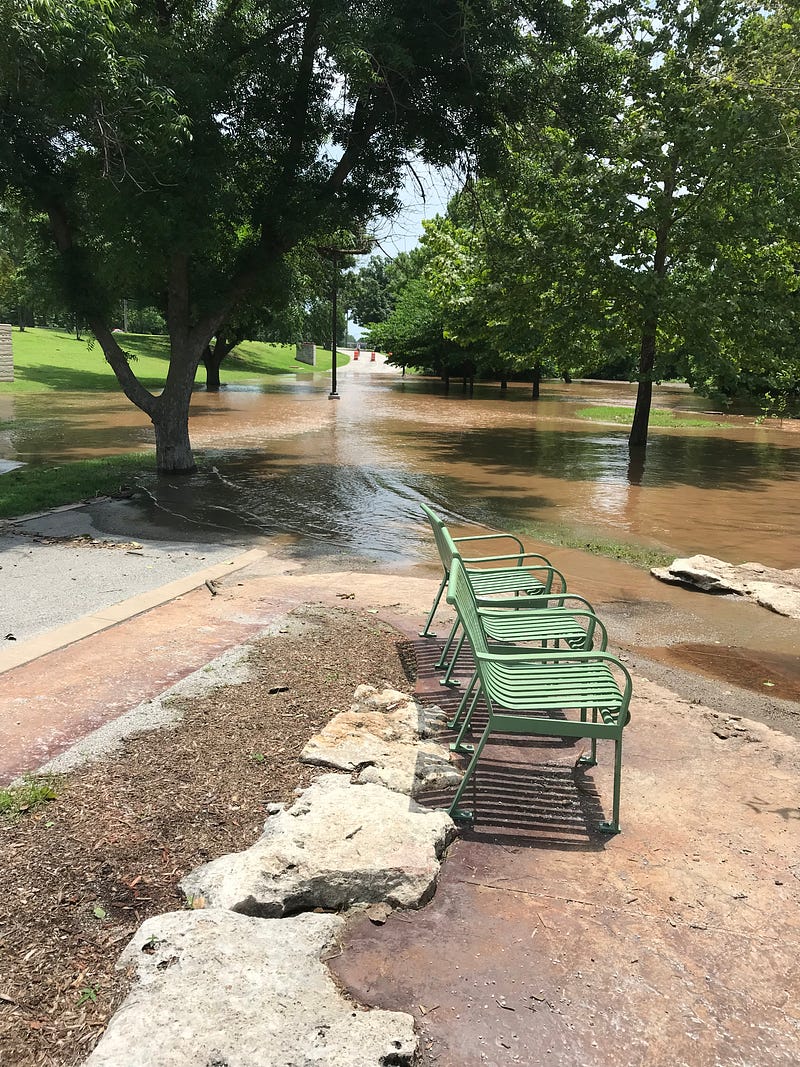
So, last spring was spent in a different territory of anxiety. As a family, we were wondering if our home would flood. We were concerned for our friends, family, and even strangers we would see on TV. We packed Go-Totes in case we needed to get into our cars and drive to a relative’s home due to flooding. Taking action usually eases anxiety to some extent, whether the action is packing Go-Totes or practicing social distancing and wearing masks in shared public spaces.
The floodplain maps suggested that our home would keep company with a few other homes on our street in a small, but secure island, amidst a neighborhood of flood damage if it came to that. This was somewhat reassuring to us, but also hard to believe. For several weeks last spring, there was an undercurrent of palpable uncertainty.
To ease my anxiety (and our son’s) I noted that our neighbors have canoes and are certified in Swift-water Safety. We packed lifejackets for our son and daughter (aged eleven and eight at the time), neither of whom are very strong swimmers. Our son worried about what might happen to us, our home, and Juno.
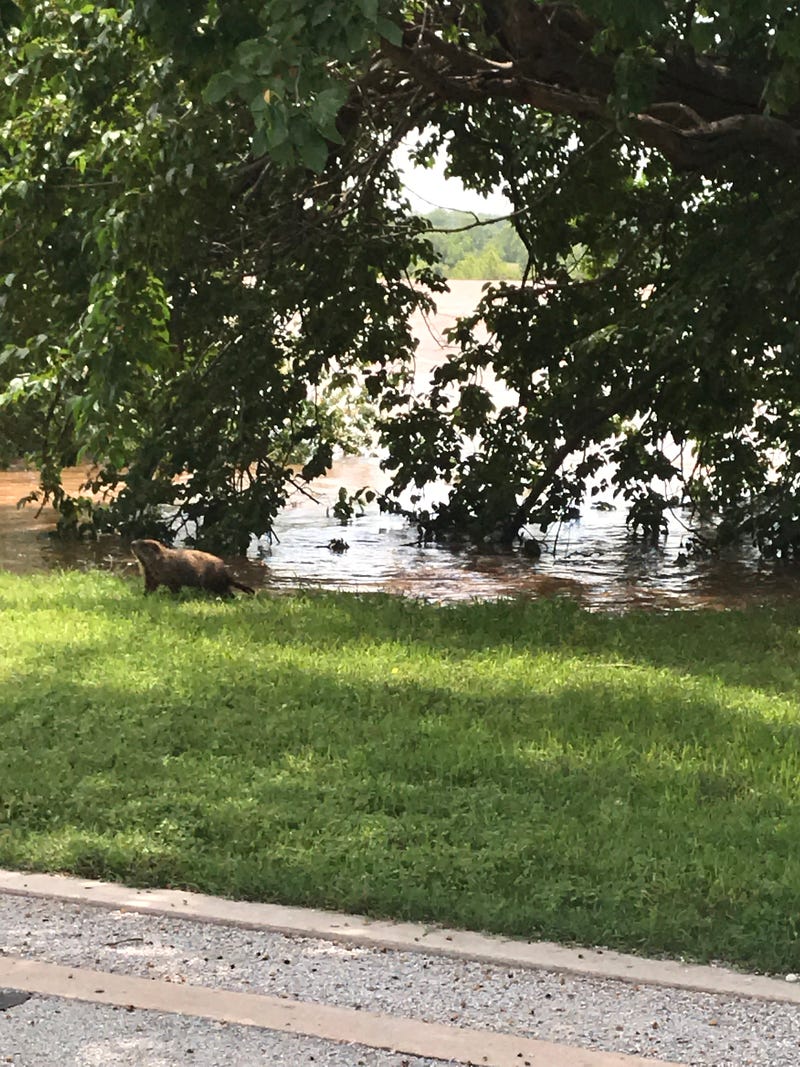
Late last May, we went as a family to witness the rising River. Hardly anyone was there. A beaver met us along the path. Snakes were washing up near, and onto, the grassy banks. Paths were blocked with signs and barricades. Playgrounds were closed until further notice. The water ran as swiftly as I had ever seen it run. It was a stunning sight to witness. Amidst all this chaos was such powerful beauty. It felt otherworldly.
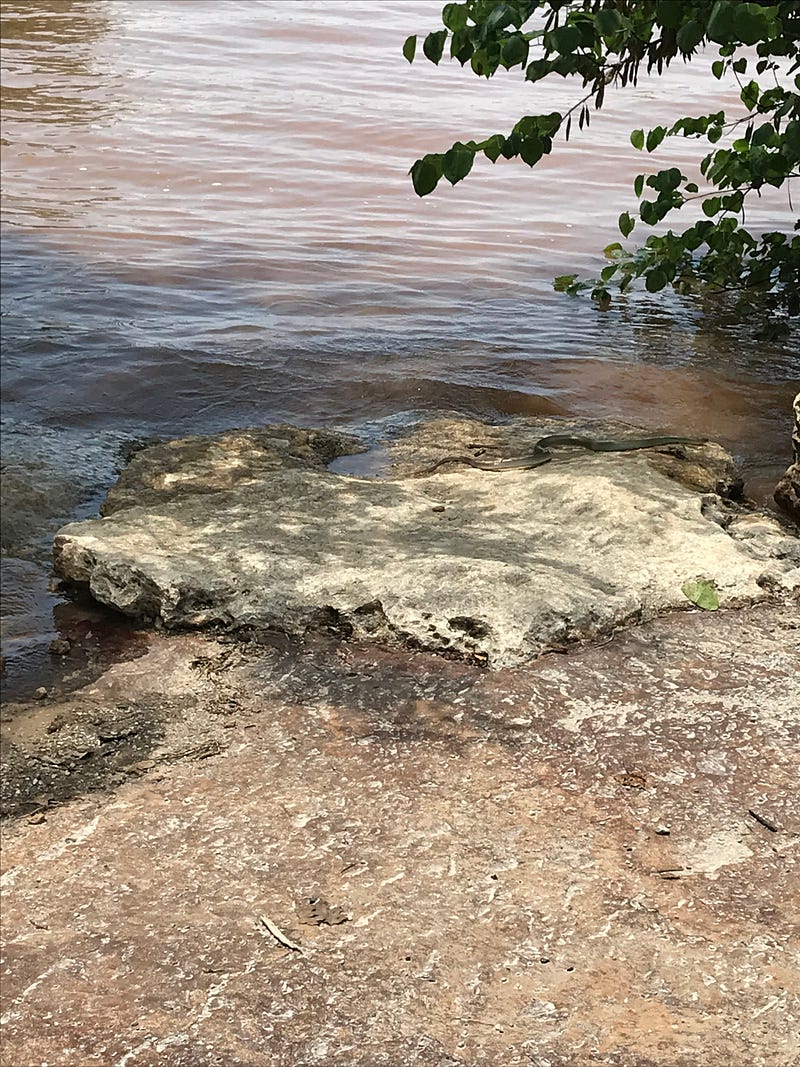
At some point during the flooding, we heard the wah-wah-wah of flood sirens for the first time in our lives. I wondered how long I would be able to make the drive over the River to bring our daughter to her gymnastics practices. I had to find an alternate way to work. We learned about levies and the Keystone Dam had a historic release. And, then, in June, the water began to recede. The rain wasn’t so torrential. And, by the end of June, we had breathed a collective sigh of relief.
Here we find ourselves, in May of 2020, experiencing another time of uncertainty amid the Covid-19 pandemic. We don’t know what will happen next. We look back to historic pandemics for points of reference, but in all reality, we do not know what will ultimately happen. On a smaller scale, we don’t even know if school will be in session this fall. No wonder, my highly sensitive son and my highly sensitive self are feeling anxious to some extent.
In Robert MacFarlane’s book Underland, he says about our current era:
We are presently living through the Anthropocene, an epoch of immense and often frightening change at a planetary scale, in which ‘crisis’ exists not as an ever-deferred future apocalypse but rather as an ongoing occurrence experienced most severely by the most vulnerable. — Robert MacFarlane
So, here I find myself raising children in a time on Earth that is indeed experiencing constant crises and energetic shifts. The most vulnerable are obviously and blatantly being most affected by this virus. Although our son experiences anxiety, he has not yet grown into adulthood and found the coping skills that work best for him. I realize that I have the benefit of years of learning how to navigate those waters of anxiety and understand that this is my lifelong journey. For a twelve-year-old — even a very perceptive one — the timeline in which we live is not an easy one and he has not developed yet a full array of coping strategies.
Yesterday, my friend, Savannah* stood at the edge of my yard, six feet away, and we talked for almost an hour. She told me about getting stung by a bee earlier this week. She said they now have 20 beehives on their property. Bees die on the ground so she has to be mindful of where she is walking as a stepped-on bee will sting. She told me that the bees not accepted into the hive have been adopted by her children.
Savannah’s children have made homes for these bees. They let the bees walk over their fingers. They pet their fuzzy bee bodies. The bees are docile. Isn’t that lovely? She told me about a spot in her yard where she likes to stand with bare feet and visualize the River running below the surface. Savannah lives even closer to the River than we do.
While reading Underland this week I also read this interesting tidbit:
The newspaper this morning reports that geologists have discovered seas of water in the Earth’s mantle. Four times as much water might be locked up there in a mineral called ringwoodite as is currently held in all the world’s oceans, rivers, lakes and ice put together. — Robert MacFarlane
So today, when my son and I set out for the River, both the obvious water of the River and subterranean water were on my mind. I was hoping to see wildlife like I saw last week: turtles, snakes, herons, mallards, butterflies, scissortail flycatchers (the Oklahoma state bird), and more.
After my son and I exited the parking lot and got going on the trails we noticed how crowded with pedestrians and cyclists the trails were. And, none of them were wearing masks. I had even driven to a point on the trails that I thought would be less frequented. No such luck. There was litter on the ground — empty plastic bottles and trash bags. When we peered down onto the river bank we saw an old tire and half-full Gatorade bottles. My son wondered out loud if he could do trash pickup for his school community service hours in the Fall.
The water smelled terrible. Trash littered our view of Turkey Mountain and the Arkansas River. My son held up his hands miming holding a video camera and talked about how the scene would make a great movie opening if the cement structure across the way could be removed. This walk was feeling like a mixed bag. The trash makes me feel blue. The scent of refineries and pollution increases my agitation and frustration.
On the other hand, aside from being self-conscious, our son was feeling pretty good. He had left the house. People were peopling. Animals were animal-ing. The world was still there outside the boundary of our home and lawn. The butterflies flitted. A blue jay caught my son’s eye. We spied five turtles sunning on logs, rocks, and the sand. Barn swallows gathered under the I-44 bridge. A pigeon flew a couple of feet over our heads.
Amidst all this uncertainty there is a grounding relief in the ability to experience this nature connection. The more we go into the uncertain, fragmented, chaotic timeline in human history — the history we are currently living through — the more I realize the immense power Earth has for healing us and for our healing Earth.
I didn’t use my binoculars today. We didn’t see as much wildlife as I had hoped for today, but my son and I did spend time bonding together. We talked about birds and turtles. We laughed together. We shared the experience of seeing bluebirds and bluejays. We shared the experience of being the only ones in masks (besides the lady in her 60s on a bicycle-at least there was one other person!). I got to teach my son about elderberry flowers and berries being edible while the rest of the plant is toxic. We got to stretch our legs and pump fresh air into our lungs.
Strangely, I have felt mostly energized during these shelter-at-home days. I have been writing and reading more. I have been connecting more with family on the phone and FaceTime as I’m not running all over the place with packed family schedules. I have joined a virtual writing group, which I wrote about in an earlier post:
I have found a Spiritual Guide and virtual earth healing group. For me, this time of separation has been an immense time of connection. I do miss seeing friends some of the time, although we have made a few backyard social distancing concessions and had a few magical visits. I miss seeing family and hugging them.
I sometimes feel exhausted under the weight of this surface-level uncertainty and of being a parent who is not in complete control of the situation. These feelings go in flux from relief at not running back and forth to school and gymnastics practice anymore to being saddened and worried about the sick and dying, and the long-term social and economic effects of coronavirus. And, I am reminded that life is both beautiful and complex. Outcomes are vastly out of our control. Nurturing connections with my humans and with nature provide deep healing for me, and for this I am grateful.
Aimée Brown Gramblin is the founder of Age of Empathy. She became a memoirist in her younger years and is writing them out now in middle age. A regular contributor to The Memoirist, Aimée is a late-blooming pop-culture enthusiast; she’s a contributor to FanFare and The Riff. With a minor in art history, she occasionally publishes art-centric nonfiction.
Subscribe to Aimée’s stories here.


