avatarAlexander Verbeek

Free AI web copilot to create summaries, insights and extended knowledge, download it at here

3735

Abstract

pilgrims and tourists. The only consistency I ever found in the too many times this issue came up is that the bar is set just below the “real pilgrim criteria” of the expert giving the interpretation.</p><figure id="60e5"><img src="https://cdn-images-1.readmedium.com/v2/resize:fit:800/1*TVSZgBRo1CAsEXJtp3J-vg.jpeg"><figcaption>The walls of Pamplona Author Image</figcaption></figure><p id="6c07">After Burguete, the route continues to Zubiri, from where pilgrims follow the river Arga through a beautiful lush landscape to the formidable walls of Pamplona, where Hemingway wrote The Sun Also Rises. He is never far from the mind, especially since the city is proud of the connection to the author. His larger-than-life statue is placed before the bull ring on the Paseo de Hemingway. During the annual San Fermín festival, the statue is decorated with a yellow scarf around his neck, referencing the traditional attire worn by the runners while running ahead of the bulls through the city’s narrow streets.</p><p id="935f">I enjoyed my return to this colorful city immortalized by Hemingway and drank a Rioja in his favorite hangout, el Café Iruña. But my progress towards Santiago de Compostela was hampered by raging forest fires west of Pamplona that would not have grown so large if there hadn’t been the heatwave I had experienced during my walk the days before. So, on day three of my five-week walk, I had already twice experienced the impacts of climate change, which stopped my progress.</p><figure id="8845"><img src="https://cdn-images-1.readmedium.com/v2/resize:fit:800/1*uC_updkoVHVHmOXgdt62vg.jpeg"><figcaption>A television in a cafe in Pamplona reports on the forest fires Author Image</figcaption></figure><p id="7699">Authorities suspended our westward pilgrimage since they had more on their minds than looking for scores of pilgrims in the forest fire danger zones. Meanwhile, a steady stream of new pilgrims arrived from the east, unaware of the challenges awaiting them and creating a scarcity of rooms usually only experienced during the bull runs.</p><p id="d2ee">I got a ride to the next big city, Logroño, which allowed me to continue my walk. I remember the views through the car window of the burned-down nature areas, still smoking in places. This year, I returned and walked through those blackened fields, where I admired nature’s resilience at every green sprout I saw, providing hope through the regenerative power of nature.</p><figure id="704e"><img src="https://cdn-images-1.readmedium.com/v2/resize:fit:800/1*MQI2hG85fjrmv1Y_mNwaMg.jpeg"><figcaption>Café Iruña Author Image</figcaption></figure><p id="7bb7">By then, early in my journey, I had already decided that more Caminos would follow and that I would intertwine my second journey with the theme of climate change; it became the lens through which I viewed the Camino. This decision transformed my pilgrimage into more than a personal odyssey; it became a quest for understanding and connection.</p><p id="ecc0">The video series that emerged from this journey in cooperation with Swiss Re became a documentary of the impact of our changing climate on the Camino route, the communities that call it home, and the pilgrims who seek spiritual growth, personal reflection, or a break with the past along its path.</p><p id="28a1">Two weeks ago, I shared the video on the impact of climate change on wine growing in the Rioja region. Last week, I shared the second video on renewable energy, inspired by the wind turbines at the famous stop on the Camino at the Alto del Perdón.</p><p id="88ab">Today’s video is inspired by the heatwaves and wildfires I encountered at several places along the Camino de Santiago. In a park close to Swiss Re’s h

Options

eadquarters in Zurich, I met with Tamara Soyka. We discussed what can and cannot be attributed to climate change regarding extreme weather and natural catastrophes and spoke about the pivotal role re/insurance plays in building resilience. Here is the complete 11-minute version:</p> <figure id="02a5"> <div> <div> <img class="ratio" src="http://placehold.it/16x9"> <iframe class="" src="https://cdn.embedly.com/widgets/media.html?src=https%3A%2F%2Fwww.youtube.com%2Fembed%2FTFybTVS5n7o%3Ffeature%3Doembed&amp;display_name=YouTube&amp;url=https%3A%2F%2Fwww.youtube.com%2Fwatch%3Fv%3DTFybTVS5n7o&amp;image=https%3A%2F%2Fi.ytimg.com%2Fvi%2FTFybTVS5n7o%2Fhqdefault.jpg&amp;key=a19fcc184b9711e1b4764040d3dc5c07&amp;type=text%2Fhtml&amp;schema=youtube" allowfullscreen="" frameborder="0" height="480" width="854"> </div> </div> </figure></iframe></div></div></figure><blockquote id="cf3f"><p>In my Patreon post, I share several video shots I made during the Camino; it shows when I arrived in Pamplona after days of walking and left two days later. The link to Patreon is <a href="https://www.patreon.com/posts/more-photos-and-93512911?utm_medium=clipboard_copy&amp;utm_source=copyLink&amp;utm_campaign=postshare_creator&amp;utm_content=join_link">here</a>.</p></blockquote><p id="b44c"><a href="https://medium.com/subscribe/@Alex_Verbeek"><b>Subscribe</b></a><b> to receive email notifications when I publish new articles</b></p><p id="bd6b">Email subscription via:</p><div id="3054" class="link-block"> <a href="https://medium.com/subscribe/@Alex_Verbeek"> <div> <div> <h2>Get an email whenever Alexander Verbeek publishes.</h2> <div><h3>Get an email whenever Alexander Verbeek publishes. By signing up, you will create a Medium account if you don't already…</h3></div> <div><p>medium.com</p></div> </div> <div> <div style="background-image: url(https://miro.readmedium.com/v2/resize:fit:320/0*R1uv7uajOdJRGoaJ)"></div> </div> </div> </a> </div><div id="c44f" class="link-block"> <a href="https://readmedium.com/cop28-when-emissions-soar-temperatures-rise-and-leaders-fall-short-7a00668651b9"> <div> <div> <h2>COP28: When Emissions Soar, Temperatures Rise, and Leaders Fall Short</h2> <div><h3>At COP28, remember that the wealthiest one percent of humanity is responsible for more carbon emissions than the…</h3></div> <div><p>medium.com</p></div> </div> <div> <div style="background-image: url(https://miro.readmedium.com/v2/resize:fit:320/1*DcZgcIxMJU2EdJ6slKntCg.jpeg)"></div> </div> </div> </a> </div><div id="00c5" class="link-block"> <a href="https://readmedium.com/the-changing-camino-de-santiago-exploring-climate-challenges-and-community-adaptation-6f17aeaa3f70"> <div> <div> <h2>The Changing Camino de Santiago: Exploring Climate Challenges and Community Adaptation</h2> <div><h3>It is the Camino that brought me back to Spain. Since I finished my five-week pilgrimage last year, I have longed to…</h3></div> <div><p>medium.com</p></div> </div> <div> <div style="background-image: url(https://miro.readmedium.com/v2/resize:fit:320/1*6P_EhGuw6AEIu5ITxUHTuw.jpeg)"></div> </div> </div> </a> </div></article></body>

When Hemingway walked the Camino
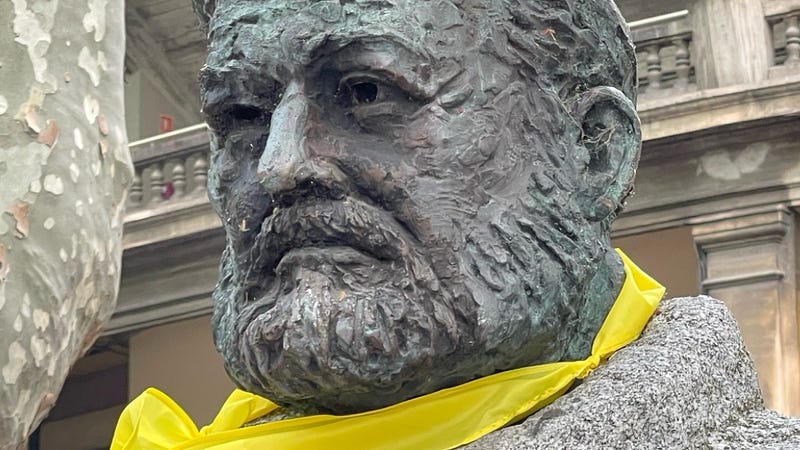
Ernest Hemingway statue outside of the Pamplona bull ring (all photos by author)

In the haze of my student days in the ’80s, Hemingway’s Fiesta, or as most know it, “The Sun Also Rises,” left a lasting impression on me. It wasn’t just the raw power of his writing that gripped me; the scenes he painted echoed some of my student experiences those days. What mainly stayed with me were the cities of Paris and Pamplona, which both set the stage for his novel.

I got to know Paris well, a city I have visited in all phases of my life. However, Pamplona remained a distant dream for me, adorned with Hemingway’s vivid imagery. It was only six years ago, en route to the Basque cities of Bilbao and San Sebastián, that I finally walked the streets of this beautiful city. There, I encountered pilgrims on their way to Santiago; it planted a seed in me to join their ranks someday, a step I took only five years later when I embarked on my first Camino.

It takes three days to walk to Pamplona from the most well-known starting point of the Camino Francés, the iconic Saint-Jean-Pied-de-Port with its steep cobblestone streets and ancient houses. The Pyrenees crossing that starts here is one of the most beautiful parts of the Camino; it is where most pilgrims set their first steps on this historic route, which many will later remember as the start of a personal journey of discovery.
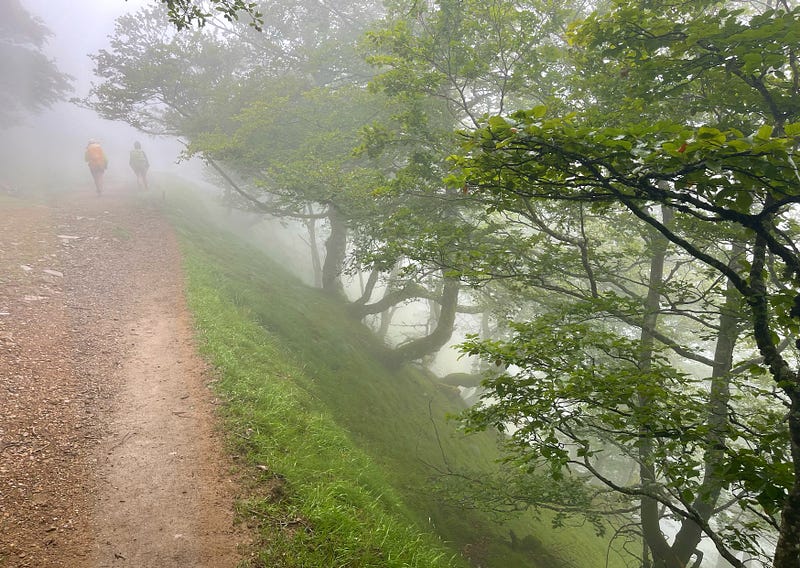
Two pilgrims ahead of me, crossing the cold and mist-shrouded Pyrenees Mountains — Author image

Not many will ever forget the experience of traversing these often cold and mist-shrouded mountains. They will remember how inexperienced or insecure they started, as fresh as their clean backpacks and their feet still blissfully blister-free.

After crossing the border and reaching the highest point, the route goes downhill to the monastery of Roncesvalles and then further through the charming small village of Burguete. In July 1923, Hemingway stayed in the local hostel to go fishing for trout, carve his name into the piano, and drink lots of Rioja wine once he found out it was included in the price.

I visited this town precisely in the same month, one hundred years after he stayed here. The short, flat, and pleasant three-kilometer walk I had just taken from Roncesvalles is, as far as I know, the only part of the Camino Hemingway has ever walked.
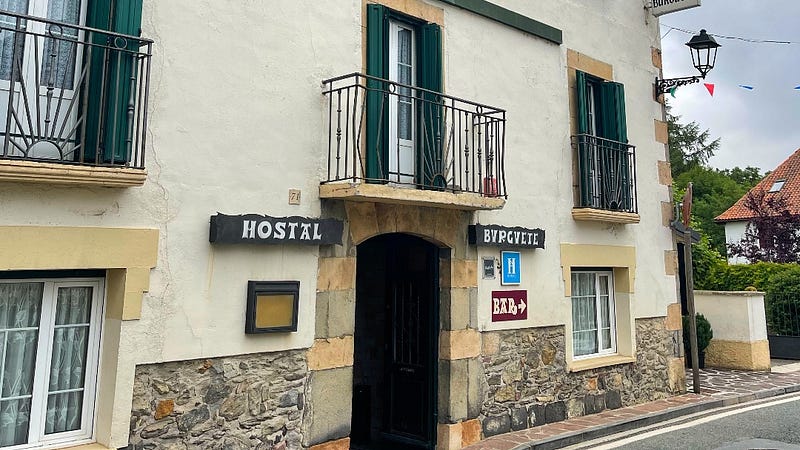
Hemingway’s hostel is still there. Author Image

He visited Burguete three more times. It seems to be the only place where Jake (Hemingway’s alter ego in The Sun Also Rises) finds peace. He spends his days mainly with Bill, and there is hardly any competition between the two men, although Bill catches the biggest fish using fly-fishing instead of worms.

For me, passing through Burgette was also a peaceful experience. I walked up with a man who was one of the rare examples I met on the Camino of what I would like to describe as a real pilgrim. I’ll write about him someday; he deserves some paragraphs of text. I’ll also write about “real pilgrims” someday; it deserves a few chapters. Suffice it to say for now that most pilgrims like distinguishing between real pilgrims and tourists. The only consistency I ever found in the too many times this issue came up is that the bar is set just below the “real pilgrim criteria” of the expert giving the interpretation.
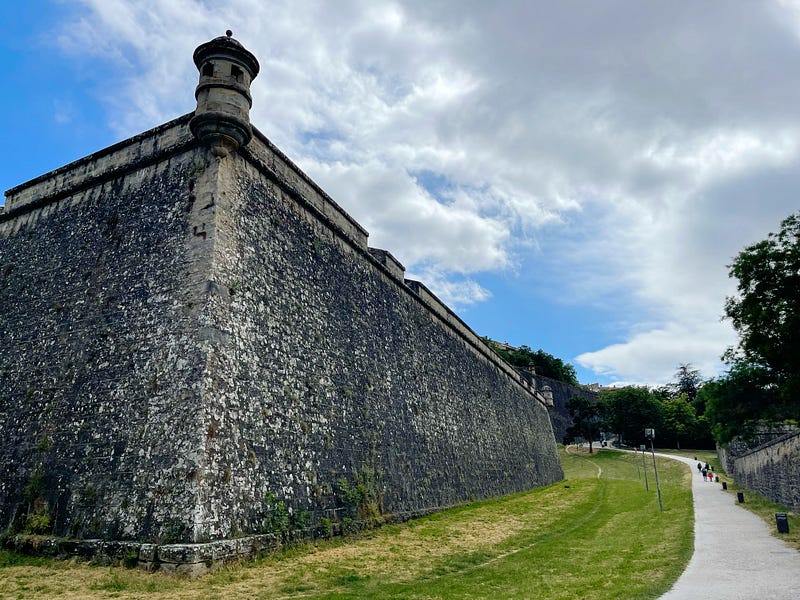
The walls of Pamplona Author Image

After Burguete, the route continues to Zubiri, from where pilgrims follow the river Arga through a beautiful lush landscape to the formidable walls of Pamplona, where Hemingway wrote The Sun Also Rises. He is never far from the mind, especially since the city is proud of the connection to the author. His larger-than-life statue is placed before the bull ring on the Paseo de Hemingway. During the annual San Fermín festival, the statue is decorated with a yellow scarf around his neck, referencing the traditional attire worn by the runners while running ahead of the bulls through the city’s narrow streets.

I enjoyed my return to this colorful city immortalized by Hemingway and drank a Rioja in his favorite hangout, el Café Iruña. But my progress towards Santiago de Compostela was hampered by raging forest fires west of Pamplona that would not have grown so large if there hadn’t been the heatwave I had experienced during my walk the days before. So, on day three of my five-week walk, I had already twice experienced the impacts of climate change, which stopped my progress.
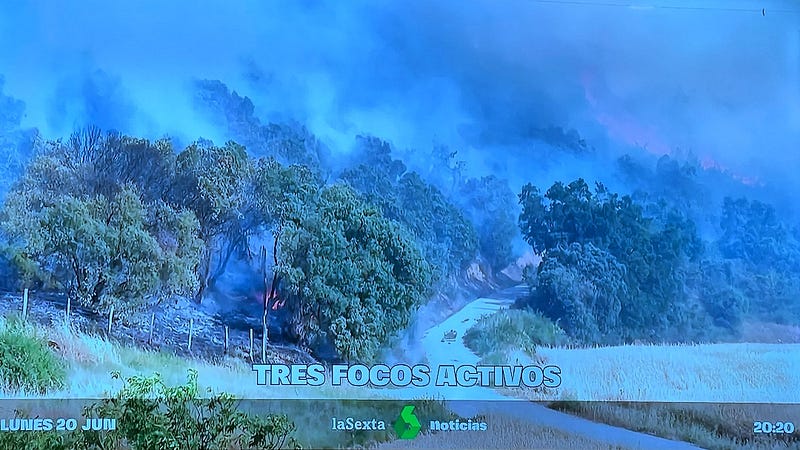
A television in a cafe in Pamplona reports on the forest fires Author Image

Authorities suspended our westward pilgrimage since they had more on their minds than looking for scores of pilgrims in the forest fire danger zones. Meanwhile, a steady stream of new pilgrims arrived from the east, unaware of the challenges awaiting them and creating a scarcity of rooms usually only experienced during the bull runs.

I got a ride to the next big city, Logroño, which allowed me to continue my walk. I remember the views through the car window of the burned-down nature areas, still smoking in places. This year, I returned and walked through those blackened fields, where I admired nature’s resilience at every green sprout I saw, providing hope through the regenerative power of nature.
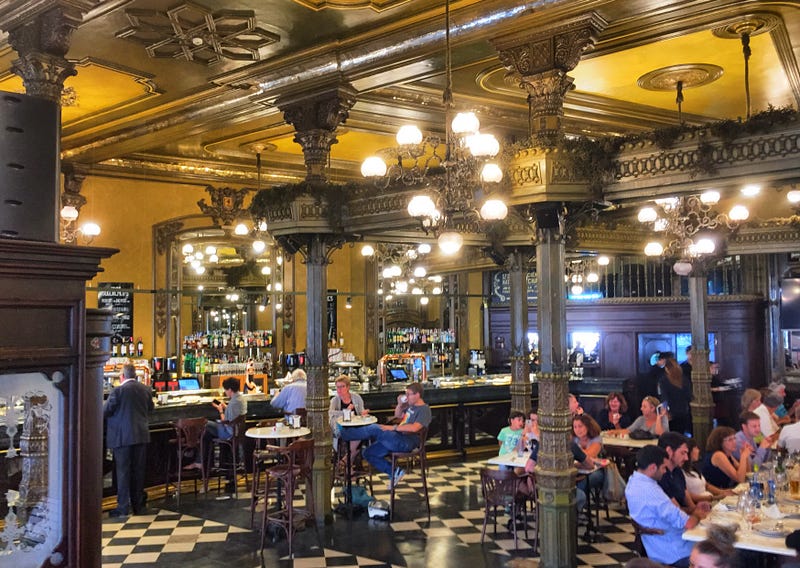
Café Iruña Author Image

By then, early in my journey, I had already decided that more Caminos would follow and that I would intertwine my second journey with the theme of climate change; it became the lens through which I viewed the Camino. This decision transformed my pilgrimage into more than a personal odyssey; it became a quest for understanding and connection.

The video series that emerged from this journey in cooperation with Swiss Re became a documentary of the impact of our changing climate on the Camino route, the communities that call it home, and the pilgrims who seek spiritual growth, personal reflection, or a break with the past along its path.

Two weeks ago, I shared the video on the impact of climate change on wine growing in the Rioja region. Last week, I shared the second video on renewable energy, inspired by the wind turbines at the famous stop on the Camino at the Alto del Perdón.

Today’s video is inspired by the heatwaves and wildfires I encountered at several places along the Camino de Santiago. In a park close to Swiss Re’s headquarters in Zurich, I met with Tamara Soyka. We discussed what can and cannot be attributed to climate change regarding extreme weather and natural catastrophes and spoke about the pivotal role re/insurance plays in building resilience. Here is the complete 11-minute version:

In my Patreon post, I share several video shots I made during the Camino; it shows when I arrived in Pamplona after days of walking and left two days later. The link to Patreon is here.

Subscribe to receive email notifications when I publish new articles

Email subscription via:

Hemingway
Camino De Santiago
History
Reading
Climate Change
Recommended from ReadMedium