
When Explaining: How much is enough?
Have you ever struggled to describe an idea or new concept to another person? Who has not?

My career is in technology. It’s an area that has been and continues to be rich in evolutions and revolutions of ideas. There is a near constant opportunity to fall behind.
Learning new things is a requirement just to stand still and not slip back. Takes an extra effort to break new ground.
I like breaking new ground. At one time (some years ago) one of those new territories was Unified Modeling Language (UML). It offered a way to explain technical concepts in a uniform manner — with simple pictures. Fantastic!
This article is not about UML.
Insight from an expert
I had the privilege of learning the basics of UML from an expert at my workplace. I was learning while doing.
I wanted to master this technology and use it correctly.
So I asked him this:
When do I stop adding detail?
His answer was very unsatisfying. He said stop when you have enough.
What a bastard.
He was serious. And it took me a few years to fully grasp that there might be no better answer. And that this answer is great.
Enough detail depends on people, not the communication technology.
Technology is just a tool. And the detail, that’s the information we are seeking to share, depends very little on the tool we use. How much detail and what detail we capture to share depends on how skilled the communicator is and how skilled the audience is in the subject not in the tool.
This insight applies to any topic in any field.
So let’s talk about people.
Skills of people?
Who thinks a novice in a subject should document more about it than an expert in that topic? What about an expert capturing more detail in their area of expertise instead of the novice?
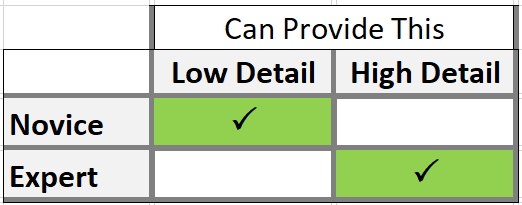
The limit of what’s useful for a novice to document, the detail they should capture, is much lower than the limit of what’s worthwhile from an expert. At least that’s the case when what we are capturing is intended to be shared.
Limits of value
Everyone is a novice in some subjects and very likely nearly an expert at some others. There are no exceptions.
And when it comes to details dependent on dynamic conditions, everyone is a novice; so bear that in mind before investing time into capturing too much predictive detail.
Respect practical value limits. Better to have documentation that lacks detail than documentation that incorporates premature detail of questionable value.
Purpose should drive effort
If you are struggling with how much accurate detail is enough, ask yourself these questions:
- Is this just for me to clarify my thoughts?
- Is this for other people to understand my thinking?
- In the future will this even matter?
It helps to know what you are trying to accomplish and how much effort that goal is worth to you.
1. Talking to yourself (clarifying your thoughts)
Know yourself and capture just enough. You might even have your own short-hand. Use it and move on.
And if you don’t have your own shorthand, consider developing one. It’s not too hard.
2. Don’t explain to strangers (explaining to others)
Guess at your audiences’ skill levels in the subject matter and capture just enough detail to bridge the gaps between the areas of understanding they already share with you. More than that and you obscure the message with noise.
The hardest part here is understanding your audience and where you think your ideas and theirs already align.
3. Dust in the wind (will we need it again)
If you are reasonably sure that your documentation serves only an immediate need and not some future reference purpose then try to engage your audience directly real-time to dialog with them.
Sometimes what seemed like a documentation exercise was really better served by a practical working session.
Direct person to person engagement is much more effective than almost any documentation artifact. And a direct conversation means low-detail visual aids instead of high-detail comprehensive documents.
Don’t waste your time on more than what is useful.
Less is more
We are all bombarded with so many details, at work, at home. Information overload. Nobody needs it.
The magic is minimalism.
It’s an art.
There are clues, but there is no formula.
Stop when you have enough.
>>> A Summer 2022 Update
I’ve been working with some folks to visualize at the speed of conversation by creating a tool we call Twigflo.com — try it out and let us know what you think.


