When Evangelicals Were Cannibals
A classic missionary story is missing some facts
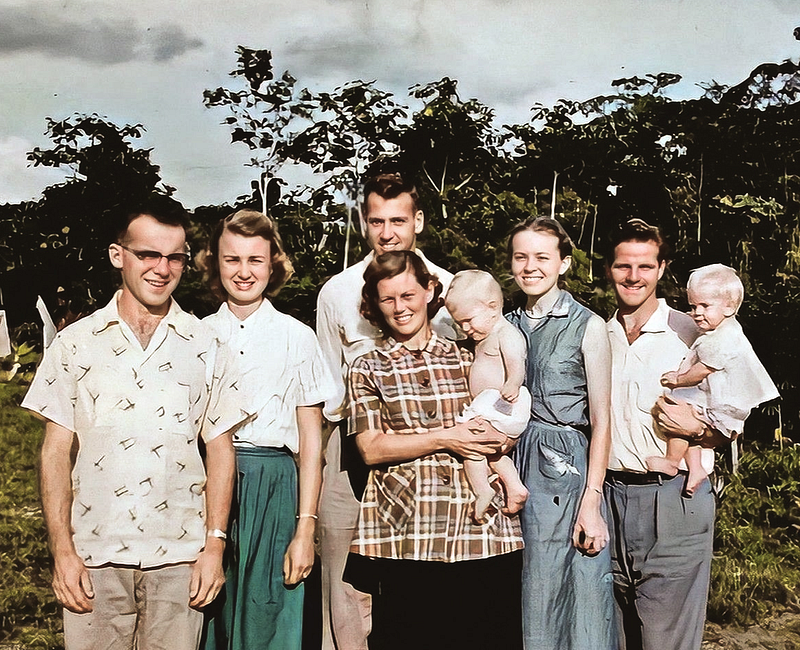
If you were Evangelical in post-War America, you knew about the five missionaries to Ecuador. In 1956, they’d gone into the jungle to ‘save’ natives—who killed them!
As narrated in the bestselling book Through Gates of Splendor by Elisabeth Elliot, a savage tribe of dark, violent ‘Auca’ in the Ecuadorian rainforest killed some beautiful missionary men who were trying to ‘save’ them.
The story of the massacre set the mission for the religion going forward: constant ‘evangelizing’, no matter the cost.
It was a beautiful story, ultimately, of the missionary sacrifice really paying off.
That seemed clear in updates to the Elliot story, in which even the killers of the missionaries had gotten saved. But I’d started to re-think all that after reading God in the Rainforest, Kathryn T. Long’s 2019 study of Evangelical missions in Ecuador.
Though not a pointed indictment, some sentences rubbed the wrong way.
“The indigenous people were secondary, shadowy figures. Most important was the book’s portrayal of the drama of missionary life and its spiritual challenge.”
All along, I reflected, even basic facts had been unclear. Why did the natives—lately called Waorani or Huaorani—kill the missionaries?
Long explained: “The Waorani believed that cowode were cannibals and that it was kill or be killed.”
The tribe thought the missionaries were cannibals?
But then, I wasn’t sure the killings were unreasonable. So many dark and malign emotions had been attributed to the natives who did the massacre, but this seemed self-defense as any peoples might do.
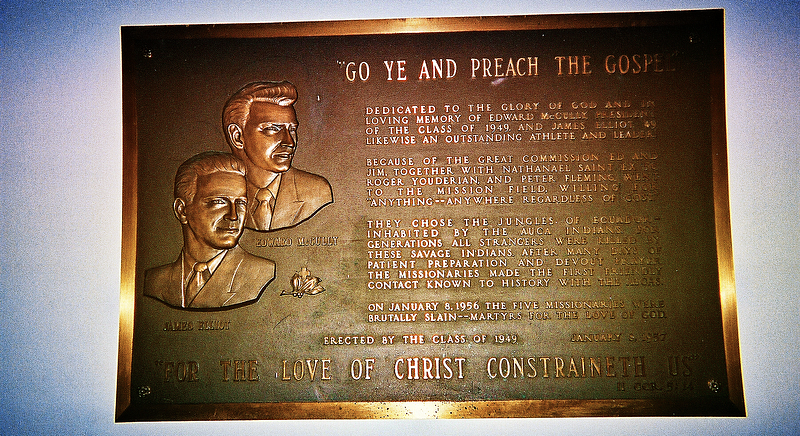
As details piled up, however, a very different reading of the whole episode seemed to lurk. It came to mind this last week when Wheaton College, the Evangelical school heavily associated with the Ecuador story, got in trouble for a memorial plaque. Calling the natives “savage Indians” had aged badly?
A replacement plaque will say “indigenous peoples.”
But Evangelicals liked the story the way it was. As Breitbart reported:
“Wheaton College, once considered a top Christian college in Wheaton, Illinois, has now caved to woke Leftist cancel culture in the most shameful and pathetic of ways.”
Evangelicals don’t like to re-visit narratives.
Once they’re found to advantage the religion, that’s pretty much the “truth” going forward. But to get into the weeds, there’s some strange facts.
First of all, the missionaries were assumed by the Evangelical reader to be Evangelical Christians. They weren’t.
Without highlighting this fact, Elisabeth Elliot hinted at it in Through Gates of Splendor, like when Jim is writing to his parents about Christians in America:
“Their condemnation is written on their bank books and in the dust on their Bible covers.”
Her follow-up biography of Jim, Shadow of the Almighty, had more of the same talk. He goes on awhile about the problem:
“American believers have sold their lives to the service of Mammon, and God has his rightful way of dealing with those who succumb to the spirit of Laodicea.”
It didn’t register even when Jim’s journal were published that he wasn’t Evangelical.
Entry after entry has full-on attacks on American Evangelicals. On May 14, 1948, he calls them “money-seeking” and “heartless.”
The core missionaries were from a separatist sect called Plymouth Brethren. This has not been a secret, but the Evangelical reader just doesn’t think much about it. Jim Elliot and two other missionaries who comprised the core group who died, Pete Fleming, and Ed McClully, were the “Brethren boys.”
They were anti-Evangelical. Plymouth Brethren didn’t believe in the pursuit of wealth or political involvement of any kind. They thought Christians should be ‘set apart’ and not have anything to do with ‘the world’.
The Plymouth Brethren sect, however, were facing extinction. In the battle with Evangelicals, they lost.
Jim was then going to Ecuador, at least in part, to begin a new Christianity somewhere else.
Kathryn T. Long dealt more with this subject in an unpublished paper that she kindly sent me. She writes of Jim’s motivations:
“He would recreate the New Testament church in the pristine environment of a jungle tribe, where he didn’t have to deal with the accretions and apathy that had tainted Christianity over the years.”
The trip to South America was something like — religious colonialism.
But there was something more—like revenge.
Jim’s writings often dwell on the problem of Evangelicals and the need to punish them for religious crimes. He writes in his journal: “If the Church is to be purged, her leaders must first be judged.”
Jim Elliot saw the “church” as infected by the sins of the “world.” He then turned to the role model of Phinehas, the zealot priest of Numbers 25 who spears an enemy who’d entered the sacred space of the Israelites.
As per his journal, Jim prays he will be allowed to be like Phinehas, adding: “Deliver me from simple weeping for sin. Teach me to judge it…”
A stray entry, September 1, 1950: “God grant me the spirit of Phinehas…”
I thought to myself: this is strange? A man who went in search of a spear-throwing tribe in the rainforest was fascinated by a spear-throwing Old Testament priest?
It’s not clear Jim Elliot wanted to be a missionary.
The odd fact of the Ecuador narratives is that Jim had gone to the country, very specifically, to meet the ‘Auca’—a word I’ll use as a marker of the fantasy he’d had of them.
As narrated in Through Gates of Splendor, at age 23, Jim had been told about the tribe, which was famous among missionaries. They lived nearly naked, and spoke an unknown language. They rarely interacted with the outside world, and threw spears at people who tried to approach.
A 1980 book called Unstilled Voices reproduces the dialogue of Jim first hearing about the tribe. A missionary who’d been in Ecuador told him of ongoing efforts to contact the tribe by an “adventurer” named Rolf Blomberg. Elisabeth Elliot had vaguely referenced this earlier approach to the Auca in Through Gates of Splendor. She writes:
“The story of the exploration attempted by Rolf Blomberg, a Swedish explorer, and guided by a missionary in 1947, has been written in detail.”
She adds: “This experience makes us wary of combining our efforts with those who have no love or special regard for these people.”
A fact is being concealed here: Rolf Blomberg was searching for gold.
His story had been “written in detail” in his 1956 book titled Buried Gold and Anacondas. He was after the treasure of the Incas, the ‘Treasure of the Llanganatis’, reputed to be buried in the jungle — and some thought the Aucas might know where.
Blomborg’s was not the first to want to meet the tribe for this purpose. In 1933, a Richard C. Gill is in the papers planning “to locate the savage Aucas tribe of ‘lost people’ believed to exist in a ‘lost world’ somewhere in the unexplored section of the Amazon valley of South America.”
In December 1948, a New York woman announces her intention to reach the tribe. A news report and feature story notes her goal: “to find a vanished tribe of savages and the lost gold mines of the Incas.”
The obsession continued into the modern day.
In 1998, two filmmakers go to Ecuador to make a documentary about the history of the search for gold there. In a newspaper profile, one says:
“At the very least, it’s a good yarn and a great adventure.”
And thinking about that, in my mind, the Elliot whirled around and reconfigured into another story.
But one would have to be reminded that Elisabeth Elliot put it all together after Jim died. He was never interviewed.
One would have to reflect on her situation in 1956. She was a mother of a small child, recently widowed. She was broke, as she’d note. But she had an amazing opportunity in American media. After the massacre there was massive interest in her dead husband.
All this interest was from Evangelicals.
And the religion assumed the missionaries were Evangelicals as well. This assumption rested entirely on the fact of Jim Elliot having gone to Wheaton College. His own writings were irrelevant.
And the Evangelical reading public had all but written the story of Through Gates of Splendor before Elisabeth Elliot wrote a word. As Kathryn Long writes of the final product:
“This was the inspirational book people had been waiting for.”
To go back and review the details, without regard to the final commercial narrative, is to see another latent storyline. Jim went to Ecuador to meet the Auca. They were extremely interesting to Western audiences—the last ‘Stone Age’ tribe to exist!
To meet them, and ‘convert’ them, would have been an incredibly interesting story—to be narrated by Jim himself.
What would’ve happened if the approach to the tribe had “worked”?
The Evangelical reader just assumes the effort was to save the souls of the tribe. But the idea was clearly also present to document the experience. The missionaries were all writing about the parts they were playing, and taking a lot of photos.
Kathryn Long notes that photos the missionaries took of the Aucas, in their brief encounter, were cropped according to “standards of modesty acceptable to evangelicals in the United States…”
The idea seems to have been to publish the photos they were taking.
The story would’ve been: a violent, spearing tribe in the wilderness, untouched by corrupt Christianity, was contacted by the true servants of the divine. And how the power of the Lord would be demonstrated!
If Jim Elliot had actually made contact with the famous ‘Auca’, he’d have been famous.
Frankly, everyone involved would have been religious rock stars—and then they might expect to have standing to speak on any range of subjects.
As I mull over the strangeness of the Elliot narratives, it can seem that the real plan was for Jim to use an exciting story in Ecuador to become a major voice in Christianity, then able to critique it, and guide it?
And it worked—just not for him. This is the path that would be followed by his wife.

That the missionaries wanted to “save souls” was not actually so apparent.
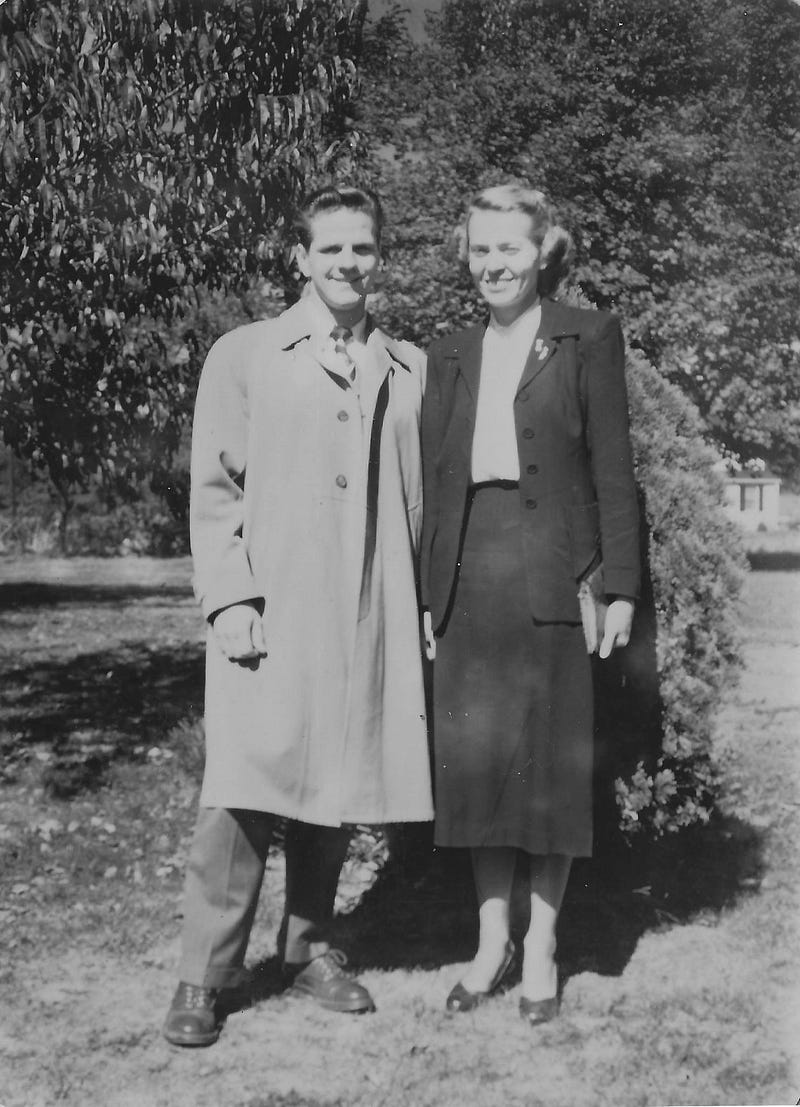
An original group of Jim, Pete, and Ed, all three Plymouth Brethren, invited two more men, Nate Saint and Roger Youderian, into the Auca adventure. The anthropologist Wade David, in One River (1996), calls them two “former servicemen looking for new adventure…”
Nate Saint was certainly a Christian, but his rationale for approaching the tribe did not linger on their immortal souls. He’d write:
“…the Aucas have constituted a hazard to explorers, an embarrassment to the Republic of Ecuador, and a challenge to missionaries of the Gospel.”
That is, they had slowed development of the rainforest, cost Western oil and rubber businesses a lot of money, and been a problem for the government — that the missionaries would solve.
Several missionary groups were in competition to “reach” this tribe.
The literature around the Ecuador massacre notes this unsavory fact. The tribe was a prize — with a lot of publicity sure to be generated for for the missionaries who “reached” the famous ‘Stone Age’ tribe.
Nate Saint’s sister, Rachel, was working with a nearby organization. A family feud of missionary warfare was playing out. Rachel had made a contact in a woman named Dayuma who’d left the tribe as a girl — and this seemed to promise a personal connection to the Auca.
Jim and the Plymouth Brethren men realized they had to act fast.
Under cover of secrecy, “Operation Auca” went into gear. The plan was to drop down into the jungle in Nate’s airplane as a kind of missionary militia. The five men of God, all of them armed, believed they wouldn’t get speared because of their technological superiority.
Jim and his crew covertly got Dayuma to teach them a few words of the Auca language — unaware she’d misremembered them.
And then they flew into the jungle, to their doom.

What happened on the day of the massacre?
This is actually unclear. There was some evidence—like journal entries, a radio transmission, and film from the men’s cameras. They’d got some shots of natives who came to visit. It seemed to be friendly and going well.
Then, as narrated in Through Gates of Splendor, on Sunday, January 8th, Nate Saint radioed at 12:30, and relayed that he’d spotted some approaching natives from far way. He said: “Pray for us. This is the day! Will contact you next at four-thirty.”
After the massacre, Nate’s sister Rachel Saint—with Dayuma, and Elisabeth Elliot—went to live with the Waorani. A 1960 book, The Dayuma Story, purported to reconstruct the killers’ deliberations leading up to the 1956 massacre. This book has the warriors concluding the white ‘cannibals’ have to be killed in pre-emptive self-defense.
“There are only five of them now, but more may come. They might kill us all.”
But then Elisabeth Elliot heard different stories.
After publishing Through Gates of Splendor and its follow up, Shadow of the Almighty, she wrote a book about living with the tribe. The first two books had been well-received, but The Savage My Kinsman in 1961 was strange and embarrassing — and not just because of the photos of the naked natives.
The subject of the killings comes up briefly. She writes:
“Some of the men who killed the five missionaries say now that they did not do well to kill them. But it was only a mistake. The Auca was trying to preserve his own way of life, his own liberty.”
Then she analyzes the massacre in terms of—racism?
The Waorani, she notes, have one very remarkable feature. They did not think white people were superior. She writes:
“Other Indians with whom I have worked had to some degree bowed to the white man’s ‘superiority.’ The Auca had no such idea. He has not a reason in the world for thinking us his betters, and he probably has some very valid reasons for thinking us his inferiors.”
A very harsh re-reading of the missionary massacre comes in view. The slain missionaries had expected the natives to be deferential to them not just because they were armed, but because they were white.
Later she heard the cannibal story.
In her archives, still unpublished, is a transcript of the account of the massacre given to her in 1961 by a Waorani man named Mincaye. But she wrote a summary of it a 1989 book, On Asking God Why.
Mincaye, she said, spoke of a party of natives going to kill the missionaries.
“He told how one foreigner was walking up and down on the beach, calling and calling. ‘Come!’ he was saying. ‘Come in a friendly way without harm!’”
Mincaye explained why her husband had died: “A cannibal! We thought he was a cannibal!”
But what exactly is a ‘cannibal’?
This matter is not addressed directly in the Evangelical literature around the tribe. I found it in a book by Laura Rival, the anthropologist at Oxford University. Discussing the tribe’s fears of outsiders in her 2002 study, Trekking Through History: The Huaorani of Amazonian Ecuador, she writes:
“They, the huaorani (literally ‘true human beings’), are under constant threat of being captured and eaten by cohuori ‘non-Huaorani’, who are, as the old Aca once told me, quènhuë ‘cannibal predators’ who live ‘on the other side.’”
The missionaries were read as evil spirits.
Mincaye told other versions of the story.
The most widely publicized account of the massacre comes not from the 1961 account by Elisabeth Elliot, or even an interview done in the 1980s by an employee of the Summer Institute of Linguistics, an Evangelical missionary organization.
The most widely publicized account is from the early 1990s, as relayed by Steve Saint, the son of Nate Saint, as found in his 2006 book, End of the Spear—which became a Hollywood movie.
This narration concerns, chiefly, Steve Saint’s relationship with Mincaye, with an inspiring narrative of Christian love and forgiveness having ended the cycle of violence.
Was Steve Saint’s account credible?
I wrote to Laura Rival asking: Can Waorani interviews by Evangelical missionaries be considered a historical source — especially when the interviews happen decades later?
She wrote back with pointers to some scholarly work on how writing ‘history’ from group memory gets complicated. She added:
“The problem with Steve Saint and a lot of what has been written by people associated with the SIL is their complete lack of understanding of the role of culture in constructing memory.”
She mentioned of a scholar named Casey High. I read his work on how the Waorani told stories, including this conclusion:
“…historical narratives have become a key social practice by which Huaorani people attempt to create peaceful sociality in their communities in the aftermath of revenge killings.”
The stories would be peacemaking fictions.
What was the Elliot missionary story, in the end?
It appears that Jim Elliot and his friends thought their guns and whiteness would make the natives do what they wanted. Excited by the prize of a compelling narrative to sell back in America, they convinced themselves that ‘God’ was moving on their behalf.
The natives saw them as—evil cannibal spirits?
I’m not sure they weren’t onto something. 🔶