
When Eric Behr Broke His Silence About the Holocaust
While he rarely told his gruesome story, he shared it with me, a college co-ed who resembled his lost love.
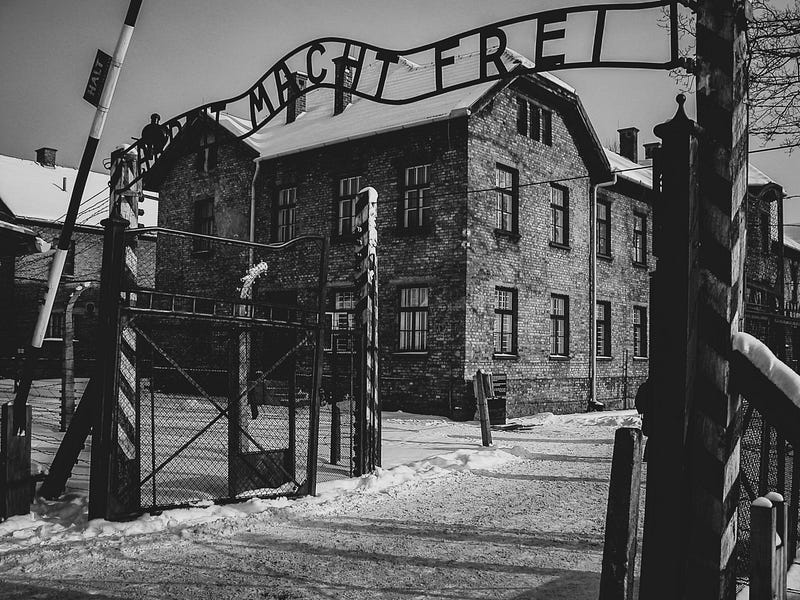
After 38 years, why would a Holocaust survivor break his silence?
For 77-year old Eric Behr, it was the appearance of a fresh, young face. A face belonging to me.
Our paths crossed in the lobby of the Milwaukee YMCA — a hulking, 18-story building, offering single-room housing to an odd mix of characters.
Occupying the top nine floors were eager, young college students like myself, squeezed out of on-campus dorms due to a larger-than-expected freshman class.
Occupying the bottom nine floors were very low-income, single, homeless people, like Behr — many struggling with addictions and mental illnesses.
This made for an interesting cast of characters, mixing in the lobby of the YMCA.
There was an old woman in pink curlers, incessantly punching the elevator buttons. There was a shirtless, tattoed African-American, snoring and passed out behind the potted palm. There was a twitchy, skinny man, compulsively checking for coins left behind in the vending machines.
And there was Eric Behr.
He was pale-skinned and bald, wearing a worn but clean plaid suit jacket. He always sat in the same plastic lobby chair, where he’d read each page of the Milwaukee Journal. In stark contrast to his lobby-mates, he exuded an air of distinguished calm.
I was a journalism student, so I took J 101, which covered the basics of writing and reporting.
My first assignment was to interview someone I didn’t know. I immediately thought of the old man.
When I approached him, he looked up from his paper, startled, his blue eyes flashing. Then he patted the chair next to him, inviting me to sit.
In a thick German accent, he introduced himself as Eric Behr. Thus began my very first interview.
I opened with the question my Journalism professor had recommended: Please tell me a little about yourself.
Behr looked at me through faded blue eyes. He tilted his head and half-smiled. Several long seconds passed.
“Mr. Behr?” My voice hung in the air, seemingly lost somewhere far away.
“Oh, Katrina,” he breathed, “your eyes are so beautiful.”
I took in a sharp breath. Oh, boy, I thought. So this is how it’s going to go.
I tried to bring Behr’s attention back to the interview. I reminded him that I am Kathleen, not Katrina, and that I had a list of questions.
Behr half-shrugged and grinned.
“My wife’s name was Katrina,” he said. “Her eyes were brown, like you.”
I sighed. “Mr. Behr,” I said, using my most confident 18-year old voice, “I only have an hour before my next class. Is there anything about your life you’d like to share?”
“Well, in that case,” Behr replied, “I almost never talk about it. But if you want to know, I lived in concentration camps.”
Thus began a long talk between me and Eric Behr.
Over the next couple of hours, he told me about his life and his years of brutal imprisonment during World War II.
Recently I was cleaning out some files when I rediscovered my interview with Behr. I was a fast and accurate note-taker, and had typed the story in much the same way the conversation had unfolded.
The only parts I didn’t include were Behr’s dreamy references to me as “Katrina,” and his repeated compliments on my eyes, hair, and skin.
Eric Behr graduated from Heidelberg University in 1922.
Like me, he majored in journalism. Following graduation, he wrote about restaurants and entertainment for newspapers in Germany and Sweden.
On March 10, 1937, Nazi detectives confronted the 36-year old in his apartment. Since Behr was both a Jew and a journalist, the Nazis felt he needed to be watched.
“They never accused me of anything. They said they wanted to question me for two minutes, and the two minutes turned out to be two years.” — Eric Behr
Behr was sent to Kislau, a concentration camp south of Munich. Kislau imprisoned minor offenders and educated people, whom the Nazis distrusted. At Kislau, Behr was forced to do hard labor in the fields. Each night, he fell into bed exhausted.
After three months, things took a turn for the worse.
Behr was transferred to Dachau, a more brutal concentration camp. Prisoners weren’t killed outright in gas chambers or by firing lines, as they were in later years. Still, thousands suffered and died as a result of the cold weather, rampant disease, and frequent mistreatment.
Behr outlined his daily routine at Dachau. “Every morning we were awakened at 4 a.m. by a trumpet or a bell or a guard,” he said. “We dressed and went out to the yard for inspection. Then we would have breakfast, hot watery soup and a piece of bread.”
He continued, “Then we would go to work, either cleaning or working outside. At noon we would have lunch, hot watery soup and bread again. Then we would work again until dinner at 6 o’clock.”
“If we were not being punished, we could eat. But if we were under punishment, we were hung from a tree by our wrists for a half an hour. I was hung several times. It was sometimes very cold out there.” — Eric Behr
Behr’s most painful punishment came as a result of talking back to a guard.
“One day a guard said to me, ‘Behr, you should be happy you are in concentration camp. If we would let you go, what would you do? You have no physical abilities. You have no mental ability. So you would starve to death. Be happy you are here.’
“I said to him, ‘Sir, if I have no physical abilities, if I have no mental ability, all I could become is a guard in a concentration camp.’”
Behr chuckled. “I never could keep my mouth shut. So I got 25 lashes and two weeks solitary confinement. I can still show you the lashes on my back.”
At this time, Behr recalled, he lost all hope in life. “I figured my life would end in camp and I would never get out,” he said. “I saw my life as finished.”
Late in 1938, Behr was transferred yet again — this time to Buchenwald, one of Germany’s largest concentration camps.
Buchenwald proved to be a little less horrible, thanks to a bit of creativity. Behr bribed the camp doctor for a certificate saying he had to walk with a cane. That piece of paper turned out to be worth its weight in gold.
One brutally cold night, a wagon filled with supplies got stuck in the deep snow. A guard crashed into his barracks, waking the prisoners and ordering them to go outside and push the wagon out.
Behr recalled, “I came with my cane, and the guard said, ‘Oh, go back, I cannot use you.’” Behr laughed, still amused by his small victory.
In January of 1939, Behr was summoned to the chief’s office.
To his great surprise, he was informed of his release.
As it turned out, Behr’s wife had influential contacts in America, who had successfully negotiated his discharge. It helped his case that the camp was already overcrowded, due to Germany’s recent annexation of Austria. Whatever the reason, Behr was now a free man.
Three days later, Behr reunited with his wife. Together, they sailed to America and made Chicago their home. In Chicago, Behr worked in public relations for the Ambassador Hotel, and tried to put the past behind him.
In the lobby of the Y, I was scribbling notes as fast as I could.
But two hours had already passed, and I had to get to my next class.
“Mr. Behr,” I said, “if I could ask you one final question: Do you often think of your years in the concentration camps?”
Behr frowned and furrowed his brow. His German accent boomed throughout the lobby.
“I don’t read books about the war. I never see movies. I almost never talk about it. It is finished as far as I’m concerned! I don’t have any reason to refresh my memories.” — Eric Behr
He hit his chair’s armrests with a note of finality.
His sudden display of temper unnerved me. I stopped scribbling and looked up from my notebook.
But quickly, Behr’s face softened. He took a deep breath, tilted his head, and sighed, “Ahhh, Katrina, you are so beautiful.”
I closed my notebook and thanked him for his time. Then I hurried off to campus…wondering why in the world Mr. Eric Behr chose to relive his painful memories for me.
That interview was the first of many steps in the road of my career.
After graduation, like Behr, I enjoyed many years as a reporter and writer.
I’m ashamed to say I never stayed in touch. Following our interview, I showed Behr the “A” I had earned on my paper. His face lit up with pride.
But after that, our interactions were limited to quick waves in the lobby. The following year, I moved out of the YMCA, and we never saw each other again.
Today, I’m haunted by the question of why Behr avoided the subject of his imprisonment, and why he broke his silence for me.
I can only surmise he was contending with old age, loneliness, survivor guilt, and massive historical trauma. Following his wife’s death, he never remarried, and the couple had no children.
Why did he break his silence for me? It’s clear I reminded him of his late wife, whose name Katrina is a German variant of my Irish name, Kathleen. We both had brown eyes. And Behr obviously appreciated the attention of a young co-ed, despite the fact that our conversation was transactional in nature.
Beyond that, I’d like to think Eric Behr saw something in me. Despite our differences — age, race, birthplace, misfortune at sharing the planet simultaneously with Hitler — we had a lot in common.
We shared a love of language and a dedication to the written word.
He knew, even if the interview never accomplished anything beyond fulfilling my class requirements, it conveyed the truth of what really happened — a noble purpose.
He could never have imagined that 44 years after our conversation at the Y, his words would be rediscovered in a dusty old file. And they would once again live.
By breaking his silence, Eric Behr left behind a shining example of the resilience of the human spirit. I’m determined to share his story to anyone who will listen.
Thanks for reading! If you liked this story, please comment, clap (up to 50 times) and join my free mailing list to get an email whenever I publish. You can support me and other writers by becoming a Medium member. You can also visit my profile to find a whole lot more, including this:


