
EXPLORATIONS INTO ETERNITY #2
When Did People Start Believing in the Immortality of the Soul?
The role of Plato in the development of Christian theology
The first article in this series discussed how the ancient peoples — specifically, the Ancient Israelites — thought about life, death and the afterlife.
If you didn’t read the first part of the series, you’d probably benefit from hopping over and reading it now.
We saw that, perhaps surprisingly, the OT writers largely believed that this existence was all we had. While many posited some form of murky post-mortem existence in a place called Sheol, they perceived this as a shadowy form of semi-existence devoid of community, strength, or hope.
The belief in the afterlife in the Old Testament is not static — but changes and develops over time.
The earliest Israelites had a vague and gloomy notion of Sheol, the realm of the dead, where all people went regardless of their moral conduct. However, some scholars argue that the Israelites also believed in the active role of the ancestors, who could bless or curse their descendants and who could be contacted through rituals and offerings.
As the Old Testament progresses, there are more indications of hope for a future resurrection, especially among the prophets and the psalmists. For example, Isaiah 26:19 and Daniel 12:2–3 speak of the dead rising from the dust.
But your dead will live, Lord; their bodies will rise — let those who dwell in the dust wake up and shout for joy — your dew is like the dew of the morning; the earth will give birth to her dead (Isaiah 26.19)
Meanwhile, Psalm 49 expresses confidence that God will redeem the faithful from Sheol and bring them into glory.
They are like sheep and are destined to die; death will be their shepherd, but the upright will prevail over them in the morning. Their forms will decay in the grave, far from their princely mansions. But God will redeem me from the realm of the dead and surely take me to himself. (Psalm 49.14–15)
These passages reflect an emerging belief that God will vindicate the righteous and punish the wicked in the afterlife — and that the faithful will enjoy God’s presence and blessing beyond death.
Therefore, the Old Testament does not present a uniform or consistent view of the afterlife but rather a diversity of perspectives that reflect different historical, cultural, and theological contexts.
However, there was one figure from beyond the Christian tradition who would play a pivotal role in the later development of Christian thinking in this area…
The importance of Platonic thinking
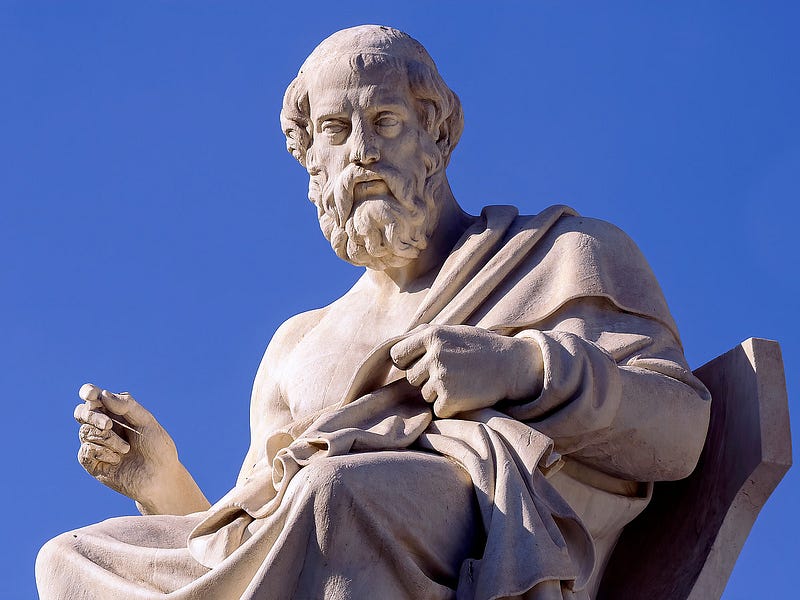
Plato was an ancient Greek philosopher born in Athens around 428 BCE. He was a student of Socrates and a teacher of Aristotle, and he founded the Academy, the first institution of higher learning in the Western world. He is one of the most influential figures in the history of philosophy, and his works cover a wide range of topics, such as ethics, metaphysics, epistemology, political philosophy, and aesthetics.
He believed that the soul was the essence of a person — and that it was immortal. He also believed that the soul was the source of life, the mind, and the moral qualities of a person.
The concept of the immortality of the soul would be the idea that, perhaps more than any other, shaped thinking about the afterlife during the New Testament period and for centuries afterwards.
It’s important to distinguish between the Platonic idea of the soul and what the Old Testament means when it uses the term “soul” — for example, in Deuteronomy 6.5
Love the Lord your God with all your heart and with all your soul and with all your strength.
Does this mean that the Old Testament writers believed in an immortal soul long before Plato came up with the concept?
Not at all — and it’s crucial that we don’t make the mistake we mentioned previously, namely “reading back” beliefs we understand from a later period onto much earlier and primitive texts.
When the Old Testament text uses the word “soul”, it is a translation of the Hebrew phrase nepesh (נפש, pronounced “neh-fesh”). It has various meanings depending on the context. It can refer to the throat, the breath of life, the inner being, the life force, the person, the mind, the heart, the desire, or the soul of a living creature. It is most often translated as “soul” in English Bibles, but that doesn’t mean the same as what Plato discussed.
There is no suggestion that Old Testament writers believed that a soul was immortal, nor could it exist outside a living human being. The writers of Genesis believed that the “life” or “breath” of a person was “breathed into” a person by God.
Then, the Lord God formed a man from the dust of the ground and breathed into his nostrils the breath of life, and the man became a living being. (Genesis 2.7)
Once a person stops breathing and dies, their nepesh cannot continue to exist. They didn’t conceive that this “life” or “breath” had any way to exist. That’s why Sheol was seen as a place where people existed in a“half-life” devoid of purpose, hope or life.
Of course, Plato believed souls were immortal. There isn’t any hint that biblical writers believed that souls existed forever — but were created at a finite point by a loving and purposeful God.
Still, we begin to see the development of the hope that souls might survive death and be one day taken into the presence of God. It’s the first inklings of the doctrine of resurrection and afterlife.

The Role of the Intertestamental Literature.
The intertestamental writings are a collection of Jewish literature written between the Old and New Testaments, mainly in the 2nd and 1st centuries BCE and CE.
These writings tell us that the hope for immortality was a diverse and evolving concept among the Jews of that period. Some of the main themes and views that emerged in these writings are:
- The resurrection of the dead: This was the belief that God would raise the righteous from the grave at the end of days as a reward for their faithfulness and loyalty. This belief was expressed in books such as 2 Maccabees, 2 Baruch, and 4 Ezra.
- The immortality of the soul: This was the belief that the soul was a separate and immortal entity that survived the death of the body and that it could ascend to heaven or descend to hell, depending on its moral state. This belief was heavily influenced by Plato and was expressed in books such as Wisdom of Solomon, 1 Enoch, and the Testament of Abraham.
- The transformation of the body: This was the belief that the body would be changed into a glorious and incorruptible form before or after death and that it would enjoy eternal life in God’s presence. This belief was expressed in books such as 1 Enoch and the Testament of Job.
The intertestamental writings show us that the hope for immortality was not a uniform or consistent idea but reflected the different historical and cultural contexts of the Jews who wrote them. They also show us that the hope for immortality was a response to the challenges and crises that the Jews faced, such as persecution, martyrdom, exile, and oppression.
Hints of evolving beliefs in 1st Century Judaism.
It’s important to understand that Jesus was born into a world that had far from settled belief about the afterlife. We will come to the New Testament texts next time, but it’s worth pausing and thinking about the different Jewish groups and their varied viewpoints about life after death.
The Sadducees did not believe in any afterlife at all. They rejected the idea of the resurrection of the dead, the immortality of the soul, and the existence of angels or spirits. They believed that God rewards and punishes people in this life only.
Then the Sadducees, who say there is no resurrection, asked him a question. (Mark 18.12)
The other prominent Jewish sect we meet in the New Testament, The Pharisees, believed in the resurrection of the dead, the immortality of the soul, and the existence of angels and spirits. They believed God would judge the righteous and the wicked in the afterlife.
The Essenes believed in the soul’s immortality but not in the resurrection of the body. They believed that the souls of the righteous would ascend to heaven while the souls of the wicked would suffer in darkness.
Therefore, the Sadducees, Pharisees and Essenes had different and sometimes conflicting beliefs about life after death, reflecting their different interpretations of the Scriptures and their various responses to their time’s social and political challenges.
This is the melting pot of ideas into which Jesus was born and later ministered — and it is that world that we will examine in the next article in this series.
Catch up with all the previous articles in this series via this curated list.


