
EXPLORATIONS INTO ETERNITY #1
What Does the Old Testament Tell Us About Death and The Afterlife?
Hint: It’s probably NOT what you thought…

Welcome to the first part of a Medium series, Exploration in Eternity, where I will be thinking about the meaning of death, the afterlife, heaven and hell — mainly, but not exclusively, through the lens of Christian thought.
We are going to range across a wide range of topics, sources and ideas — so please read the whole series to capture the fullness of my arguments.
With that said, let’s get started by digging into the Old Testament and see what the first half of the Christian Scriptures say about life, death and the afterlife.
Life and death have fascinated humanity since the dawn of time.
In traditional societies, people accept life and death as natural parts of existence. However, in modern times, death is often viewed as something to be conquered or managed.
We live in a culture that sees death as the ultimate enemy, to be fought off at all costs. Yet, despite our best efforts, death remains an unavoidable part of the human experience, leaving profound impacts on individuals and their loved ones.
For Christians, this fear has both biological and theological dimensions. The Catholic theologian Karl Rahner suggests that humans were “not meant for death, leading to an inherent dread of its inevitability.”
In traditional Christian belief, death is seen as a deviation from the original divine plan, a consequence of humanity’s fall from grace.
Christianity places death at the core of its worldview, recognising that true flourishing cannot be achieved without confronting mortality. Given the certainty of death and the tension between living in the present and anticipating the future, there’s a need for a theological framework that addresses both life and death in Christian thought.
What did our ancient ancestors believe about life and death?
In our ancient texts — the Old Testament and other contemporary writings — there is no notion of an afterlife.
This probably comes as a surprise to many modern-day Christians, schooled in the later concepts of “heaven” and “hell.” We have grown used to “reading back” our theology into those texts. But when taken at face value, the Old Testament appears to hold out any prospect of an afterlife as we might now imagine it.

The ancient Israelites and the people amongst whom they lived viewed life and death as integral parts of daily existence. Life was highly valued, with longevity as a sign of God’s favour and blessings.
For instance, in Genesis 15:15, God promises Abraham a peaceful death at a good old age, setting a precedent for how life was perceived — his long life was a mark of divine favour.
If there was any post-mortem “reward” for the Ancient Fathers, it was in the promulgation of their legacy through their descendants. So Genesis 22.17–18 promises Abraham:
I will surely bless you and make your descendants as numerous as the stars in the sky and the sand on the seashore. Your descendants will take possession of the cities of their enemies, and through your offspring, all nations on earth will be blessed because you have obeyed me.
The blessings of life carried over beyond our earthly existence in the form of happiness, prosperity, and blessings for our descendants. We could expect no more.
But the Israelite perspective on life goes beyond mere biological existence. The Old Testament teaches that life encompasses a spiritual dimension that transcends death.
When people die, they are believed to enter Sheol, often described as the realm of the dead. Psalm 88.3–5 opines:
I am overwhelmed with troubles, and my life draws near to death. I am counted among those who go down to the pit; I am like one without strength. I am set apart with the dead, like the slain who lie in the grave, whom you remember no more, who are cut off from your care.
In this passage, the word “death” is the Hebrew Sheol. This word occurs more than 60 times in the Old Testament. Its precise meaning is a matter of scholarly debate — but it is widely agreed that it has zero connection with any concept of “hell.”
Indeed — as Bart Ehrman notes in his book “Heaven and Hell: The Story of the Afterlife”:
Nowhere in the entire Hebrew Bible is there any discussion at all of heaven and hell as places of reward and punishment for those who have died.
We will doubtless return to this somewhat contentious (at least to some) assertion again in this series.
The plain reading of the many Old Testament texts suggests that Sheol is a shadowing place of semi-existence. There are no rewards and no punishments. Instead, it is a place of — well — “nothingness.”
Sheol is not depicted as a place of divine reunion; rather, it signifies the end of one’s relationship with God.
Hezekiah’s lament in Isaiah 38:18 underscores the notion that the dead cannot praise God, indicating a separation between the living and the divine.
For the grave (Sheol) cannot praise you, death cannot sing your praise: those who go down to the pit cannot hope for your faithfulness.
This negative perception of death extended beyond the natural end of life to premature death, which was seen as a sign of an unfortunate fate. Jeremiah 17:11 warns that those who pursue wealth through unjust means will face premature death and ultimately be deemed foolish.
While death was seen as undesirable, dying prematurely was considered even worse. The preferred time to die was in old age, as King David expressed to his son Solomon before his passing, acknowledging that death is an inevitable part of life (1 Kings 2:2).
The book of Ecclesiastes stands out in the Old Testament for its frequent references to death. Ecclesiastes 3:19–20 captures the existential reflection on death, asserting that humans are no different from animals in the sense that all return to dust.
Surely, the fate of human beings is like that of the animals; the same fate awaits them both: As one dies, so dies the other. All have the same breath; humans have no advantage over animals. Everything is meaningless. All go to the same place; all come from dust, and to dust, all return.
Yet, amidst this seemingly bleak outlook, the author suggests that there is still hope in life, even though death might seem to lead to despair. Ecclesiastes 9:4–5 reflects this paradox, highlighting that the living have hope while the dead are unaware.
Anyone among the living has hope — even a live dog is better off than a dead lion!
For the living know that they will die, but the dead know nothing; they have no further reward and even their name is forgotten.
People will point to passages in the Old Testament which appear to give a different viewpoint. For example, some will quote the famous “Valley of Dry Bones” passage in Ezekiel 37.
Again, with respect, I would argue that we tend to read those verses through the lens of Christian belief in the Resurrection — because the passage itself makes it clear that it describes the restoration of the nation of Israel.
He said to me: “Son of man, these bones are the people of Israel… This is what the Sovereign Lord says: My people, I am going to open your graves and bring you up from them; I will bring you back to the land of Israel (Ezekiel 37: 11, 12)
Here, we see the problem arising when we handle ancient texts through our later perspective rather than their original context.
Perhaps the absence of belief in an afterlife in the Old Testament writings shouldn’t surprise us when we consider other ancient writings from that period.
Writing around 850 BCE, Homer wrote about Hades — a Greek word for the place deep under the earth, which is sunless, dark, murky and a repository for post-mortal entities. In The Odyssey, he describes a journey into this “Underworld.”
The language and terminology employed by Homer are strikingly resonant with what we have already seen in the Old Testament.
But a man’s life breath cannot come back again — no raiders in force, no trading brings it back once it slips through a man’s clenched teeth.
This is the realm of the “breathless dead” — the dwelling of “shades” rather than “people” as we might recognise. These shades have no strength, life, knowledge of the world above or immortality.
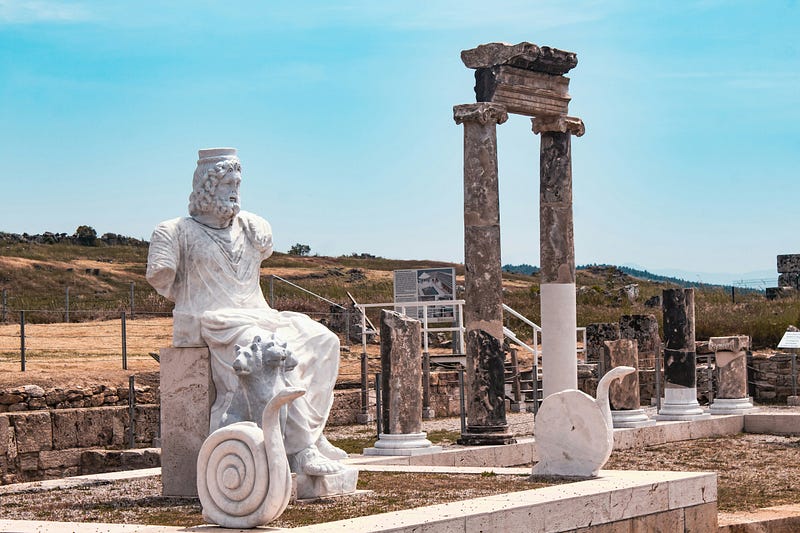
This resembles the “Sheol” we find in the Old Testament — a world of endless emptiness with no hope or belief in a resurrection or redemption. Homer employs the Greek word “Hades” — the equivalent of the Hebrew word “Sheol.”
Before we wrap this necessarily brief examination of ancient writings, I want to touch on a story from 1 Samuel Chapter 28 that always appeared to my eyes to be out of phase with the rest of the Old Testament — that is, until I understood the broader context of ancient literature.
Here, we see King Saul assuaged by Philistine enemies, taking the unprecedented step of consulting a medium — something outlawed by Israel’s law (Exodus 22.18). Under cover of darkness, Saul consults with the so-called “Witch of Endor” and begs her to summon up the shade of Samuel.
My purpose here isn’t to discuss the whys and wherefores of what Saul did but to note how the episode chimes with what we have discussed in this article. We see that both Saul and the witch speak of “bringing up Samuel from the ground” — and the shade of Samuel confirms this in verse 15.
Samuel asked Saul, “Why have you disturbed me by bringing me up?” Saul replied, “I am terribly troubled.
There is no hint that Samuel — one of Israel’s most godly leaders — is in the heavenly realms. He is “resting” in the shadowy world of Sheol. Indeed, his annoyance at being “disturbed” suggests that he is content within that realm — it is being dragged back into this world that is jarring.
Interestingly, the only time in the Old Testament narrative where we see a person from beyond death interacting with earthly existence appears to assume that our existence beyond death is in a dark and lonely place of semi-existence, a million miles away from our contemporary assumptions about eternity.
Well, I’ll wrap it there for this week — please join me again next week as we continue to examine the biblical record for clues about the afterlife as we turn our attention to the New Testament.