

What You Really Mean When You Call A Black Woman ''Loud''
Despite having facts to support our arguments we are turned into the antagonist
Imagine just wanting to uninterruptedly speak your truth and justify your opinions with valid statements to back your argument. Imagine just wanting to speak out on issues that affect you and those that look like you and again support your assertions with supporting evidence. But no, upon this attempt you are immediately labelled as the villain for just stating your opinion in an argument. This is the reality for a black woman.
In society when a black woman decides to speak up on issues that she has to face in her daily life due to her skin colour, society decides to downplay her pain and dehumanise her and turn the tables on her to make her a villain at that moment.
When we think of a villain, we think of a character that is malicious and devoted to spite and wickedness. Now, why is the case for black women? Well, this is because of the plethora of demeaning stereotypes and tropes that surround our existence. This includes the angry black woman trope, sapphire trope and of course misogynoir. Now even though these tropes predate back to the early 19th and 20th century they are still overtly present in our communities and used against black women.
Angry Black Woman trope
“Their main way of interacting with the men around them was to scream and fight and come off angry, irrationally so, in response to the circumstances around them."(Blair Kelley, associate professor of history at North Carolina State University)
The angry black woman depiction was started in the 19th Century and has a long trail of prevalent existence in America. The angry black woman stereotype is a trope in American society that portrays African-American women as sassy, ill-mannered, and ill-tempered by nature.
See when a black woman is vocal about something that is clearly wrong and when she calls out inequality the tables quickly turn on her and she, within the snap of two fingers is now the ghastly antagonist of the narrative. The angry black woman stereotype did not stop after its peak in the 19th century; it instead has continued to grow and live in the minds of society. How come men are allowed to display their frustration as it is a sign of masculinity and white women can openly project their anger, why can't the same energy be given to black women?
An example of this trope would be the racist and misogynoiristic US Open cartoon of Serena Williams in 2018.
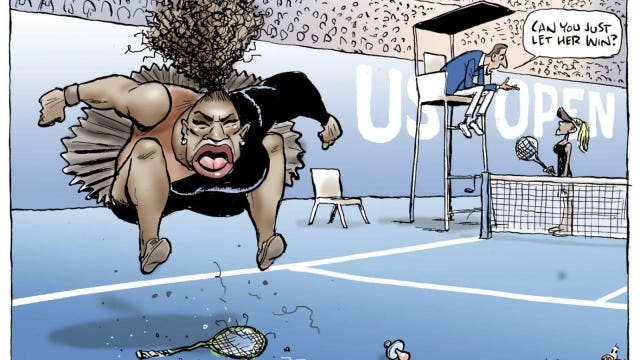
“The cartoon plays on old and discredited images of African American ‘sambos’: unintelligent, emotional (rather than rational) and childlike.” ( Dr Joe Street).
The US Open final was a day full of emotions and those emotions were let out onto the court. Despite this, it is inexcusable for racist caricatures of a Black woman to be drawn, printed and sold to thousands. The image above displays Serena with enlarged lips( which are linked to racist imageries such as Sambo) as well as the illustration of a large nose ( which is also a racist depiction of Black features).
In addition to this, gender bias towards Black women is prominent in this cartoon. Misogynoir is another element of black women being portrayed as the villain because as you can see, Serena is depicted as a monstrous being, implicitly showing the masculinisation of black women in society.
“This, alongside the harmful rhetoric used in various news stories to paint Serena as the immature ‘ballistic’ aggressor speaks to a larger problem of misogynoir in the media.” ( Chante Joseph)
This cartoon is the apex of black women being villainized for expressing their emotions. As Serena Williams conveyed her thoughts and feelings to the umpire she was immediately set out to portray this impulsive character by the media.
When Black Women are called ''loud''
Loud? For being passionate and outspoken? There is this repeated ideology that black women are being too loud for just expressing how they feel towards a certain topic. This arises whenever black women confidently make their points and back them with well-supported evidence. Upon this society sees this confidence and will as a threat and immediately disregards the black women opinions and tags the opinions as a blaring outburst.
On the contrary, if a white woman was to do the same, society praises and glorifies her instead. With outpours of accomplishment and pride. Not ever does the black woman receive the same level of praise. Instead, we are subject to being restricted to this "angry and strong" stereotype and we are shunned away from expressing ourselves without having to face a plethora of misogynoiristic remarks.
Now when we speak out about being portrayed as the villain, again we are stopped and silenced. Then this is where the antagonist defensive card is pulled out and used to combat our rightful truths. And sadly it works almost every time. When are characterised as the villain of a situation it makes us the people that are immediately hated and shunned away by society for speaking out on issues that most tiptoe around out of fear. Prohibiting us from abolishing the villainization once in for all.
How do we progress?
It starts by letting us speak; without interruptions. It starts by stopping defensive mechanisms from prohibiting us to speak our truth. The way to move forward would be educating yourself about the angry and strong black woman tropes and the sapphire stereotype; to really understand the roots of this villainization. We need to address the past to progress and dismantle the systems that are preventing us from progression.