
When a Fish Thought I Was a Whale (And I Thought It Was A Shark)
The tale of an unexpected encounter underwater
I ran up to the dive shop, keen to share the story of our dive.
I had a slightly sore red patch on my arm. It was barely visible, but I knew the creature had tried its luck with me.
Neither my dive buddy nor I knew why it had hounded us or what it was.
When I reached the dive shop manager, I eagerly shared what we’d experienced, hoping she’d help us to figure out the mystery of who we’d met on our dive.
It was just another day on Utila. I woke up, pulled myself out of bed and headed to the canteen for breakfast. It was a morning when a fried doughnut-y delight joined our grey-ish scrambled eggs, so I was pretty happy. I’d learned the best combination of condiments for this breakfast variation: I slathered ketchup on the eggs, and syrup onto my doughnut-delight.
Utila had been my home for almost six weeks. Part of the Honduran Bay Islands, it sits at the southern end of the Mesoamerican Barrier Reef, the second-largest barrier reef in the world, providing some incredible diving opportunities.
It was the whole team’s final full day on the island. We had spent the past couple of months learning about reef ecology and carrying out important research on the reefs.
Our schedules involved two dives per day, one in the morning and one in the afternoon. On this particular day, I was eagerly anticipating my 50th dive ever.
The dive day began like any other. I set up my scuba equipment alongside the PhD candidate I was helping out, and then we prepared our tile collection kit together.
A big thing I learned while carrying out marine research is that there are many ways to complete tasks underwater (and marine researchers are pretty innovative). You can write underwater for starters — we use a white piece of plastic called a dive slate and a normal pencil. You can also lift heavy things using a lift bag.
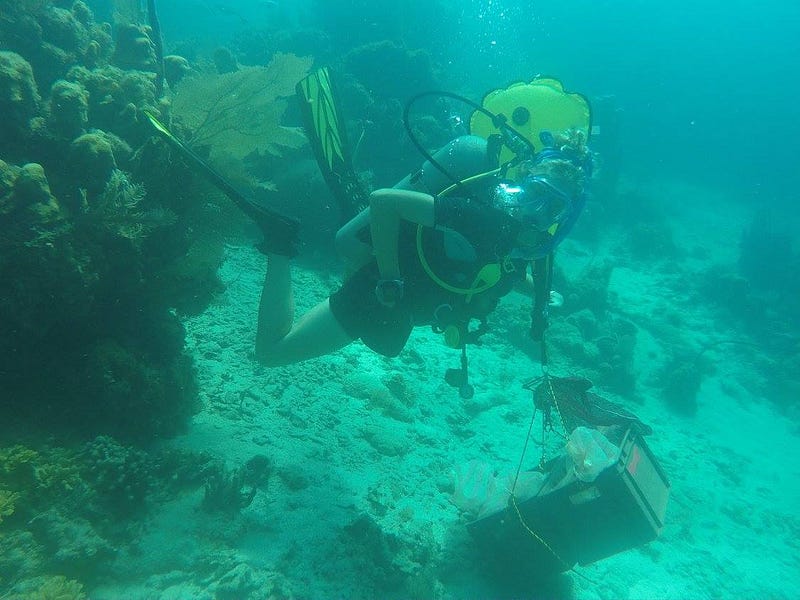
For the dive I was about to go on, we required a crate and a lift bag to help us carry some concrete tiles off the reef. The year before, the researcher I was working with made two types of concrete tiles and planted them on the house reef. And we were measuring the results a year later.
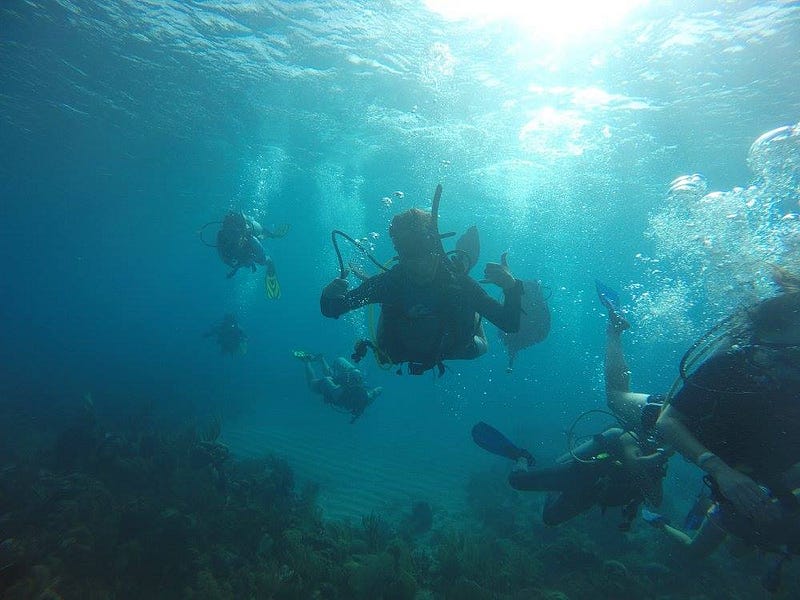
After ensuring we had all the materials we needed, we headed out to the dock, where we entered the reef channel. The dive spot was called Blue Bayou Reef and we could view it from our accommodation. It started out shallow, but after paddling out for about 30 metres, you reach the reef slope, a sudden dropoff deep into the ocean. It’s like the equivalent of an underwater cliff edge.
My dive buddy signalled thumbs-down (the sign for descending), we each grabbed our BCD hoses (the tool that helps a diver control their buoyancy) and we deflated our BCDs. The freefall started.
Diving is pretty indescribable. You experience a sort of weightlessness as you drift down to your designated depth. From there, you would adjust the air in your BCD to become neutrally buoyant, at which point you will neither sink nor float, you’re basically a fish.
We swam on our longest journey around the reef to reach our final cluster of tiles. Each cluster had been placed in groups of six, in different orientations.
While we collected the majority of tiles, sometimes they evaded us. On this particular dive, we managed to carefully pick up and label each tile, apart from one. We tried searching for it but we decided it was a lost cause — either too well hidden or it had become dislodged.
We blew up the lift bag and prepared to head on the long swim back to shore.
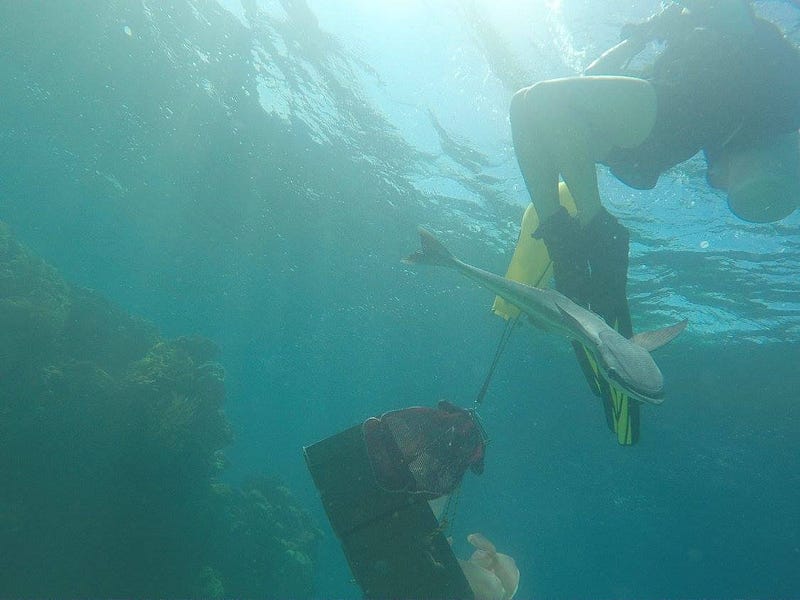
Out of nowhere, a curious grey-coloured fish swam right up to us.
It circled us like a dog greeting its long-lost owner. I smiled as this playful fish was interacting with us. Most fish have no interest in being so close to humans so this felt like a unique experience.
I reached into my pocket for my camera, keen to capture the interaction. As I held my arm slightly still, the fish swam alongside. Feeling it was a little close, I pulled away and felt a scrape. I instinctively clutched my arm with my other hand.
My first thought was that the fish had tried to bite me. I was cautious of this unusual creature and wondered if it might be a small shark.
I tried to get away from it but the annoying thing wouldn’t leave me alone. We were spinning in circles together, the fish being a much more confident dance partner in its home environment. It was fun at first but I really wanted this encounter to end.
Then all of a sudden, the fish disappeared.
I spun around but it was nowhere to be seen.
I looked over to my dive buddy and shrugged my shoulders to say, “Where did it go?”
In reply, she turned her body slightly and tapped her tank.
Great, I had a passenger on my tank.
Believing I had some type of small shark on my back made me a little nervous. The unusual thing was that my arm wasn’t bleeding, it just felt slightly sore. Potentially a lucky escape?
Since we’d completed our job for the dive, we headed on the long journey back to the shore, a journey which I ensured was much quicker than usual, so we could get back to the safety of land.
Each time I kicked my fins, I felt the tail of my hitchhiker. I kept checking my air, which was going down faster than usual. I was conscious that my breathing was quicker, both because I was swimming faster and I had a stranger on my back. I was keen to get out of the water as soon as possible.
After completing our safety stop, we ascended into the shallow channel. As I turned to check on my passenger, the fish decided to ditch my tank. It circled us again as my dive buddy and I took some pictures, but as quickly as it had appeared, it disappeared into the reef.
As our heads emerged from the ocean next to the stairs of the dock, we both looked at each other, eyes wide and asked, “What WAS that?”
We described our experiences and how we were feeling when the fish swam up to us, the adrenaline fuelling our conversation. I also showed my buddy that my air had gotten pretty low (not dangerously low), but my tank was noticeably lighter. Hers was similar.
We took off our fins and half-ran to the dive shop because we knew there was one person who might be able to help us identify the fish.
After listening to our story, the dive shop manager had an idea about who our little fishy stowaway might have been.
She flicked through a reef ecology book into the Remora family chapter, and her finger pointed to this grey, flat-headed fish that looked exactly like our boisterous passenger. We’d been harassed by a Live Sharksucker (Echeneis naucrates).
The dive shop manager joked that the fish probably thought I was a whale. You see, the Remora family (Echeneidae) often attach themselves to a host species, such as whales, sharks, manta rays and turtles. When you watch a video of large, ocean-living organisms, there are often many little fish surrounding them, and they’re remoras. The flat part of their head is a modified dorsal fin (the fin found on the back of a fish), and the slats allow the remora to latch onto a host via suction.
Learning about the fish was fascinating but also relieving. It wasn’t after me, it just hoped we could get into a mutualistic relationship. But I wasn’t the right host, not least because I couldn’t protect it, I didn’t swim very fast and I wasn’t staying in the water for very long.
It made me realise that the more we understand the world, and other animals within the world, the better we are able to live alongside them. Sharks are the obvious animals with a bad reputation but that’s mostly down to the media. Those who learn about them and understand them have a great deal of respect for sharks.
I was in the sharksucker’s world so why wouldn’t it think that this 1.5 metre swimming mammal wasn’t a baby whale it could cling onto? I don’t blame it. But next time I’ll make sure to wear a wetsuit so it doesn’t scrape me if it decides I’m a good enough whale to latch onto.
If you’d like to hear about more active adventures, I recommend checking out:
Scott-Ryan Abt who takes students up a peak in East Africa and shares his reflections on the importance of the trip for the students
And if you want more diving stories, check out Anne Bonfert’s experience diving in the Indian Ocean, featuring some great pictures of what it’s like beneath the surface
And if you can’t get enough of travel stories, why not sign up to Medium for a little more than the price of one coffee per month? By clicking this link to sign up you will also help support my writing.


