
What's Up With Kissing Under the Poisonous Mistletoe?
And how did it become connected to Christmas?

Mistletoe. How did it become associated with Christmas? And what's up with kissing under the mistletoe?
And does this strange, parasitic plant kill the trees it grows on? I decided to investigate.
Long ago, back in the days of the Romans, Saturnalia was the major celebration of the year. Romans had raucous parties and exchanged gifts during this week-long holiday held between December 17–25.
Even earlier, Pagan people celebrated the Winter Solstice with bonfires, feasting, and decorating their homes with evergreen plants. In the northern hemisphere, the Winter Solstice is usually on December 21. It is the date with the fewest hours of daylight.
Historians acknowledge the birthday of Jesus is unknown, but in the early days of Christianity, it became linked with the Solstice and Saturnalia. Perhaps to not deprive the populace of their favorite holiday, gradually Solstice and Saturnalia celebrations merged with a celebration of Christ's birthday, to become Christmas.
Now it is the primary winter holiday for much of the world.
The Viking celebration of Yule, or Jul, may have even surpassed the Romans' parties. For twelve days, beginning on the Winter Solstice, Norse people marked the days with drinking, feasting, songs, and games. Children put out their shoes with treats of hay and sugar in anticipation of a night-time visit from Odin on his eight-legged horse.
Bringing trees and greenery inside was common with the Vikings. Evergreen plants like spruce, pine, holly, ivy, and yes, mistletoe; served as a reminder that the sun would return along with summer.
Mistletoe also had mythical importance.
In Norse legends, the god of peace and light, Balder, was slain by an arrow of mistletoe. However, when his mother’s tears turned the berries of the plant red, he was revived.
In Northern Europe, the Celtic Druids decorated their temples with evergreen branches to signify everlasting life. Again, mistletoe was viewed as a sacred symbol of life since it bloomed in the winter. In addition, the Druids brewed a careful tincture given to animals and humans in the hope of restoring fertility.
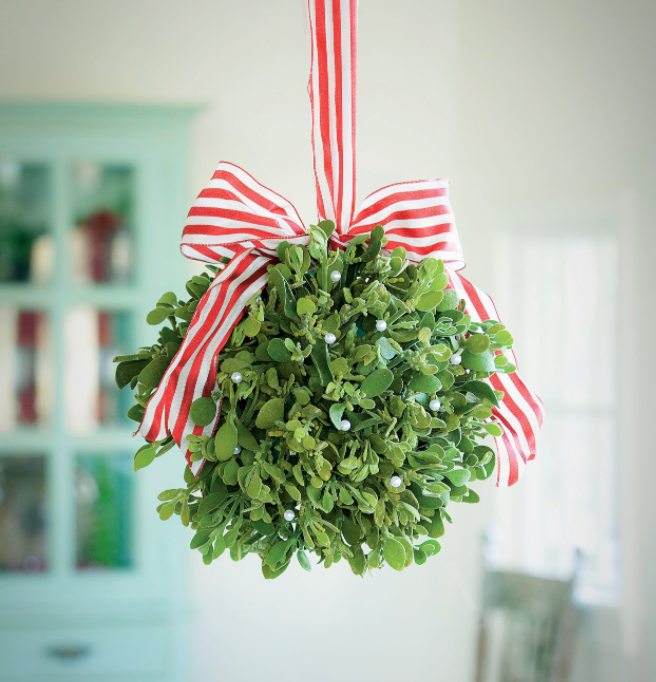
Perhaps, because of this ancient link to fertility, it became common in Victorian England to feature mistletoe in a decorated ornament called a kissing ball.
Guests at holiday parties played kissing games beneath the ornament where a kiss was said to ensure lasting friendship and good luck. But, according to tradition, refusing a kiss under the mistletoe brought a woman bad luck.
Learn how to make your kissing ball from this article.
Yes, mistletoe is poisonous, so keep it away from kids and pets.
The good news? It appears that American Phoradendron mistletoe is less toxic than the European species Viscum album. Reports of poisoning related to Viscum album are all reported to result from ingesting concentrated doses as an herbal remedy.
According to a poison control article, none had symptoms in cases where a few berries and leaves were eaten. However, it is still recommended to keep them out of reach of curious kids and animals.
Why does mistletoe grow only on trees?
Mistletoe is a hemiparasitic plant, meaning it gets water and nutrients from the roots it sends into the tree, but its leaves can also convert energy from the sun into sugar.
Tree thief is one of many common names of American mistletoe, Phoradendron serotinum or Phoradendron flavescens, as it steals sustenance from the tree.
Birds love to eat the berries and then deposit the seeds along with their waste on a tree branch where it sprouts and grows. Large amounts of mistletoe growing on a tree can result in stress and the tree's decline. The only control for mistletoe is to physically cut the branch it's attached to, only practical for small amounts.
Harvesting mistletoe with berries for holiday decoration reduces the number of female plants, inhibiting the spread of this plant. Like most wild plants, mistletoe has the benefit of providing valuable food for wild birds in the winter when food can be sparse.
Curiosity satisfied, enjoy your traditional mistletoe decorations. And may you only have good luck under the Kissing Ball.
Cindy Heath is a writer passionate about helping others enjoy nature, growing vegetables, and preparing healthy food. Join the conversation.
If you subscribe to Medium, I get a portion of your monthly fee at no extra cost to you, and it will go a long way in supporting me as a writer. Just click here.


