
What’s It Like to Study in France?
Bring your French skills, a laptop and coffee

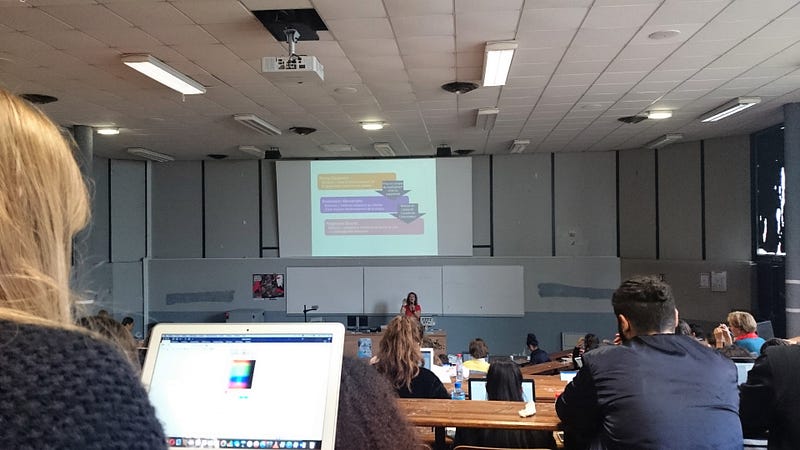
Upon entering a lecture hall, you’d see more than 200 students, most of them sitting behind a laptop. You’d hear the incessant, rhythmic sound of keyboards and a professor speaking French into a microphone. A PowerPoint presentation full of information would be projected to the wall. If you took a glimpse at the students’ laptop screens, you’d either see an open text file being filled diligently, a private Facebook feed or an shopping website.
Welcome to a typical lecture of mine in France! Studying a French-German bachelor’s that ended with a double degree allowed me to spend three semesters in this beautiful European country. I was in Lyon in Southern France from September 2017 to January 2019 — in the public university Lumière Lyon II.
Since I wasn’t an exchange student, I had the same classes as the locals and experienced the pressure, the workload but also the good sides of being enrolled at a French university. My study program in France was Information-Communication, thus communication science.
The first culture shock for me was that most French students wrote down almost every single word a professor said during a lecture (picture what I described in the introduction paragraph). Furthermore, when I entered a lecture hall called amphithéâtre, short amphi, I would see almost nobody taking notes by hand (which is different in Germany).
Facts and figures about the study system
In France, studies are counted in years. You would say “Je suis en L2” to say that you’re in the second year of your bachelor’s program (called licence, therefore the L). A year is divided into two semesters, one starting in early September and ending in December, the second one from late January to April. The exams are written in December/January as well as in April/May. A bachelor usually takes three years and can be followed by a two-year master’s (divided in M1 and M2).
From about mid-May or at least June to the end of August, you usually have holidays. Remember that August is pretty much a month of national holidays in France: numerous restaurants and shops close, offices run on the back burner; city people flee to the beaches, mountains and countrysides.
The French grading system goes from 0 (the worst grade) to 20 (the best). Having a 10 means you passed, and getting anything between 18 and 20 is considered almost unachievable since professors are quite strict. At university, you don’t have to pass every subject to be allowed in the next year — but your average grade must surpass 10.
Most seminars (TD) are mandatory and most professors will tick off the names of all students on a list at the beginning of each class. Lectures on the other hand (called CM for cours magistral) are not always mandatory — that depends on your study program and university. In my study program at Université Lumière Lyon II, the attendance of lectures was optional.
French university or: A bird’s nest
At a house party in Lyon, a French woman in her late twenties and I were talking about the French academic system, when she came up with a metaphor that accurately described what I thought:
“You know, as a student in France, I always had the impression that students were viewed as small birds — birds looking up to the all-knowing professor, the powerful mama bird, feeding them bits of wisdom and knowledge. As a bird, you are expected to pick up as much as possible with your tiny beak. Then comes the exam or any other form of evaluation — and as a baby bird, you spit out everything you have ingested.”
Let me explain why agree with this statement.
- There is a clear hierarchy within the French university system. You will most likely never call your professors by their first name, and the French language allows the usage of polite pronouns (vous instead of tu). This hierarchy means that a student correcting their professor is usually not well-seen. The ultimate wisdom and authority a professor holds is not to be questioned.
- Since lecturers and professors are in the hierarchical position of (supposedly) knowing everything better, a culture of debates and discussions in seminars is almost non-existent. Seminars often feel like lectures. In most of them, the first few sessions will be dedicated to theoretical knowledge — meaning the lecturer stands in front of the class to educate the students on certain topics. After these sessions, it’s time for group work — or most likely first a test to see how well you’ve listened to the lecturer. Groups are formed (either by the lecturer or by the students themselves) and a presentation has to be prepared by each of the groups. The following sessions of the semester are dedicated to the presentations held in class in front of your 30–45 classmates.
- Every semester, I had a dozen different subjects. This might be different for master’s programs because they are more specialized. In my B. A., we had 12 to 13 subjects every week (a little more seminars than lectures), which amounted to quite a lot of time spent on campus. My classes each lasted 1 hour 45 minutes. Some French friends from other study programs told me “Oh, you have so much free time!” because, in their study program, they had class from morning to evening every day. Don’t ask me how they did it — I guess coffee helps.
- Having that much input about different topics makes it quite hard to concentrate on a topic in depth at home. 12 mama birds aka professors tell you that their subject is the most crucial and feed you bits and crumbs of knowledge. Result: You try to chew, there’s new food coming, your stomach is filled with bits of different topics, and you’re glad to empty that during the next exam.
Off to work at 22!
Deadlines are very important in France — if you miss them, you’ll likely fail the subject. Shortly after the end of the semester, you get a relevé des notes which is a document with all your grades. Prolonging your studies is almost impossible or at least not recommended. It is not well seen by employers if applicants have done “gap years” during their education.
My friends and acquaintances repeatedly told me that in the French corporate world, it’s mostly your grades and your certificates that count. That’s why French people with university education start working full-time quite early. Following the path of high school/bachelor/master, many graduates are done studying at only 22. Again, this is completely different in Germany: Taking gap years? Why not! Prolonging your studies? Go for it, take your time! Having your first full-time job at 27? That’s alright, you’re still young!
Do you speak français?
If you expect to study in France without speaking French, the French system will put a spoke in your wheel. Have I mentioned how proud the French are of their language? In this article for sure:
English is not a forte of France in general. Only a few study programs are taught entirely in English, and those will mostly be in Paris. In the article above, I mentioned that in my experience, most exchange students coming to France speak French with each other! French improvement guaranteed…
Do I recommend studying in France?
Yes and no. If speaking fluent French is your goal, it’s a great way to get there. As an exchange student, you will also have the big advantage of not having to take as many classes as I was obliged to. Hence, you’ll still have lots of free time and not too much work to do. Even I found time to babysit, do activism and volunteer beside university.
The upside of having many classes is that while you might hate some of them, you’ll discover some you really enjoy. And: You will probably learn a lot. There were definitely some classes in Lyon that I consider to be useful for my current master’s (in Sweden) or for some of the internships I did.
If your goal is to get to know an academic system where critical thinking and personal responsibility is required, you might be disappointed in France. Autonomy doesn’t seem to be key but doing a master’s will probably be more fulfilling in that regard than a bachelor’s.
The French approach to university education is different from the one of e.g. Germany where you are expected to have certain skills (like scientific writing) prior to entering university. In France, I felt like classes were taught in a way so everybody could understand the subject and participate, no matter their background. Everything started with the basics, e.g. I had a whole class about how to use Word and Excel whereas, in Germany, a new student is expected to know how those programs function. I wouldn’t say one system is either good or bad.
Many professors are quite young (which is explained by the early entry age into most professions). That doesn’t mean they are not strict — remember that you’re still supposed to think that they have innate knowledge due to their profession… It does mean they remember their own studies just a few years back and are more open to innovations and digital solutions.
In my experience, professors were almost euphoric when international students held good presentations or delivered good exams. Language classes in the French academic system are often quite bad, and foreigners speaking really good French impresses them. My advice for you is to write “Étudiant (or “Étudiante” for females) international(e)” on top of your exam paper — it will make professors more indulgent with your mistakes in the French language.
What I also like is that the exam evaluation is pretty unbiased. At my French university, I had to write my name on the corner of the first page, then folded and sealed so that professors don’t give grades based on personal preferences. The secretaries will reveal the name and write down the corresponding grade on a separate list.
If you asked me if I’d decide to study in France again if I could go back in time, I’d always reply with a clear yes.
Thank you for reading my perspective.
© Annika Erika 2020


