
What They Don’t Teach You At The Gym
Three simple exercise rules I learned as a swimmer

In the past there was a school of thought that believed strength training offered little in terms of health benefits other than to gain bigger muscles — Nothing more than a body beautiful idea.
As an ex-athlete, I assure you that this concept is false.
“The fight is won or lost far away from witnesses, behind the lines, in the gym, and out there on the road, long before I dance under those lights.” — Muhammad Ali
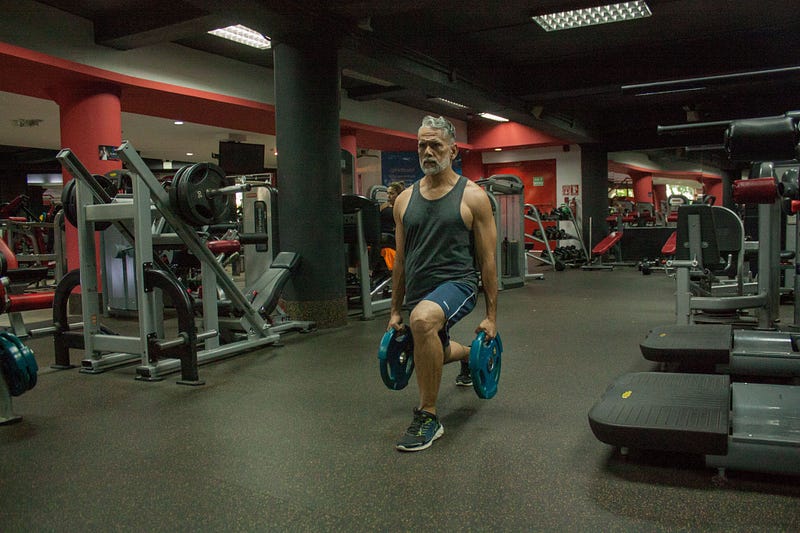
In fact, Harvard school of health research discovered that if you lift weights, at least once a week, you’re 23% less likely to develop heart disease than those who don’t lift (Harvard, 2009). Other studies have validated the benefits of strength training:
- Cardiac patients lift weights to gain muscle mass and rebuild strength
- Diabetic patients lift to control blood-sugar levels — Muscle gives excess blood-sugar somewhere to go rather than stay in the bloodstream and clog up arteries
Not to discredit aerobic exercise over strength training. Not at all. On the contrary, merging both aerobic and anaerobic is the best approach.
Three Simple Rules
After 14 years as a competitive swimmer, swimming upto 20 km a day plus an hour in the gym, I learned some basic principles. In addition to 7 essential movements that I’d like to share with you.
If you take nothing else from this article, remember these three rules:
1. Just do something
Procrastination can reveal its ugly head in our lives, causing paralysis and we end up doing very little or nothing.
I know, I do it too.
So I urge you to do something, because doing eliminates procrastination. You can become fit by sticking to a basic roadmap, an exercise plan. So no matter what, be active.
“The best activities for your health are pumping and humping.” — Arnold Schwarzenegger
2. Do something you enjoy
If you don’t like gyms or lifting weights then don’t do it. Be creative.
There are lots of other strength/resistance training regimes that you can incorporate into any exercise plan or activity, outside the gym.
If you like to swim, climb, wrestle, kayak or whatever tickles your fancy then go for it, but a mix of resistance training should make its way into your plan.

3. Remember rule # 1 and rule # 2
Look, everything else is more or less in the detail in terms of what you do, for how long and whether it’s aerobic, anaerobic or even both each day. If you form a habit whereby to rule 1 and 2 become part of your life — Great — that’s the ultimate goal.
It’s worth noting that anything you’re passionate about, or love, you’re more likely to stick to and enjoy it all the more. So find something that you really enjoy and mix it up with the resistance movements below.
Persistence is key but not moreso than fun and enjoyment.
“Take care of your body. It’s the only place you have to live.” — Jim Rohn
Final Thoughts
There are seven fundamental exercise movements that I learned as a swimmer. I call them the ‘Essential Seven’, which are:
- Dead-Lift
- Lunge
- Squat
- Push
- Pull
- Core, and
- Twist
All these movements engage the body’s major muscle groups in a coordinated fashion, by design. You’ll be much better off doing workouts that incorporate the ‘Essential Seven’.
Lastly, don’t forget your mind. Your mind is a muscle too. The most powerful muscle at your disposal, so I invite to read the article below.
“Mind over muscle. Believe it before you do it.”

Copyright ©. Paul Myers, Jan 2020. All Rights Reserved.