
Who We Really Need In A Crisis
The value pyramid turns upside down
What’s amazing to notice in the current ever more constrained UK society is how many things we take for granted turn out to be completely dispensable.
Cinemas, bars, restaurants and gyms can all be shut down in a heartbeat and I haven’t heard too many grumbles at this necessary sacrifice. Schools are next, with a nationwide closure starting tomorrow. This is more painful, both for the students who have been studying for now-cancelled Summer exams and the parents who have to find a way to look after the younger pupils.
Special arrangements will be made for continued centralised schooling of the children of essential service workers, who might otherwise be diverted from where the need is greatest to look after them at home.
What’s most interesting is to see who qualifies as essential service workers. Police (of course), nurses (well it is a health crisis) and delivery drivers.
I think I have heard more mentions of delivery drivers on television in the past 48 hours than in the whole of my life before that point.
It turns out that lawyers, accountants and banking staff, towards the upper end of the earnings pyramid, can perfectly well take time off to look after little Johnny, but the guy who delivers the Tesco orders is suddenly irreplaceable.
I hope that, in the longer term, this new-found respect for care workers, nurses and delivery drivers will be reflected in their pay-packets.
Many of the traditional professions (excluding doctors) can, it turns out, be practised perfectly well over the internet, if the work needs to be done at all.
In the financial services firms that I support, working from home is proving more productive in some cases than trekking into the office. Perhaps there are fewer distractions without your mates around. There are certainly fewer sports fixtures to discuss, even over Skype.
When the virus threat has passed I wonder whether some of those firms will be a little more relaxed about flexible working as a standard approach, or whether they will revert to the quasi-macho attitude of getting to the office early and working at your desk all day.
I also wonder whether society will be the same after we recover from the inevitable human and economic carnage which is bearing down on us.
We thought £39BN a high cost for the Brexit divorce bill, yet the Chancellor just magically found £350BN to deal with the public health and economic consequences of the virus.
Someone in Whitehall has been briefing journalists about the possibility of a universal basic income, to act as a safety net after many companies founder and countless jobs are lost, for example in the travel and entertainment industries.
There has similarly been talk of taking transport and utilities back into public ownership.
There is a three month moratorium on evictions from rented property, and leniency for those struggling to pay their mortgage.
Could we end up in a Corbynite socialist vision of the UK, at similar cost to the Labour manifesto commitments, even though the Conservatives won the election?
I’m not going to be so crass as to look for silver linings before the worst is yet upon us.
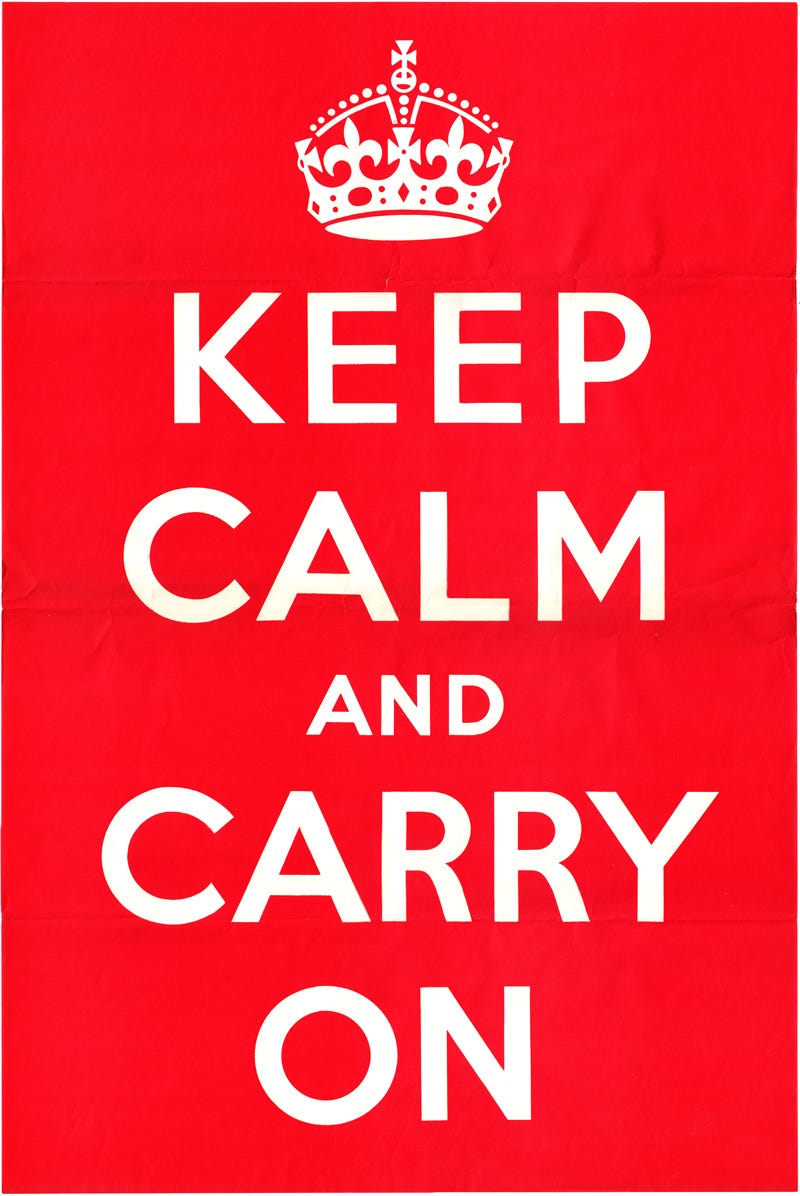
However, I am encouraged to have seen the glimmer of a resurrection of some of that banding-together wartime spirit that the Brits are supposed to be famous for.
The panic-buying is now more or less under control, and some shops have even carved out specific hours where the elderly can do their shopping before the shelves have been stripped bare.
We are still assailed by mainly bad news on all fronts, and are hunkering down with a siege mentality. One of my daughter’s twenty-year-old friends just tested positive and we are mentally tracing back through our contacts with her.
But by and large we are trying to keep calm and carry on.
Just as Winston taught us.
Many thanks for reading!
The virus, the virus, it’s all about the virus. Apologies for my one-track mind of late, but if you haven’t read your fill yet, you may appreciate these:
#500Race


