
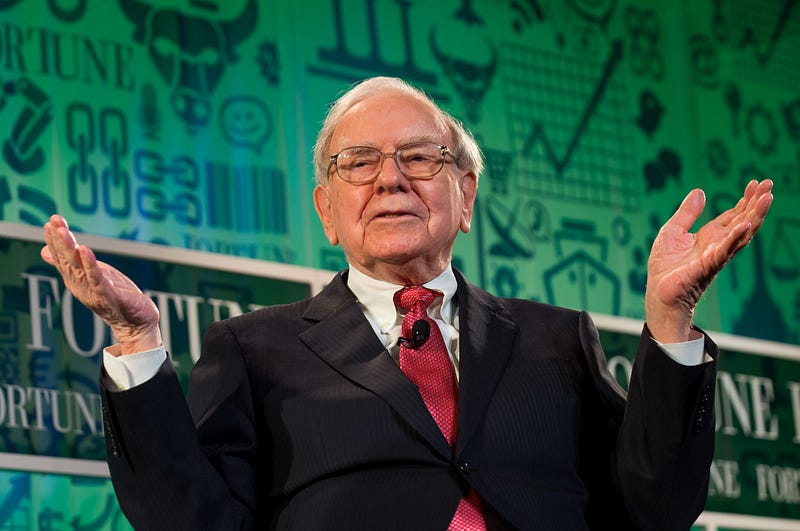
What Warren Buffett’s Two-List Strategy Can Teach You About Productivity and Focus
Every action has a cost.
“It’s said that a wise person learns from his mistakes. A wiser one learns from others’ mistakes. But the wisest person of all learns from others’ successes.”
— John C. Maxwell
Warren Buffett is the fourth-richest man in the world, with a net worth of $70.5 billion. If you measure success from a monetary perspective — which I’m pretty sure he does — this guy has made it.
I don’t know him personally (wishful thinking) but I am pretty sure about one thing: Given his success and wealth, he has his priorities down and knows how to make the most out of his time.
He has huge investments in tons of businesses and a CEO and chairman position in one of the wealthiest companies in the world — Berkshire Hathaway. You can imagine that he has a myriad of things competing for his attention. Reports, investment decisions and options, news, meetings, calls, interviews, and so on.
You’re not going to be the next Warren Buffett but that doesn’t mean you can’t learn from some of his strategies and secrets.
So how in the world does a man with so much on his plate stay focused and productive? Let me tell you a little story.
What Buffett Teaches His Personal Employees
Obviously, Buffett has got a personal pilot — actually, he has had several over the years. This story is about one of them: Mike Flint.
After Flint had been flying him around for a couple of years, he had a chat with Buffett about his career goals. Buffett being Buffett, he encouraged him to let go of his current job and instead go after his dreams. He told him to put together a list of 25 items that were important to him but that he currently did not have in his life.
This list was easy to come up with. What was a lot harder was the next step: Buffett told Flint to circle the five items that were most important to him. After some hesitation and a lot of pondering, he finally settled on his top five items.
After he had his top priorities circled, Buffett asked him if he would start working on them right away. And Flint confirmed that, eager to go after his dreams.
So far, so good — pretty standard process to find out about your priorities and biggest goals. What’s so special about this whole story? Don’t worry, the real kicker is about to come.
Then, Buffett asked him the crucial question: “Mike, what about the other 20 things on the list? What are you going to do about them?”
Flint said what most of us would have: “I am going to focus on my five main priorities, but the other ones are still important to me. They aren’t urgent, but I still want to work on them and put in some effort when I find time in between.”
And that’s when Buffett came up with his famous response: “No. You’ve got it wrong. The things you didn’t circle — they are the things that you have to avoid like the plague. Until you have completed your Top 5, don’t spend any time or energy on the other ones.”
Every Opportunity Has a Cost, so Choose Wisely
The tasks that have the greatest likelihood of derailing your progress are the ones you care about, but that aren’t truly important.
— James Clear
Every action, every behavior, and every decision has a cost to it. In economics, this is called Opportunity Cost.
To stay with the investor example of Buffett: Even if you invested $10000 into a company and it would be worth $12000 next year (a 20% annual gain, not bad!), this still had the opportunity cost of what else you could have done with the money. Maybe there was another investment that would have provided a 30% gain.
This concept is especially important when it comes to our time and energy. Why? Because we have limited amounts of both. Yes, you might be doing things with your time that propel you forward and get you closer to your goals. But you could have also used that time and energy to work on your Top 5.
Moral of the story? To focus on what really matters to you and make progress towards it, you have to let go of other things — even if they sound tempting.
But that is only half the learning.
The problem isn’t to let go of the things we don’t like anyway. If you dreamed of having your own successful business but hated going to the opera, choosing between the two on a Friday night is a no-brainer.
The problem is letting go of the things that are not your Top 5 priorities but that you would also like to do. Maybe you are an entrepreneur with his own business or someone in a corporate job who wants to climb the next step of the career ladder. These things take a ton of time and work. Unfortunately, you would also like to have your own podcast, YouTube channel, or other things. And that’s when the decision gets hard.
This is why Buffett’s two-list-strategy is so brilliant. It does not only help you to find your priorities, but it also shows you the things that are most likely to derail you and keep you from succeeding.
To recap, it’s as simple as effective. To conjure up razor-sharp focus and follow through to achieve your dreams and goals, go through these three steps:
- Write down your top 25 goals and dreams.
- Select your top 5 out of these.
- Your top 5 go onto your to-do list. The other 20 go onto your avoid-like-the-plague list.
Being Focused Is a Superpower
There are tons of options and opportunities you have in your career and life. In such a world, being able to focus on a few things becomes a superpower very few people have.
The few that do have realized a simple but fundamental truth: Everything in life has a cost. And the things that you care about but have little payoff or aren’t part of your utmost priorities are the ones that are most likely to get you off track.
To develop razor-sharp focus, reach your goals, and achieve your dreams, you have to let go of the things that aren’t conducive to them. Even if it hurts.
Warren Buffett spends as much as 80% of his day reading. While you don’t have to spend that much time on getting smarter, it certainly helps to retain more from the books you read.
PS: If you like my style of writing and don’t want to miss out, feel free to subscribe to my tiny little newsletter.


