
4 Useful Tricks to Retain Twice as Much from the Books You Read
Beat the forgetting curve and rise above.
I am a book worm. I love reading. In my early teenage years, I devoured books like other kids gummy worms. When I fell in love with a book, I’d read it over and over again. I went through the second part of the Harry Potter series more than ten times. Last year, I challenged myself to read 24 books in 12 months and did it.
However, after reading the first couple of books of this challenge, I noticed something interesting. Although the reading was fun and I put in the effort to focus on the book at hand, I didn’t retain much of what I was reading.
I am sure that you have been in the same situation as I. You open a book, start reading and become enchanted by it. The content is interesting, the writing flows naturally and you encounter words, sentences, and stories you wish you’d never forget.
However, by the time you flip the last page and admire the book’s cover for one last time in awe-stricken silence before you put it away, most of what you have read has already slipped your mind.
What’s even worse is that this is only the beginning of the forgetting curve. While most forgetting happens right in the beginning, your memory deteriorates even more over time. And often, after a mere week or two, all the great stories, all the life-changing insights, and all the crucial information you swore to never forget have evaporated into thin air.
No sugarcoating here: this sucks donkey balls. You spent so much time and effort on reading through books and acquiring information and then boom, a couple of weeks later, it’s almost as if you’ve never read the thing at all.
I feel you. After I have finished a book, I don’t want to feel like I’d have to read it again after two weeks. I got other stuff to do. I got so frustrated with this that after the first three or four books I read last year, I decided to end this cycle once and for all. I decided to design a system that would allow me to not only retain and remember more of what I read but also to engage with the information more and apply it to my own life as I go.
Forgetting is inevitable. It is a natural process that can’t be stopped. What you can do, however, is to take certain steps that will make you not only retain more of what you read in the first place but also slow down the process of forgetting. This way, you increase the amount of information that enters your long-term memory and decrease the rate at which it leaves. The result: More knowledge, less forgetting. Sounds good? Then read on.
How to retain more from your reading
I read for education purposes mainly, which means that I usually stick to non-fiction books. I’ll throw in a bit of fiction and a good novel every now and then, which I read without trying to remember it — I just enjoy reading it. But if your goal is reading a book to learn from it, these techniques are the way to go.
Get an overview first, then ask the two most important questions
When I start a new book, I don’t dive into right away, although it might be tempting after reading a promising blurb and looking at a sexy cover. For your brain, this would be the equivalent of being marooned somewhere in the wildlands, without any clue about where you are, how you got there, or how you will find your way back. Sure, it might be exciting and captivating, and your first instinct is to start moving. But without a map, without a concept and an understanding of the big picture, you are likely to get lost.
If your brain is lost, retention will suffer. It doesn’t know why you are feeding it certain information or where to put it.
Therefore, you should always get an overview of a book first, before reading it. Check the contents and chapters, read the blurb a second time and map out what you can expect. This gives your brain a framework to work in, like putting up numbered shelves in a storage room, so it can label and memorize what is about to come.
But getting an overview of what you are about to read is only half of the equation to set the stage. You also want to prime your brain to make the connections between the external knowledge in your reading and the internals, aka your own personal life.
To do this, you have to ask yourself two questions:
- Why do I want to read this?
- What do I want to gain from this?
The first one refers to your internal motivation for the read. Maybe you have some unresolved issues, maybe there is a certain part of your life you want to improve.
The second one makes the connection to the external part — the knowledge you want to gain from the book. Think about how this book might benefit you.
When I set out to read Atomic Habits, these were the exact questions I asked myself. I wanted to read the book because I could see that building solid habits is the key to achieving success in any area of your life. The book provided an easy to follow, a detailed guide to build them.
Your brain is an incredibly powerful machine and most of its miracles happen without you noticing. The only thing you need to do is to give it a framework to operate in and a direction into which to go.
Increase your depth of processing
In psychology, there is a concept known as the levels of processing model. It states that “shallow processing leads to a fragile memory trace that is susceptible to rapid decay. Deep processing results in a more durable memory trace.”
To put it short: The more you engage with something, the better you will remember it.
This is why you should highlight text, jot down your own thoughts and use sticky notes to mark important sections. It not only makes reviewing the content a hell of a lot easier, but it also increases your depth of processing, and therefore, how much you will remember.
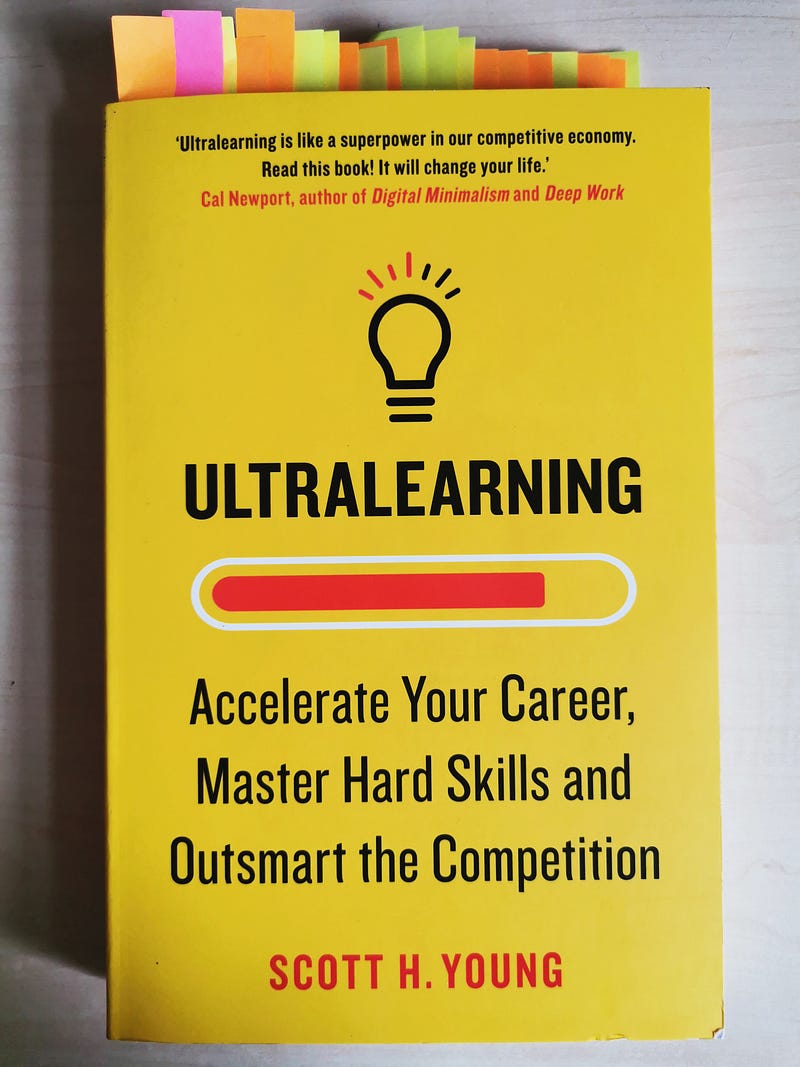
Look at my copy of Ultralearning. You can see that I use sticky notes in three different colors. It’s not because I am particularly artistic or crave variety. Instead, I use a three-level system of categorizing information and knowledge.
Yellow — minor facts, case studies, and otherwise noteworthy elements. Anything remotely interesting gets a yellow sticky. However, you could understand the main points of the book without looking at these specific details.
Orange — main points. Without these, you wouldn’t understand what the book is about. Core assumptions, smart methods and concepts, and important claims all go into this category. If you do it right, you have your own complete summary of the book by opening up the sections marked with orange.
Red — mind-blowing insights and summaries. Here, I collect everything that either gave me an Oh my god moment when I read it or that summarizes a chapter or part of the book.
On top of that, I take notes within the book, usually to summarize paragraphs or rephrase something in my own words.
This system allows you to easily find information when you are looking something up. Do you want a quick overview and summary? Open up orange pages. Do you want all the details? Yellow it is. And if you only want to look at the very core, mind-blowing insights, have a look at red.
Applying these techniques increases your depth of processing, which means that you will greatly increase the retention of what you read.
Not only that, but they also make reviewing a book’s contents much easier when you want to refresh your memory.
Speak to the voices in your head
If you can’t explain it simply, you don’t understand it well enough.
— Albert Einstein
For anyone interested in the science of learning, I can recommend Scott H. Young’s Ultralearning. One of the points he makes is that you haven’t really understood a concept if you can’t explain it in your own words or using your own methods.
After reading something, we often think we understood it and could explain it to someone, when in reality, we can’t.
If you want to see this in action, do the following exercise:
Take a sheet of paper and a pen. Now, draw a bicycle. You know, one of these things that you see people pedaling around on every day. Complete and accurate, including the pedals, chain, handlebar, saddle, frame, and wheels. No points for artistic mastery, but for structural accuracy.
I did this with a few of my friends and most of them (even the avid bike riders) couldn’t draw a bicycle accurately as it is.
This is like pouring herbicide onto the delicate flower of memory. If you haven’t understood something right after you read it, how are you going to make sense of it in the future, when even more of it is lost in the ether?
Don’t worry, solving this problem won’t take more than five minutes per chapter and is as easy as it is effective.
All you have to do is close your eyes and imagine yourself sitting in front of one of your friends. Then, explain the contents of the chapter to them. Tell them about the main points, the storyline, and as many detailed examples as you can remember. Not only does this make sure that you understand what you read, but the increased depth of processing and exposure to the material will greatly improve your retention. Ideally, you choose a curious and critical friend for your mental conversations.
If you know them well, you will already know what kind of questions they are going to ask. That’s perfect. Have them ask questions. Have them challenge your thoughts and concepts. This will force you to think about the subject and improve your retention even more.
Of course, if you can get your friend to actually sit with you, listen, and ask questions, that’s even better. But since my friends don’t have the time to sit with me day in day out, I have to keep these conversations confined to my head.
Create your own library
Okay, time to be honest. You won’t be able to hold all the contents of all the books you’ve ever read in your head. Even if you apply all the above techniques and reread the material on a regular basis, you can’t remember everything.
What you can do, however, is to create your own library of book summaries. Imagine a place where all of your greatest reads are summarized in a way that makes sense to you, highlighting all your important and life-changing insights. A place that you can revisit any time and freshen up your memory on a particular subject in no more than five minutes.
I know, writing a book summary seems like tedious work at first. But the cool thing is, you do it for yourself and yourself only. You don’t have to follow any guidelines and it won’t be graded. You can make it as long or as short as you want to, although I recommend no more than two pages, depending on the book. And if you followed my advice above and used sticky notes of different colors, you will be done in less than 20 minutes.
If you do this consistently, over time, you will end up with your own personal bible of knowledge — handwritten by and for you.
Want to see a truly impressive example of what such a library can look like? Head over to Niklas Göke’s fourminutebooks.com for summaries of over 600 books (and counting!)
The little things
It’s always the little things that make the big things happen.
― Jeffrey Fry
Apart from the big hitters I mentioned above, there is a little bit of gewgaw that I’d like to throw in here. These things won’t skyrocket your retention ability overnight, but they will make a difference, often a significant one.
First of all, you should figure out your personal reading prime time. This might depend on many factors, such as your schedule, sleeping pattern, and personal preferences. That is why there is no universal answer to this question, but if you are willing to experiment with it, you will find a time slot that is conducive to your memory.
Second, this article suggests that reading books in a physical form leads to greater retention than reading the same book in a digital form. I know, e-books are cool because you can take thousands of them anywhere without much effort, they are cheaper than hard copies, and you don’t have to cut down trees. These are all valid arguments. Personally, I have a hard time switching to electronic copies though. It might be the smell of paper, holding a physical product in your hand or the act of flipping pages and watching your highlighter soak into the paper. Whatever it is, hard copies are my preferred method of reading. However, I always buy second-hand books if I can. They are often in almost perfect condition, cost less than new ones, and yay, no dead trees.
Last piece of advice I am going to hand to you today: Get a reading buddy. Not only will this increase your reading through some good old peer pressure, but you will also stumble about some new books and improve your understanding and retention of what you are reading through an explanation.
No one can take away your knowledge from you
Sometimes you read a book so special that you want to carry it around with you for months after you’ve finished just to stay near it.
— Markus Zusak
Books are a unique way of archiving thoughts. Authors often spend months or even years on fleshing out drafts, aligning sentences, finding examples, and creating storylines. That is how a masterpiece is crafted.
It’s foolish to assume that all this work, all this effort, all the thoughts, memories, connections and insights that have taken months or years to put together can be taken in and digested in one simple read. It’s impossible.
But what is possible is to do your best to remember as much as you can and to make the read worth your time.
Now it is time for you to decide which of these methods you are going to apply. And the question you should ask yourself is:
If you don’t remember what’s in it, have you really read the book?
Books are cool. If you’d like to read more but somehow can’t make time for it, this one is for you:
PS: If you like my style of writing and don’t want to miss out, feel free to subscribe to my tiny little newsletter. No spam, no weird stuff, no requests to wire money to an offshore bank account. Just a simple notification whenever I publish a new article and a lot of love. Thanks!