
What to Expect When You Weren’t Expecting a Gender Non-Conforming Child
Five things every parent should do when their kid comes out
Before I begin, I have a quick quiz for you, dear reader:
- Are you a Don’t-Say-Gay Floridian?
- Do you support blocking access to gender-affirming care for kids?
- Are you one of the seven Kappa Kappa Gamma members suing their transgendered sister?
If you’re answered “yes” to any of these — or if you identify as any flavor of right-wing nutjob nonsense — then stop reading, right now.
This article is not for you.
I have no space for your intolerance. So, off with you.
Now that we’ve cleared that up — who is this article for?
If you’re the parent of a child, tween, or teen who came out as non-binary, gender-fluid, or gender non-conforming — then, hello!
This article is for you.
If your experience is anything like mine, you’re probably a liberal LGBTQ+ ally living in a blue-dot urban city. You’re raising your kids to be tolerant, fair, inclusive, open-minded, all the good stuff.
But your child never showed any indication they were questioning their gender.
Until they just did.
And they caught you off-guard.
Another quick quiz: Did your child do one or more of the following?
- Inform you of a new preferred pronoun and/or gender.
- Pick a new preferred name.
- Come out at the same time as their friend group.
- Start obsessively drawing (or buying) different rainbow-colored flags.
- Change their clothing or hair to align with a new gender identity.
If so, congratulations! Your child is still the same child you’ve always known and loved!! They’re just coming of age at a time when norms around gender are different.
Now, how about you — are you unclear on how to proceed? Do you have questions, doubts, fears? Again, congrats! This makes you 100% normal!! Rest assured, you can be confused and questioning and also be a loving, supportive parent.
But with the awful political situation for trans kids, even asking a question can feel like a betrayal of ally-ship.
At least, that’s how I felt when my child first announced their transition.
That’s why I’m sharing my story and some wisdom (I hope). I aim to create a safe space for like-minded parents to share knowledge, express concerns, and ask for advice.
The world is divisive and weird, and we parents need support too — so we can be our best selves for our kids.
But first, a quick queer vocabulary lesson.
As the parent of a gender non-conforming child, you’re going to need to learn a new lexicon. I’ve included a few terms below for the uninitiated, but they’re truly the tip of the gender iceberg.
My pal Merriam-Webster has this to say…
- Gender non-conforming: “Exhibiting behavioral, cultural, or psychological traits that do not correspond with the traits typically associated with one’s sex. Having a gender expression that does not conform to gender norms.”
- Non-binary: “Relating to or being a person who identifies with or expresses a gender identity that is neither entirely male nor entirely female.”
- Gender identity: “A person’s internal sense of being male, female, some combination of male and female, or neither male nor female”
- Gender-fluid: “Of, relating to, or being a person whose gender identity is not fixed. Gender-fluid individuals prefer to remain flexible about their gender(s). Some dress in ways that reflect both genders at the same time, while others may express one gender one day and another gender another day.”
- Genderqueer: “Of, relating to, or being a person whose gender identity cannot be categorized as solely male or female”
Yes, these terms overlap. Yes, some of them are one word, some are two words, some are hyphenated. Yes, that drives word nerds like me crazy.
That said — don’t mock these words. This is an emerging vocabulary and your children likely value the nuances.
And finally — if you only learn one vocab lesson here — do not ever say things like, “But I was taught ‘they’ is plural!” This makes you seem 1,000 years old and deeply dismissive.
Merriam-Webster declared the singular “they” as word of the year back in 2019.
As parents, we need to keep up.
Nico’s story
(Shared with their consent)
In winter 2020–21, my two daughters spent hours texting with their friends. During peak COVID, it was their only social outlet. They were in 7th and 5th grades, and my youngest tagged along in the older kids’ conversations.
One evening she let me know: many of her older sister’s friends were changing their names and genders. They hadn’t told their parents yet. But within the friend group, new identities were being carved.
In her voice, I could hear she was considering a change as well.
Fast forward a month or so. (What even was time during COVID, anyways?)
Every girl in my eldest child’s friend group changed their pronouns and names — except for her. Her identity has been a rock, firmly on Team Girl.
Then my youngest came downstairs on the cusp of her 11th birthday, handed me this note, and suddenly was no longer a daughter.
Or a her. Or Annika.
They were Nico.
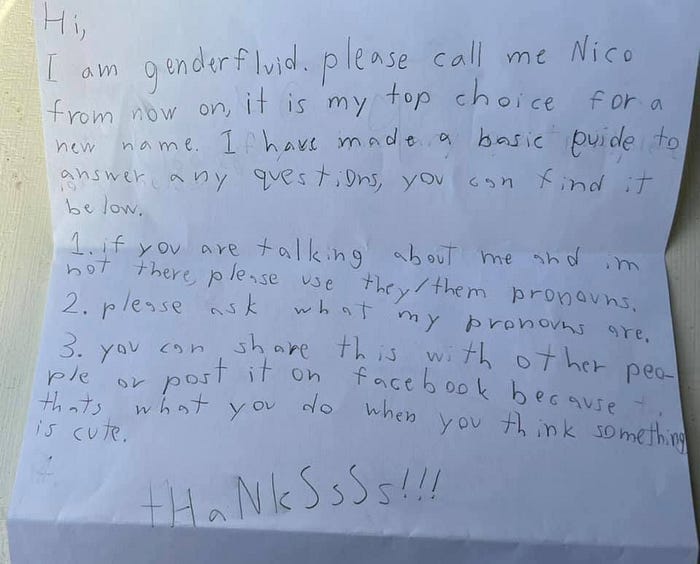
“Hi, I am genderfluid. please call me Nico from now on, it is my top choice for a new name. I have made a basic guide to answer any questions, you can find it below.
1. if you are talking about me and i’m not there, please use they/them pronouns.
2. please ask what my pronouns are.
3. you can share this with other people or post it on facebook because thats what you do when you think something is cute.
tHaKsSsSs!!!”
I did think the note was cute. But it was much more than cute. It was articulate; it was assertive; it was clear; it was confident. And it demonstrated how well they knew their audience.
I was — and still am — immensely proud of how assured my child felt in sharing their truth, and that they trusted me to relay the message.
Which I did, simply and succinctly — and on Facebook, as requested.
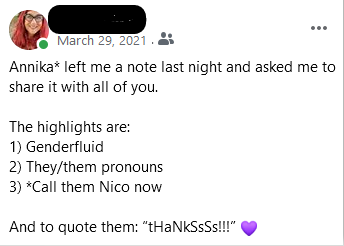
The responses were unequivocally supportive. I’m so grateful Nico had an accepting, loving online community to come out to.
For many months following this note, Nico experimented with gender and sexual identity. In addition to identifying as gender-fluid, they explored non-binary, neoboy, pan-sexual, bisexual, and lesbian as they explored their fluid new world.
Now 13 years old, Nico has settled on “use whatever pronouns you want,” and I alternate between she and they. She’s given me permission to use the words “daughter” and “sister” for her, and for this I’m immensely grateful.
I missed those words, a lot.
And now, my top five recommendations for parents when their child comes out:
- First — and I do mean this above all else — love and accept your child. Let them know they’re safe, adored, and valued. Don’t get rattled. If they want to use they/them pronouns and change their name to Brick or Ash or Grim or Scott or Frazier or anything else, let them. If they request a change that would be challenging for you, then be open and have a conversation. For example, I told my child that “it” would be a pronoun I’d have trouble using, as I’d find it dehumanizing. They said they understood, and thankfully, never requested to go by “it.” That said, if your child insists pushing a name or pronoun that’s hard for you, even you absolutely can’t bear it — do it anyways. Let your child know they’re heard and loved, no matter what.
- Know that this is normal. A mom reached out to me, concerned that her now-son wanted to change his name at school, but not with extended family. His lack of certainty gave her pause about officially requesting a gender and name change at school. “What if he changes his mind in a year? Will he be picked on?” she asked. Understandable concerns, from our GenX vantage point. But to these kids — this is just normal. As the Kinks presciently sang back in 1970, “Girls will be boys and boys will be girls, it’s a mixed-up, muddled-up shook-up world.” Your child may go through multiple gender, sexuality, and name changes during their school years, and their peers likely will not care. To them, these things are fluid and normal. Take that worry off your plate, parents.
- Feel empowered to question permanent changes. The thing about being a child is, you’re certain your current world view is correct and always will be. The wisdom of age tells us otherwise. I’ve heard some bold requests from kids through my parenting community. Many of us want to let our child lead the way, especially regarding their own identity. But if your child requests a change they can’t undo — for example, top surgery — I‘m here to tell you that being an accepting parent doesn’t mean 100% giving in to all gender-related requests. As a parent, it’s your job to protect your child. And sometimes this means saying no. As much as you can, try to reach a compromise. For my friend with the child who wanted top surgery, they researched and found a good binder, with a commitment to revisit the conversation when he’s a bit older. I realize these choices get more complicated the older the child gets, and the longer they’ve been steadfast in their gender journey. Then it moves into case-by-case basis, evaluating one-way versus two-way doors, and lots of communication. Which brings me to my next bit of advice…
- Find your community. The issue of gender care is so divisive, and the ways we think about gender are so new and ever-evolving. Hopefully you have like-minded parenting friends. If not, you may need to seek them out online. I’ve had so many parents contact me since Nico first came out. Usually the conversation starts with, “So (insert child name) just asked to use they/them pronouns…” I can hear the unstated question mark at the end of that trailing phrase, and I always start by assuring them — this is going to be fine. Use the pronouns. And come to me if you need to talk/vent/ask about anything. Because while the focus here is on the kids — as it should be — we parents are also going through transition. It’s completely fine to mourn the loss of son or daughter you thought you were raising. My friends and I lament how we miss saying endearing words like “daughter” or “the girls.” Humor also helps. For awhile my crew joked how we needed a spreadsheet to keep track of all the changing names and pronouns. Confusion, sadness, even anger — all normal feelings to have as you adapt as a parent. It’s always okay to feel your feelings. It’s just not okay to process them with child. So, find your people.
- Know this may last — or it may pass. For some kids, their identity changes will be long-standing, perhaps lifelong. For others, they’re passing, a fleeting phase of adolescence. And since we’re parenting on the front lines of a massive cultural shift, it will be many years until we really know the impact. All we parents can do is try to guide our kids through it all, the best we can.
Parents: I’m here to help support you, so you can support them.
I make no claim that I’m an expert here. The one thing I know is, in liberal cities, gender fluidity is the new-normal. We parents need to recognize this, to support each other, and — most of all — to love our kiddos unconditionally through all the peaks and valleys of adolescence, including gender journeys.
Your kids need to know you’re informed, interested, and engaged. It’s your love and support that’s going to buoy them.
Give them all you’ve got.
And know I’m here to support you and help you find other like-minded parents, if you need me/us.
Greetings!
I’m All My Little Words, a GenX word nerd living in the Pacific Northwest with a whole lot of little words to share. I write about career, music, feminism and perimenopause, cooking, ambition, fun, parenting, and more, with an offbeat perspective on how and why the world works (or doesn’t).
If this story resonated with you, why not buy me a coffee? (Make mine an iced oat milk decaf mocha, please and thank you.)


