Genetics and science
What Have I Got To Do With Mitochondrial Eve?
Understanding the Riddle of Ancestry

If you were alive in the late 80s, you may remember The Mitochondrial Eve story.
Researchers had found the mother of us all. An African woman who lived in the Makgadikgadi basin about 155,000 years ago, in what is now northern Botswana.
They called her Mitochondrial Eve.
And for a minute, humanity felt good knowing that in the distant past, there was a mother to us all.
It was a great story. Except it was garbage.
The Myth of Mitochondrial Eve
Mitochondrial Eve is nothing more than a statistical quirk. A hypothetical woman who lived way back in the mists of time. And who is, in effect, nothing more than a mutation. A mutation that is found in the Mitochondrial DNA (mtDNA) of all of us.
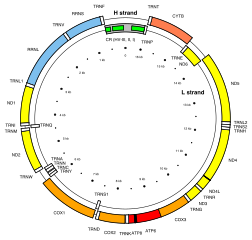
If you remember Biology classes, you might recall that Mitochondrial DNA is separate from the DNA of your nucleus. It has no part in reproduction and is simply transferred from mother to child — its DNA structure unchanged for thousands of years.
Except occasionally, a mutation occurs. And it is these mutations that able us to track human evolution and migration.
So Who Is Mitochondrial Eve?
Let’s imagine a woman 155,000 years ago. Let’s call her Eve, and one day she had a mutation in her mtDNA. This created a fork in the road. A signpost. A signature of where she came from.
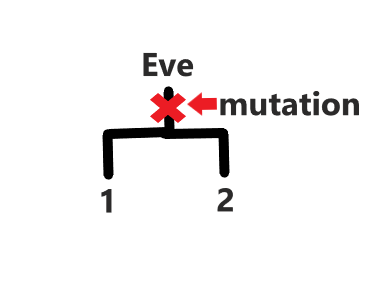
Eve had two daughters: 1 and 2, who inherited the mutation. And so did their descendants. Then another mutation occurred, and another and another, giving this group of people in that area a specific genetic makeup on their mtDNA.
We call these Haplogroups, and if you’ve ever done a DNA ancestry test, you might have been assigned one (along with a Y-Chromosome test, which is another test but on the male side).
My haplogroup is H1a1b, which is typical for British people. What it means is that I’m descended from a group of people who had similar mutations in their mtDNA. A group that originated about 20,000 to 25,000 years ago in what is now present-day Syria. (British racists look away now!)
Out Of Africa
About 90,000 years ago, some humans left Africa and migrated all over the globe. Like so.
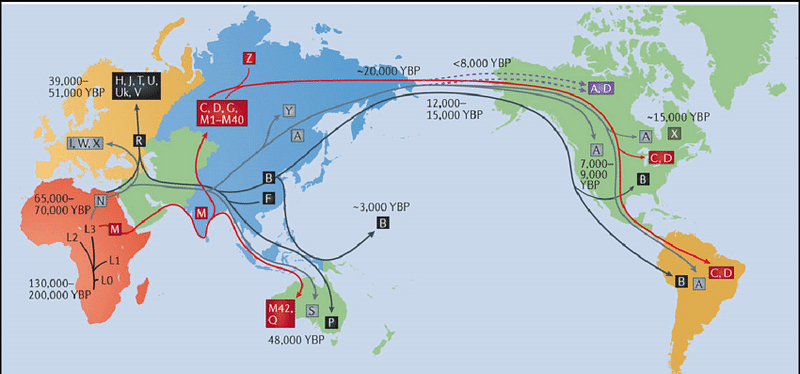
If you look at the map of the States there are a lot of “As”. This is because this is where the first research was carried out (into Native Americans), and so it was labeled A. It is not related to genetics or order of ancestry. Or supremacy.
You can see Haplogroup H at the top-left of the map. They originated from Haplogroup R and then migrated north to Scandinavia. Then they invaded England and called themselves The Vikings. I’m one of these.
This is really what the original research was looking at. The origin and migration of humans. Unfortunately, they threw in the word Eve and everyone thought they were talking about The Garden of Eden.
Misconceptions
1. Where’s Mitochondrial Eve’s mother in all of this?
This is a good point.
There were other women around at the time, otherwise, she wouldn't have existed. So why aren’t they Mitochondrial Eves as well?
Because the results are based on statistical models using a limited data set. It doesn’t have enough data to keep going on forever until the beginning of time. The family tree has to end somewhere. And it ends at Mitochondrial Eve.
However, as more samples come available and more branches emerge, the date of Mitochondrial Eve is pushed back in time. Conversely, if branches die out, she shifts forward in time.
This is why I like to think of Mitochondrial Eve as a mirage. She exists, but she doesn’t exist.
2. What’s this to do with Adam and Eve?
Nothing.
The researchers, Rebecca Cann, Mark Stoneking, and Allan Wilson, didn’t use the word Mitochondrial Eve in their original research.
It was only after the publication of an article entitled “In Search of Eve” by Cann, and another by science writer Roger Lewin called “The Unmasking of Mitochondrial Eve” that unleashed the forces of an uneducated media.
3. So is she our closest ancestor?
No.
Remember this test is only based on Mitochondrial DNA, and therefore the female line. It isn’t the full genome by a long way.
The actual Most Recent Common Ancestor of humans is currently unknown but is believed to have lived between 5000 and 10000 years ago. Although determining this with any accuracy is virtually impossible due to the sheer spread (and isolation) of humans around the globe.
What we can be sure of though is that they would have definitely existed. Unlike Mitochondrial Eve, who will always remain a statistic. Albeit a nice one…
Thanks for reading, for less sensible stuff, check out