
Nature | This Happened To Me
What the Feijoa!
All about feijoas and a limerick too!
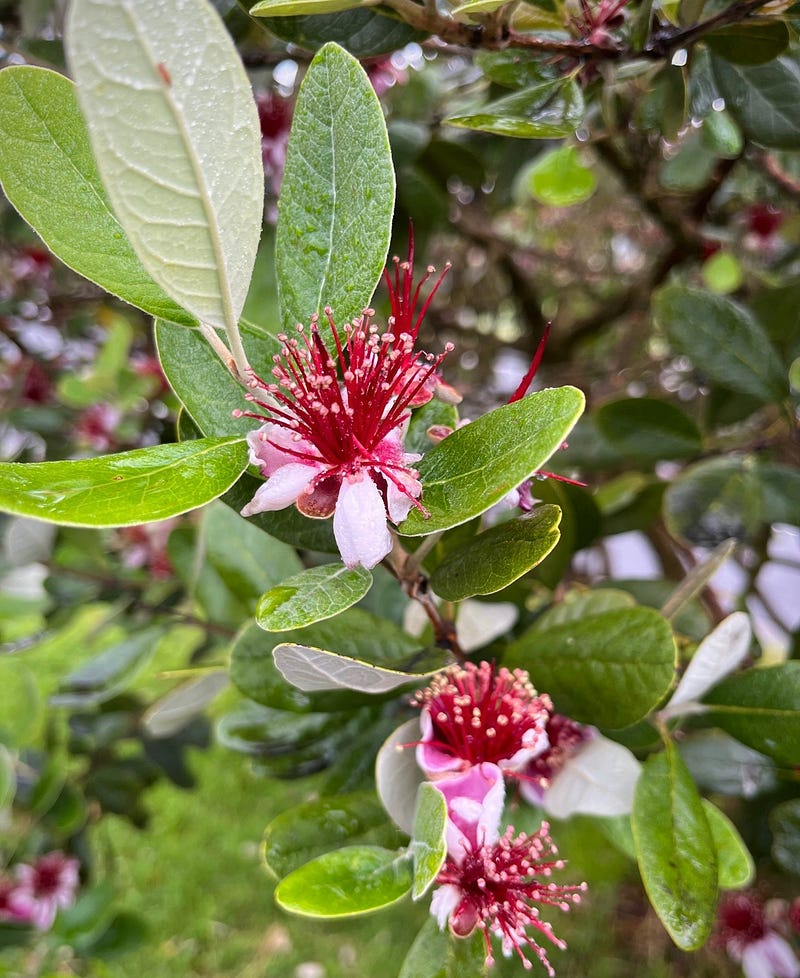
Last week, I published a Christmas twittle about feijoa flowers then later realised (thanks to those who left comments e.g. Jenine, Liberty, pockett), that not everyone knows what a feijoa is!
To be honest, I was a feijoa-duffer until a few years ago when I saw my neighbour picking fruit from the tree on her nature strip (that’s the Australian term for the grassy verge beside a roadway). Curious, I asked her if she knew the name of the fruit.
I fully expected her to shrug her shoulders and say, “No idea”.
I should have known better.
Manika (not her real name) is a fabulous cook. If she was picking fruit off a tree, it was because she knew what to do with it. Which meant she knew what it was called.
“Oh,” she said with her customary gracious smile (she tolerates fools better than I do!), “these are feijoas. They’re delicious.”
She reached up and plucked another of the small matte-green fruit from a branch just above her head and handed it to me. “Here, hold out your hands. I’ll give you some to try. I’m sure you’ll like them.”
“What did you say they were called? Fah….” (Yeah, I’m a der-brain when it comes to registering a new word in my memory box. 😜)
Manika looked at me and without the faintest hint of ‘Are you stupid?’ in her voice, she carefully pronounced the word, “Fee-joe-uh”.
She anticipated my next question. “You eat them like kiwi fruit. Cut them in half crossways and scoop out the flesh.”
She dropped a couple more into my cupped hands, making a clutch of five feijoas each one the size of a chicken egg.
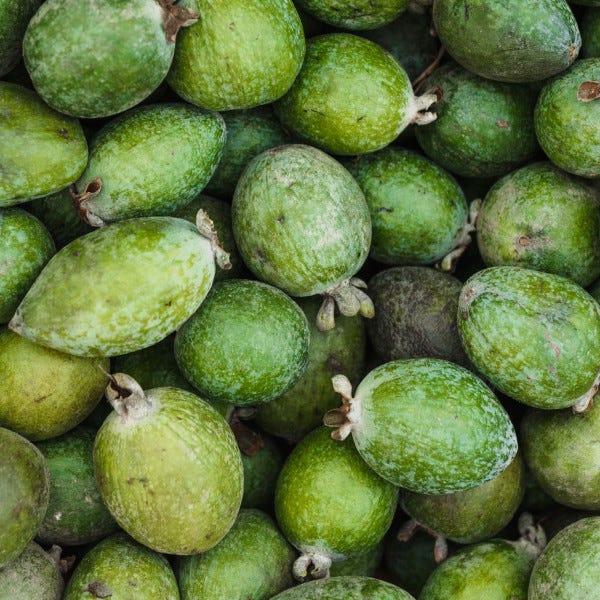
I studied the tree with greater interest. It was only then I noticed the plentiful supply of ‘green eggs’ cleverly disguised among the leaves. There were dozens of them! Isn’t Mother Nature clever the way she protects her babies so well?
Isn’t it amazing how unobservant human beings can be?
I’d always thought of myself as being quite attentive to my surroundings. The feijoa proved me wrong.
For years, I’d lived within metres of a feijoa tree and never taken any notice of it until I saw Manika picking its fruit.
Maybe it was because the tree itself was, erh…um…hardly a tree at all. Not in the sense of a shade tree to have a picnic under. Or one that kids could climb. Or build a tree-house in.
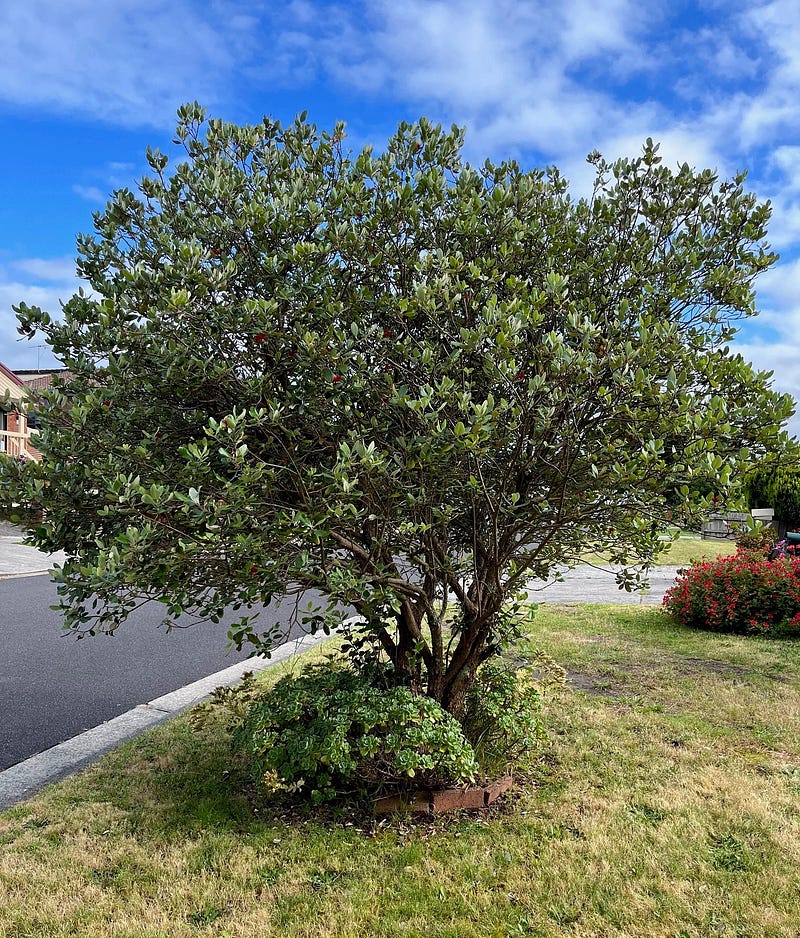
Compared to other trees in the neighbourhood, Manika’s feijoa tree was a midget, no more than three metres (10 feet) tall.
Being vertically challenged was something I could relate to. I understood what it felt like to be there and not seen. Heavens, if it weren’t for me wearing something lairy — or nothing at all! 😜 — I’d be forever lost in the crowd!
“You know, Manika,” I said, “it’s as if this tree’s been invisible. I’ve never noticed it till now.”
She laughed. “That’s because it never changes. It’s looked like this for years. And it’s evergreen.”
No nudy-rudy-nakey parade in winter!
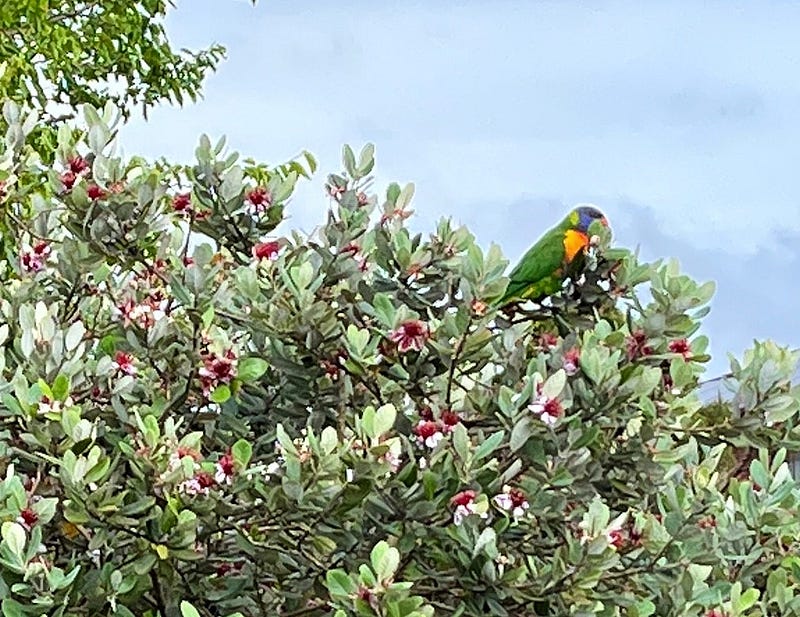
In fact, the only attention-grabbing trick feijoas have up their branches are the fizzy red and white flowers in late spring/early summer…
…unless, of course, you include rainbow lorikeets. 🦜
“Look,” Manika said, pointing with her right hand, “there’s another feijoa tree up there outside number 19.”
Sure enough, there was.
I’d never noticed that one either. 😳
From then on I ‘found’ more and more feijoa trees in our neighbourhood, some of them even less tree-like than Manika’s — some of them more shrub than tree. Trunkless tree?
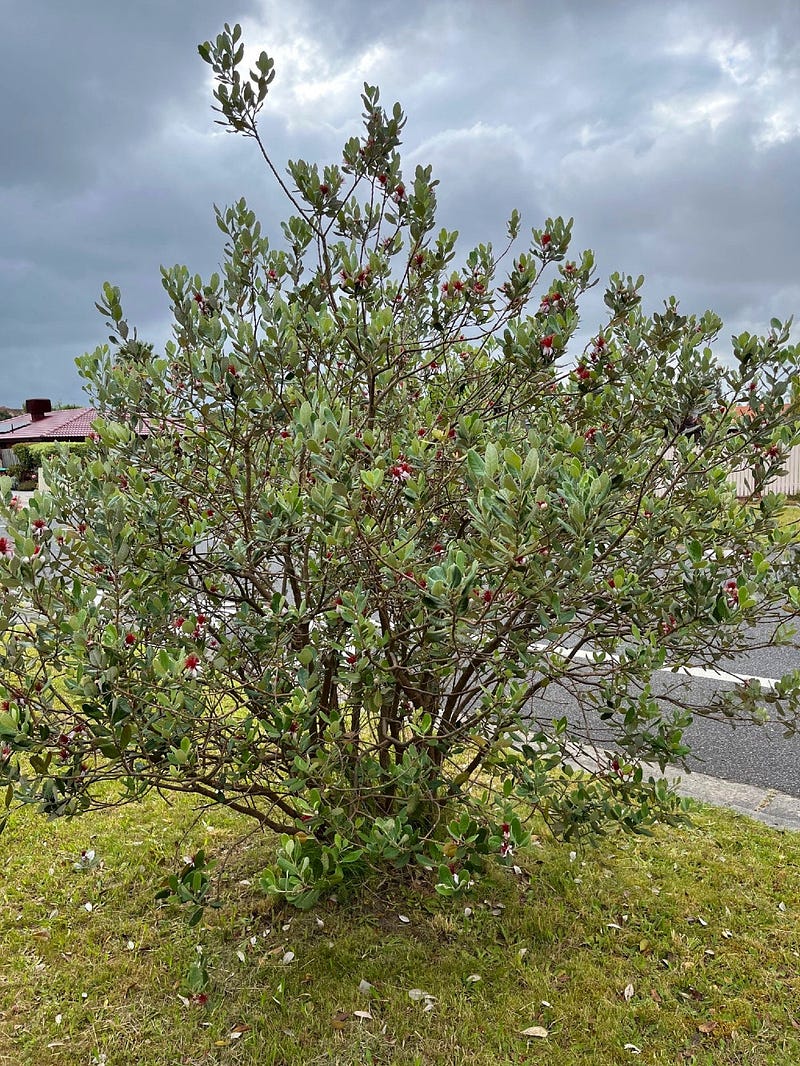
Some in a classic ornamental form —
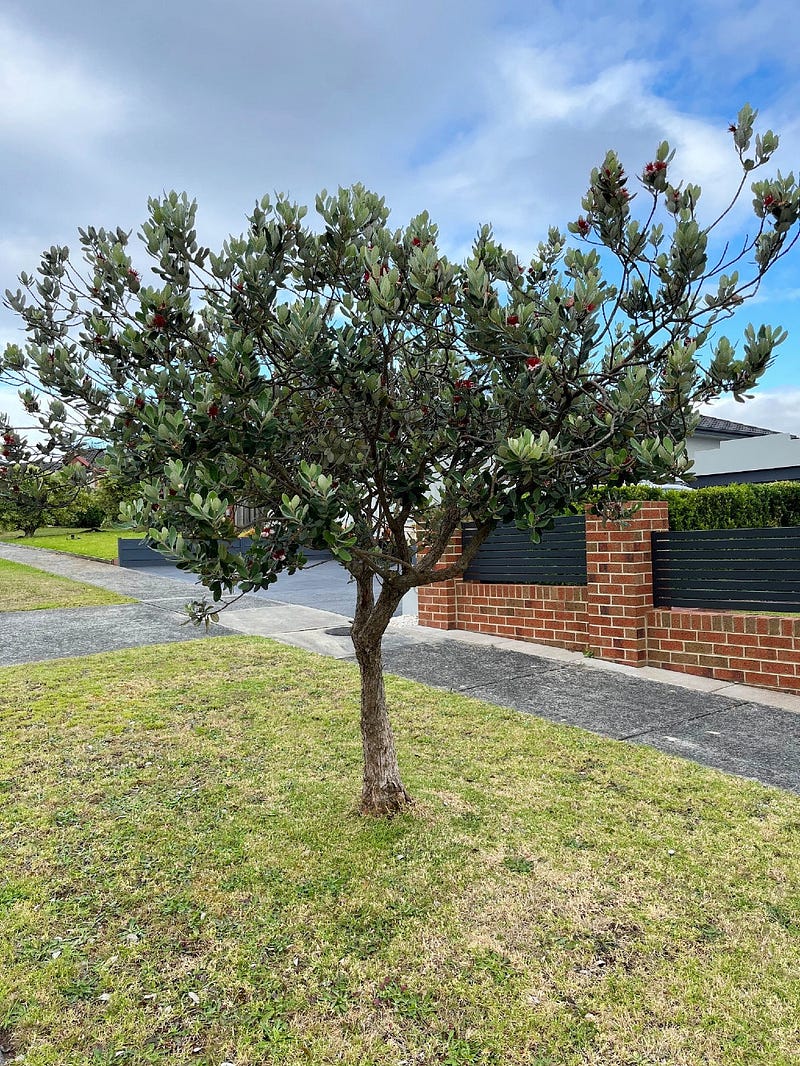
Others more like a squat umbrella —
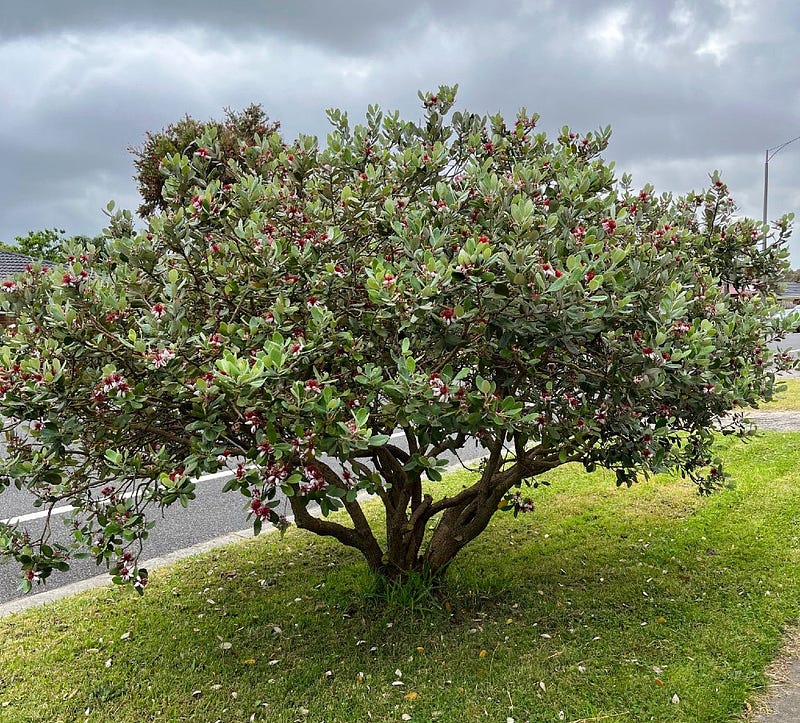
I took my handful of feijoa fruit back home and did what Manika had instructed. I cut one in half crossways to reveal creamy-white flesh with a network of five gelatinous cells in the centre.
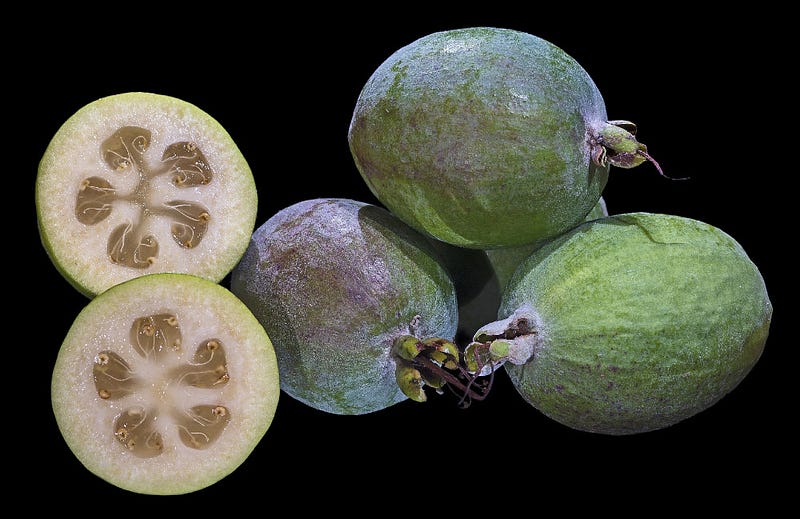
The smell reminded me of perfume. Very inviting. 😊
I scooped out a small spoonful of the soft flesh and taste-tested it. Mmmm, it was like kiwi fruit crossed with avocado crossed with pear — smoothish and creamy with a pleasant tang.
I gobbled up the rest in no time! 😋
Feijoa Fun Facts
- feijoas are native to South America — specifically in the region between Brazil and Argentina.
- feijoas grow well in New Zealand and Australia.
- feijoas are also known as pineapple guava or guavasteen even though they are not related to guava.
- their botanical name is Acca sellowiana and they belong to the myrtle family.
- feijoa flowers are edible — not that I’ve ever tried them — I’m told they go well in salads.
- feijoas are considered superfruits — they’re packed with vitamin C and other goodies.
- the skin of the feijoa fruit is also edible — personally, I find it bitter so I prefer to scoop out the flesh.
- the Portuguese pronounce it, ‘fee-zhow-uh’ and the Spanish, ‘fee-hoe-uh’.
- the fruit ripens in autumn and is ready to eat when it is slightly soft to the touch.
- the fruit is usually eaten raw but can be used in a range of recipes from chutneys to cheesecake to ice cream. 😋
The Kiwi Grower and Feijoas
Kalem Berntsen is The Kiwi Grower from New Zealand and he knows a thing or two about feijoas. Even if you’re not interested in feijoas, he’s fun to watch! 😉
What the Feijoa? — a limerick
Look, you’ll have to cut me some slack with this one because I just couldn’t help myself! 😆
Yesterday, when I was busy writing another story, I came across a cute little fella called a jerboa.
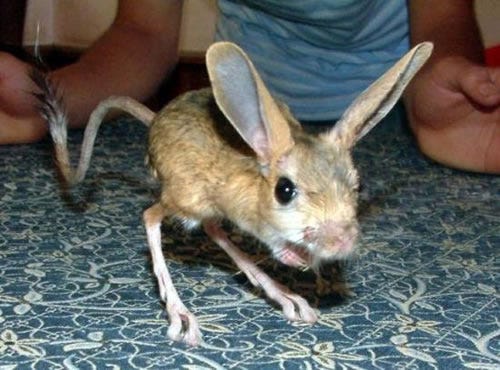
I’ve had the jerboa-feijoa earworm in my head ever since! I had to do something with it, so I’ve turned it into a limerick!
There once was a long-eared jerboa Who wore a hot-pink feather boa She could jump, skip and hop If you asked her to stop She swore at you, “What the feijoa!”
And on that note, I will say ‘thank you so much for being here’ and special thanks to Dennett and Louise Peacock for finding a pozzie for this piece at Weeds & Wildflowers. 🙏 💕
© Carolyn Hastings 2022
✨ If you like what you’ve read, how about — 👉 Subscribing to my email list 📩 👉 Becoming a Medium member using my affiliate referral link ✨


