
What the Fake, People— Stop with the Pretend Reads
Fake engagement hurts us all
Another day in the life of a writer — I’m online, researching for a story idea. In-between I’m peeking at my stats, because I just published two stories in the last 24 hours and want to see how they’re travelling. I get a notification to say a person has clapped on a story. So I stick around to see whether she’ll leave a comment. I watch this person … clap on 1 …2 …3 of my stories.
Views are not rising accordingly on my overall stats graph. I look at the individual stories — and watch the Fans tally bump up one, but not the Reads.
Conclusion — she’s not reading at all. Supporting evidence: no comments or highlights on anything she’s supposedly reading.
I check back again ten minutes later to ascertain if it’s a lag in stats or not. On those stories, no change to those tell-tale “Reads” numbers. Apparently she’s a huge fan of my work without having to read a word …
The Worrying Trend of Fake Engagement
Around June 24th, Medium sent out an email giving everyone (finally) some transparency as to their intentions with bonuses going forward, and an outline of the criteria for eligibility. As a recipient of the April bonus, I can tell you, I was damn excited when I read it — as I’m sure many others were.
We’re keeping the same tiered structure that we implemented for May. We calculate rankings based on your monthly Partner Program earnings, which is a direct reflection of member reading time, and use the following tiered structure:
Top 1,000: $500 bonus
1,001–1,500: $100 bonus
1,501–2,000: $50 bonus
I’m only just noticing this trend of less reads than fans in my stats as a more regular phenomenon since that announcement. As I write this, of the eight stories that were either recent stories in circulation on the 25th, or published thereafter, fifty percent of those are showing more fans than reads. In late June, one of my stories had seven more Fans than Reads for several days. Another, published three days later, had four more fans than readers.
Of course, because it’s common for people to read without clapping or commenting, over time this discrepancy reduced, becoming hidden. Wish I’d taken a screenshot beforehand. But take a look at the bottom two stories for July — although not as large a discrepancy now, they are still both showing two more fans than reads.
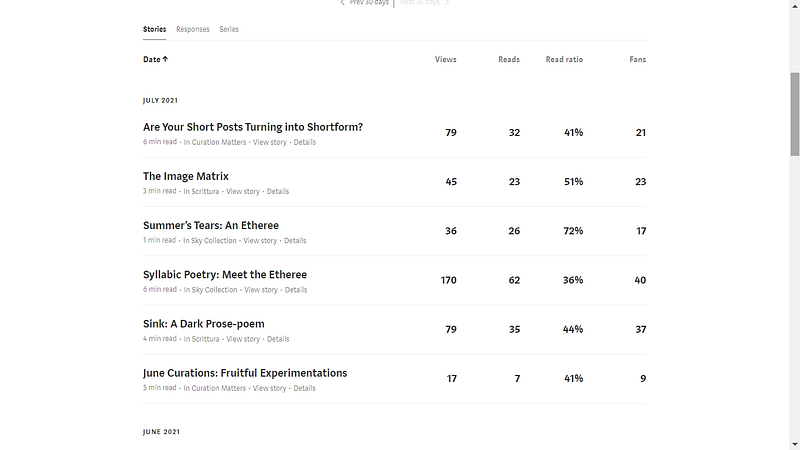
In the past — sure, occasionally it would happen — like less than 10% of the time. Sometimes it was a stats glitch and would adjust itself. Sometimes, it was a pretend read or maybe a so-damn-fast read (it can easily happen on a 1-minute poem) that Medium didn’t register it.
Consistent and Intentional Faking is the Issue — not Forgivable Random Human Error
Now, I’m sure we all, very occasionally, slip up and clap on a story we didn’t read. I can think of several understandable scenarios. Here’s one.
You have multiple tabs of Medium stories open — some you’ve just read, others you’re in the middle of, some you intend reading. Your phone rings right at the end of reading something. You need to look something up while taking the call. You go back to what you think is the story you were reading while you’re finishing the call, quickly scroll down and clap. You close the tab, while wrapping up the call, and you get back to writing.
What you don’t realize is, you opened the wrong tab, clapped on a story you hadn’t read, and closed the tab. Later, you notice the story you have read is still open, and thinking you’ve clapped, you close it. You’re busy, you don’t give it another thought.
These kind of unintentional slips are not what I’m talking about.
Are You Faking It?
I have to wonder, about those people faking engagement on Medium. I mean, how far and deep does that lack of integrity run? In their jobs, are they faking reading important office memos? Are they taking the credit for other’s work? Are they faking it in the bedroom too?
It’s a bit hard for me to slide into the mindset of the people I’m talking about. But I’m imagining they’re not writing as much or as well as they would rather. Maybe they’re not doing as well as they want to. They tell themselves they’re low on time and need more reads and Followers.
Maybe they’re just plain lazy.
So they decide to look as if they’re reading others’ work — perhaps targetting those they want to read their articles and/or follow them, but in a super-duper time-saving way — by not reading, only clapping — to see if they can get more people to Follow and read them.
Of course they want their own reads to be genuine, not fake. Because this is how they roll. Only thinking of themselves.
Forward Play — Consequences of Faking it
Here’s how I see the consequences of this continued behaviour playing out. If it becomes a more widespread thing, Medium analytics will undoubtedly detect it.
Maybe they’ll ask us nicely not do it once or twice.
But if it continues — and they can link it to the new Bonus initiatives — poof —
No more bonuses.
As a writing platform, Medium is unique in the generosity of the bonus scheme. Years ago, as a less experienced writer, I gave away so much — not just my final written pieces, but the hours and sometimes days of labour I poured into them — for the cheap price and often illusory promise of “exposure” on some lonely little website. Other times I was paid ten dollars for an article that took four hours to write.
So fakers, you’re going to incur a tonne of fury down upon your quaking, faking shoulders from the authentic writers and engagers on Medium if you are seen to be the cause of the bonus incentive being withdrawn.
How to Spot a (Potential) Faker
- Not a known Follower of your work
- Claps on several articles consecutively (an attention-getting ploy)
- Sometimes gives quite low claps, or consistently gives 50 claps.
- Does not highlight or comment on any of the articles supposedly read OR
- Only comments with vague generalities — like: “Great article.”
You are Not Anonymous — Stop Faking Around
Writers using advanced stats tools such as Google Chrome extensions can SEE individual readers who are faking engagement. They have told me they can trace it back to the actual offender. One high-profile writer says she routinely blocks people she identifies as giving her work fake reads.
I’ll say it again — you are not anonymous. And I’m pretty certain the Medium analytics team have the technology to trace it back to the individual users. If they can detect individual fakers, maybe they’ll start banning them from writing on Medium. It would be a pretty embarassing email to receive, wouldn’t it?
WARNING: You have been detected as a Faker.
Your writing and earning privileges in the Medium Partner Program Benefits have henceforth been suspended and you are banned from the platform.
Even if I’m watching in real time with the standard stats, I can see who you are if you’re repeat offending, like the person I describe in the opening. Apparently, having a degree after her name didn’t make her any less stupid.
And if I even suspect you’re faking engagement with your flimsy fake reads, there’s no faking way I’m going to come read your work — like EVER. I’m already keeping a blacklist. I warn you — don’t fake me around.
And if it continues, and enough people get pissed off about it, well, inevitably there will be naming and shaming in Medium Facebook groups. How embarrassing will that be, if you’re a faker? And then to watch your Follower numbers on both Medium and social media dwindle rapidly , as well as your reputation — so much faking fun.
Wake the Fake Up
The practice of intentionally faking engagement hurts us all. It definitely hurts the writers who are writing hard, reading genuinely and who care about their connections here — writers who (I fervently believe) are in the majority. It also hurts Medium as an entity and a concept — if overall reads are diminishing, then their model may be perceived as not financially viable and things may change for all writers for the worse.
So in fact, faking engagement hurts everyone, including the fakers. If I can pick up on it as a mere single user with the basic stats analyses tools Medium accords all users, imagine how abundantly clear it is to the Medium analytics team.
Many of the writers here including myself work hard at our craft, are passionate about what we write , and we value Medium as a community: a place for writers to mingle, connect and collaborate — not just as a place to upload a few stories in the hope of making a quick buck.
Fakers, you’re risking destroying a good thing for everyone.
So before you consider or continue being a Faker, ask yourself — is it really worth it?
I’ll say it one more time — Wake the fake up.
Follow Melissa Coffey — for provocative poetry, fiction & essays
More Sass:
More on the Mysteries of Medium:


