avatarJulia Christina

Free AI web copilot to create summaries, insights and extended knowledge, download it at here

3811

Abstract

">A common characteristic of these experiences (whether psychedelic-induced or not) is the deep recognition that consciousness is timeless, eternal, and indestructible.</p><p id="965c">This insight is shared among spiritual teachers, mystics, yogis — and surprisingly, physicists, too. Here’s what Albert Einstein, the world’s most prominent expert on time, had to say about this:</p><blockquote id="e874"><p>“I have realized that the past and future are real illusions, that they exist in the present, which is what there is and all there is.”</p></blockquote><p id="7ede">The present moment is the crux of consciousness, it’s what holds everything that has ever happened and that will ever happen.</p><p id="4ac8">Unity consciousness and the present moment are two sides of one and the same coin.</p><p id="2335">Here’s how <a href="https://www.amazon.com/Sacred-Knowledge-William-Richards-audiobook/dp/B0751XCK7J/ref=sr_1_1?crid=5YFZMEHSYHDP&amp;keywords=sacred+knowledge&amp;qid=1645661588&amp;sprefix=sacred+knowledg%2Caps%2C154&amp;sr=8-1">William Richards puts it</a>:</p><blockquote id="4b51"><p>“Consciousness” from this perspective perhaps may be best understood as the ultimate energy that makes up all that is and is to be found at the core of all that is.</p></blockquote><p id="9362">So, if you can access unity consciousness through your very own mind, what does that tell you about your mind?</p><h1 id="2842">The Holotropic Universe: Is Everything Conscious?</h1><p id="fbb8">Stan Grof coined the notion of <a href="https://www.amazon.com/Holotropic-Mind-Three-Levels-Consciousness-ebook/dp/B00134XEQY/ref=sr_1_1?crid=7KEOZ1PAO6L2&amp;keywords=the+holotropic+mind&amp;qid=1645660113&amp;sprefix=the+holotropic+min%2Caps%2C136&amp;sr=8-1">the holotropic mind</a> to describe this phenomenon through his analogy to holograms.</p><p id="1d02">Here’s how <a href="https://www.amazon.com/Way-Psychonaut-One-Encyclopedia-Journeys/dp/0998276596/ref=sr_1_1?crid=3HMASPUKWHSKG&amp;keywords=the+way+of+the+psychonaut&amp;qid=1645660104&amp;sprefix=the+way+of+the+psychoana%2Caps%2C343&amp;sr=8-1">Grof explains it</a>:</p><blockquote id="917e"><p>“One fascinating property of holograms is that the information is distributed in them in a way that it can be retrieved from each of their parts. If we had a conventional photograph and we cut it two pieces, we’d lose half the information. A hologram can be cut into a large number of pieces, and, by illuminating each of the fragments with a laser, we can retrieve from it the information about the entire object.”</p></blockquote><p id="add9">In a holotropic universe, all pieces that contain consciousness, which humans do, also contain the universal and eternal consciousness that’s the fabric of our universe.</p><p id="e8b6">This is what the spiritual saying “as above, so below” refers to. Mystics like Sufi-poet Rumi have attempted to give language to this phenomenon for millennia:</p><p id="50ee" type="7">“You’re not a drop in the ocean, you’re an ocean in a drop.”</p><p id="b020">Is it only conscious beings like humans and animals then, who have holotropic minds?</p><p id="c25b">Perhaps not.</p><p id="ccd1">The most extreme iteration of this theory is the field of <i>panpsychism</i>.</p><p id="4f86">In panpsychism, it’s believed that the mind or a mindlike aspect is a fundamental and ubiquitous feature of reality. In the world of panpsychism, <i>everything carries consciousness</i>, every plant and every matter, down to the smallest molecule. Every atom is a piece of the hologram, so to say.</p><h1 id="7827">The Human Brain as a Filter vs. the Origin of Consciousness</h1><p id="57d2">So, if your mind is holotropic and you’re an expression of the entire universe, how come you can’t access unity consciousness in your day-to-day?</p

Options

<p id="61d7">Aldous Huxley, who <a href="https://www.amazon.com/Doors-Perception-Heaven-Hell/dp/0061729078/ref=sr_1_1?crid=2QM08RH3L2UAF&amp;keywords=doors+of+perception&amp;qid=1645662993&amp;s=books&amp;sprefix=doors+of+perception%2Cstripbooks%2C137&amp;sr=1-1">wrote extensively about his journeys with mescaline and LSD</a>, suggests the following:</p><blockquote id="4194"><p>“We should do well to consider the suggestion that the function of the brain and nervous system and sense organs is, in the main, eliminative and not productive.”</p></blockquote><p id="c444"><a href="https://www.amazon.com/Food-of-Gods-Terence-McKenna-audiobook/dp/B009IBRSJI/ref=sr_1_1?crid=2PIJRK6V8GKDM&amp;keywords=food+of+gods&amp;qid=1645662413&amp;s=audible&amp;sprefix=food+of+gods%2Caudible%2C146&amp;sr=1-1">Terrence McKenna explains this further</a> by arguing that the main function of the brain and nervous system is to protect us from the overwhelm and confusion that would invariably result from the massive amounts of potentially irrelevant information. Our brain shuts out most of what we could technically perceive in service of our own survival. In his words:</p><blockquote id="30d2"><p>“Each one of us is potentially mind at large but we are animals and our purpose is to survive, and to make survival possible, mind at large has to be funneled through the reducing valve of the brain and nervous system. What comes out is whatever is required to survive on this particular planet.”</p></blockquote><p id="f4de">Sometimes this theory is also explained with the analogy of the internet. Imagine consciousness is the internet, and our brains are the wifi routers.</p><p id="e22c">This contradicts the widely-held belief in modern science that the brain produces consciousness (which, astonishingly, is the most prevalent theory despite a lack of scientific proof, <a href="https://www.amazon.com/Way-Psychonaut-One-Encyclopedia-Journeys/dp/0998276596/ref=sr_1_1?crid=KGVXYKO2KC4I&amp;keywords=way+of+psychonaut&amp;qid=1645752435&amp;sprefix=way+of+ps%2Caps%2C462&amp;sr=8-1">as Grof points out</a>).</p><p id="31f8">These alternative models propose that we never see reality, we only see the version our brain constructs for us.</p><p id="9d08">We only see what made it past the filter of our brain.</p><p id="87d4">Psychedelics reliably remove that filter and open the floodgates.</p><h1 id="7920">The Great Mystery of Our Universe</h1><p id="6a4c">The parallels between the thinking of mystics, spiritual leaders, physicists, and psychologists on this matter are intriguing.</p><p id="fcc1">What’s even more intriguing is the fact that these substances exist abundantly in nature, and that we have a brain that can metabolize these molecules.</p><p id="1452">We, humans, like to think that we’re the pinnacle of consciousness, but psychedelics prove us wrong.</p><p id="9f10">To the psychonaut, plants and fungi such as Ayahuasca and Psilocybin are just as conscious and potentially even more evolved than humans ever will be.</p><p id="d724">It might be hard to grasp that nature is conscious, but when you think about it, it makes perfect sense.</p><p id="a2d3">As <a href="https://www.amazon.com/The-Cosmic-Serpent-Jeremy-Narby-audiobook/dp/B01B1XUN1K/ref=sr_1_1?crid=3R1QFW1W97I2D&amp;keywords=cosmic+serpent&amp;qid=1645663890&amp;sprefix=cosmic+serpe%2Caps%2C159&amp;sr=8-1">Jeremy Narby puts it</a>:</p><p id="ac86" type="7">“How could nature not be conscious if our own consciousness is produced by nature?”</p><h2 id="74ff">Curious to learn more about psychedelic medicine?</h2><p id="c4dd"><a href="https://juliablum.substack.com/">Join my community on Substack</a>, where I publish <i>The Journey, </i>a free weekly newsletter for psychonauts traveling inward with intention.</p></article></body>

What Psychedelics Reveal About the Mind-Boggling Mysteries of Our Universe

A holotropic mind, a holotropic cosmos
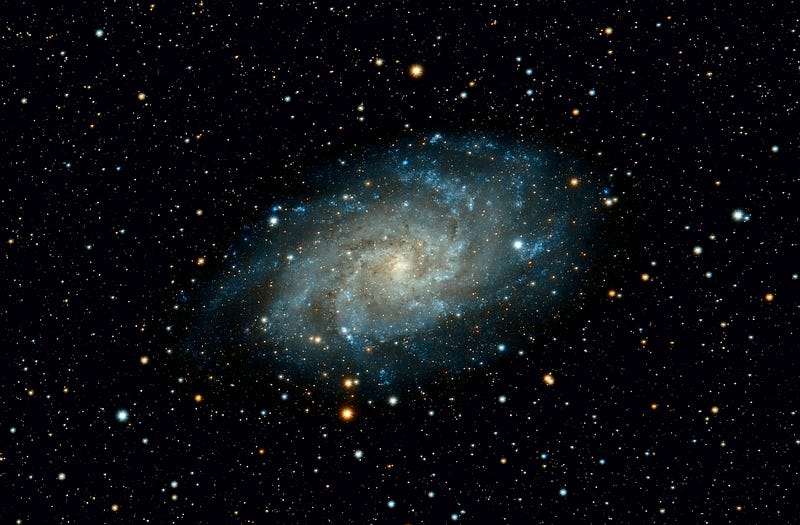
Photo by Guillermo Ferla on Unsplash

If you let them, psychedelic journeys will turn your view of the world upside down.

The first thing I ever took away from psychedelic experiences was that reality as we perceive it and reality as it is are two very different things.

Psychedelics illuminate realities about the nature of consciousness that are inaccessible to us in our regular waking state. It might be tempting to dismiss these outer-worldly experiences as “drug experiences”, but that’s not the belief most psychonauts hold. I certainly don’t.

So what can you make of these experiences? What do they tell you about reality?

Making sense of the bigger picture, let alone the fact that psychedelics exist in nature to begin with, is a core piece of integrating them. Read on for a glimpse into what psychedelic journeys teach us about consciousness and the universe.

Everything You Experience During a Psychedelic Journey Is Already In You

The first thing you have to realize is that the experience psychedelics produce is not contained in the actual substance.

Yes, the substance is the reason you’re having the experience. But the chemical molecule itself is devoid of meaning. It doesn’t include any visions, memories, childhood traumas, or insights.

Rather, psychedelics act as a catalyst. They magnify what’s already there. They blur the lines between the conscious and the subconscious. They dissolve your ego and allow you to tap into universal fields of consciousness.

They produce these experiences by triggering brain regions to communicate that usually don’t. Researchers have illustrated this with this infamous image of your brain on mushrooms (on the right):
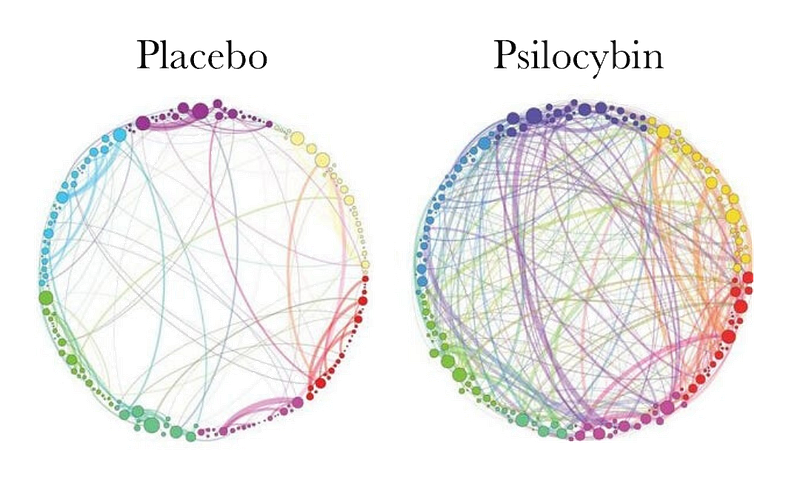
G. Petri, D. Nutt et al., Homological scaffolds of brain functional networks, 2014

If you want to learn more about how psychedelics work in the brain, this is a good 6-minute read.

The key point is that everything you experience is already in your consciousness.

This further becomes evident when you realize that it’s possible to experience altered states without any substances at all, simply through practices such as meditation and breathing. There are many ways to explore the contents of your mind and the realities of consciousness. Psychedelics are simply the most potent (and fastest) option.

In the words of psychiatrist Stan Grof, who conducted ~4,500 LSD therapy sessions back in the days and developed the field of Transpersonal psychology:

“Psychedelics will be for the study of the mind what the telescope was for astronomy, and what the microscope was for biology.”

Experiencing the Timeless Nature of Unity Consciousness

At high doses, psychedelics reliably produce mystical experiences, which are often accompanied by ego dissolution.

A common characteristic of these experiences (whether psychedelic-induced or not) is the deep recognition that consciousness is timeless, eternal, and indestructible.

This insight is shared among spiritual teachers, mystics, yogis — and surprisingly, physicists, too. Here’s what Albert Einstein, the world’s most prominent expert on time, had to say about this:

“I have realized that the past and future are real illusions, that they exist in the present, which is what there is and all there is.”

The present moment is the crux of consciousness, it’s what holds everything that has ever happened and that will ever happen.

Unity consciousness and the present moment are two sides of one and the same coin.

Here’s how William Richards puts it:

“Consciousness” from this perspective perhaps may be best understood as the ultimate energy that makes up all that is and is to be found at the core of all that is.

So, if you can access unity consciousness through your very own mind, what does that tell you about your mind?

The Holotropic Universe: Is Everything Conscious?

Stan Grof coined the notion of the holotropic mind to describe this phenomenon through his analogy to holograms.

Here’s how Grof explains it:

“One fascinating property of holograms is that the information is distributed in them in a way that it can be retrieved from each of their parts. If we had a conventional photograph and we cut it two pieces, we’d lose half the information. A hologram can be cut into a large number of pieces, and, by illuminating each of the fragments with a laser, we can retrieve from it the information about the entire object.”

In a holotropic universe, all pieces that contain consciousness, which humans do, also contain the universal and eternal consciousness that’s the fabric of our universe.

This is what the spiritual saying “as above, so below” refers to. Mystics like Sufi-poet Rumi have attempted to give language to this phenomenon for millennia:

“You’re not a drop in the ocean, you’re an ocean in a drop.”

Is it only conscious beings like humans and animals then, who have holotropic minds?

Perhaps not.

The most extreme iteration of this theory is the field of panpsychism.

In panpsychism, it’s believed that the mind or a mindlike aspect is a fundamental and ubiquitous feature of reality. In the world of panpsychism, everything carries consciousness, every plant and every matter, down to the smallest molecule. Every atom is a piece of the hologram, so to say.

The Human Brain as a Filter vs. the Origin of Consciousness

So, if your mind is holotropic and you’re an expression of the entire universe, how come you can’t access unity consciousness in your day-to-day?

Aldous Huxley, who wrote extensively about his journeys with mescaline and LSD, suggests the following:

“We should do well to consider the suggestion that the function of the brain and nervous system and sense organs is, in the main, eliminative and not productive.”

Terrence McKenna explains this further by arguing that the main function of the brain and nervous system is to protect us from the overwhelm and confusion that would invariably result from the massive amounts of potentially irrelevant information. Our brain shuts out most of what we could technically perceive in service of our own survival. In his words:

“Each one of us is potentially mind at large but we are animals and our purpose is to survive, and to make survival possible, mind at large has to be funneled through the reducing valve of the brain and nervous system. What comes out is whatever is required to survive on this particular planet.”

Sometimes this theory is also explained with the analogy of the internet. Imagine consciousness is the internet, and our brains are the wifi routers.

This contradicts the widely-held belief in modern science that the brain produces consciousness (which, astonishingly, is the most prevalent theory despite a lack of scientific proof, as Grof points out).

These alternative models propose that we never see reality, we only see the version our brain constructs for us.

We only see what made it past the filter of our brain.

Psychedelics reliably remove that filter and open the floodgates.

The Great Mystery of Our Universe

The parallels between the thinking of mystics, spiritual leaders, physicists, and psychologists on this matter are intriguing.

What’s even more intriguing is the fact that these substances exist abundantly in nature, and that we have a brain that can metabolize these molecules.

We, humans, like to think that we’re the pinnacle of consciousness, but psychedelics prove us wrong.

To the psychonaut, plants and fungi such as Ayahuasca and Psilocybin are just as conscious and potentially even more evolved than humans ever will be.

It might be hard to grasp that nature is conscious, but when you think about it, it makes perfect sense.

As Jeremy Narby puts it:

“How could nature not be conscious if our own consciousness is produced by nature?”

Curious to learn more about psychedelic medicine?

Join my community on Substack, where I publish The Journey, a free weekly newsletter for psychonauts traveling inward with intention.

Consciousness
Psychedelics
Society
Self
Mental Health
Recommended from ReadMedium