
What Mental Health Really IS
Why it’s not about your happiness.
I’m currently on an evening train out of town to visit family but the reason behind it couldn’t be more apt for this week’s essay.
You see, for most of the week, I’d been in a rut.
I would get up from bed, get ready and go to work as usual. I would “get things done” yet with little to no motivation or productivity. I would conduct entire vaccination campaigns from start to visit, attend to patients with a smile on my face and even wave at the street vendor on my driving route (which had become our ritual seeing as I’d never actually had a reason to purchase anything from him).
It’s also why I procrastinated completing this piece until the evening-into-midnight before uploading.
Now, some might say that my mental health was in a bad place.
And they might be right.
They might even suggest that my low mood, low energy, and lack of interest in a previously pleasurable activity (eg writing) are symptoms of depression.
And they might also be right (according to the manual for mental illnesses).
And yet, I wouldn’t have gone as far as saying that.
Which had me considering – what is mental health truly about, anyway?
A guided tour into the mind
“Mental health is a state of well-being in which an individual realizes his or her own abilities, can cope with the normal stresses of life, can work productively and is able to make a contribution to his or her community.” – WHO
A definition I find interesting especially as the concept of mental health goes mainstream and slowly becomes a buzzword.
I also found it rather amusing how nothing about personal “happiness” was brought up. Nor the entire removal of stress from life, which was even encouraged to be coped with. After all, isn’t living in the highs and lows? Can we truly enjoy the one without the other?
Similar to physical health, our state of mental well-being isn’t always 100%. It’s a spectrum that fluctuates over seasons, even down to hours.
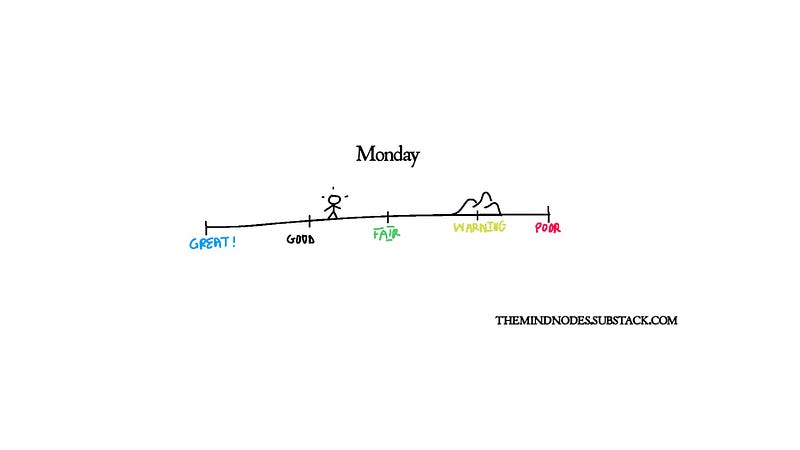
For example, it’s normal to feel anxious every once in a while, perhaps even considered healthy. It’s a sign that your sympathetic nervous system (aptly named; aka “fight or flight mode”) works.
It becomes a disorder when it’s sustained for an abnormally long period, no rational cause can be found (i.e can no longer be simply “mentally dismissed/controlled” by the person), and/or it begins to affect daily functioning (at work, school, socials, etc).
But the human brain is…tricky. Or should I say the mind?
Speaking of –
Where IS the mind?

It’s not quite straightforward.
A question that has defied time, alongside if the mind is the same as the brain.
“I think therefore I am,” – Descartes
Ranging from Descartes’ dualism (the brain and mind as independent entities) to materialism (there is no mind without the brain) to radical behaviourism (there is no mind at all), the debate is endless.
Although, if research has indeed shown mind over matter, one can’t help but wonder…
No doubt, the brain plays an incredibly important role. But our mind cannot be confined to what’s inside our skull, or even our body,” – Prof. Dan Siegel
Another question I’d considered was if mental health was affected by physical health (particularly gut health).
Short answer: yup.
Long answer: it’s complicated.
What mental health is not
A caveat —
Quoted verbatim from one of my favourite authors, Matt Haig’s Notes On A Nervous Planet:
“What mental health problems are not:
A bandwagon.
Fashionable.
A fad.
A celebrity trend.
A result of a growing awareness of mental health problems.
Always easy to talk about.
The same as they always were.”
If I might add, not an excuse to simply always do “whatever you like”.
🚨 Resources (for anyone who needs professional help):
Outside Nigeria: Betterhelp
Within Nigeria: Asido Foundation, MANI
Please share others, if you are aware of any as well.
Ah, my train ride has ended.
And it’s funny – at the mere thought of seeing loved ones soon, my good mood meter and energy levels have suddenly tripled.


