
What Make Us Very Similar but Different?
Our similarities bring us to a common ground; our differences allow us to be fascinated by each other — Tom Robbins
This is a story about the magic of genes.
In my previous article, https://readmedium.com/regene-the-center-of-life-9e502ed0f93f, I wrote about the importance and the short history of the gene as the center of life. Here, we will discuss how a gene can make organisms in the same species, very similar but different in the individual's level.
Have people ever told you you have the same eyes as your father? Or tell you that your eyebrows are as beautiful as your mother’s. Every organism has reproduction ability and produces offspring that always have similarities with their parent. Mother cats always give birth to kittens who are very much like their parent. Humans and all organisms always have similar traits that are inherited both from mother and father. On many occasions, some traits from older predecessors can reappear skipping one, two, or more generations.
The sexual organism has two kinds of cells, somatic and gamete cells. Cell with a reproductive function called gamete and the other cells are called a somatic cell. Sperm is the representative of gamete cell in males and ovum is female gamete cell. Along with the reproduction process, the parent’s gene will be passed in the next generation through the gamete cell (in the sexual organism). Those processes are following the evolution point of view that the success of a species depends on how many copies of their gene exist in the world.
The more copies of the gene the more successful an organism and reproduction is a way to make more copies of the gene.
Sperm has a copy of the paternal chromosome from the father and the ovum has a copy of maternal chromosome from the mother. Chromosomes that contain genetic material, both from the father and mother, will unite during the fertilization process. Sperm will fertilize the ovum and produce a single cell called a zygote. The zygote will divide continuously until a multicellular organism is formed.
There is a process called gene replication that occurs in every cell division. A copying mechanism of the gene. In each cell division, the gene must be accurately replicated to maintain genomic stability, otherwise, harmful mutations can occur and the organism will be at risk of morbidity and mortality.
Watson and Crick mentioned in their paper, published in 1953, that DNA’s double-helix model is not merely a beautiful and stable structure, but it has a higher purpose, related to its function as a functional unit of inheritance. Every strand of DNA can be used as a template to make a copy of itself, so it will produce a double-strand from the former double strand. The mechanism was proven by Matthew Meselson and Frank Stahl in 1958 (https://www.pnas.org/content/44/7/671 ).
Replication is a complex mechanism. The double helix DNA can’t make copies of itself autonomously. It requires complex coordination with a wide variety of proteins and enzymes. A biochemist, Arthur Kornberg, in 1958 successfully isolated the DNA copying enzyme from Escherichia coli bacteria and named it DNA polymerase. This enzyme is essential for an accurate replication process.
In the replication mechanism, there are 3 activities: initiation, elongation, and termination.
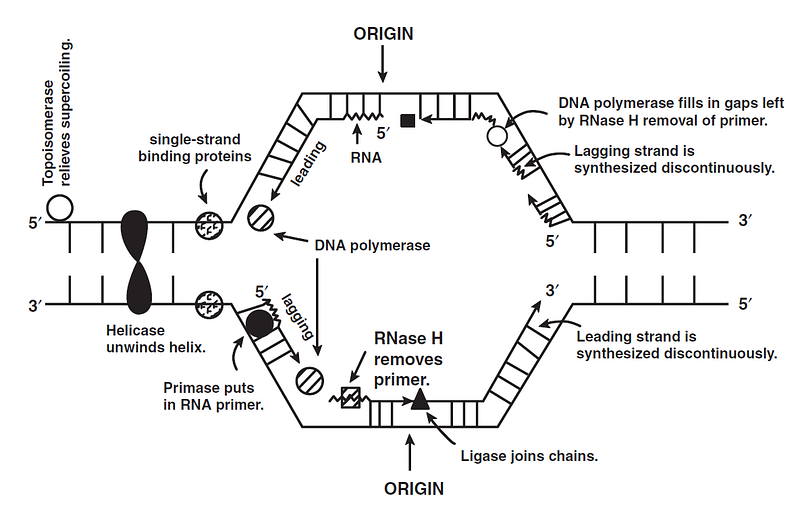
According to the term, the initiation activity means the stage that initiates the replication process. The starting point of replication, as known as the point of origin, will be recognized by some regulatory proteins. Then the double helix of DNA must be unwound into a single strand of DNA by an enzyme called unwinding enzyme and after that, the DNA will form a structure called a replication fork. That’s where the synthesis of daughter strands takes place by an enzyme called DNA polymerase.
Furthermore, the elongation stage is played by a replisome in the form of protein complexes. Replisome is associated with a particular site of the replication fork and it will move along DNA. As the parental strand separates, the daughter strand will be synthesized. In the last stage, the termination stage, an enzymatic reaction will stop the replication process at the termination site. Once the entire genome is duplicated, only after that the cell will continue the process of cell division.
It is through this replication process that genes multiply and pass on the traits to the offspring.
If the genes of the parents are replicated, then it will be passed down to the offspring, and the process is always like that since the beginning, how can there be the diversity of organisms? Even in the same species, there is always a difference between individuals.
What causes the variation of organisms?
As stated before, the fidelity of a gene or DNA inside a genome must be maintained, otherwise, mutations can lead to morbidity or mortality. So, to ensure the fidelity of DNA, there is a proof-reading process that ensures the fidelity of DNA, perform by DNA polymerase enzymes during every replication process. But, on the other hand, variation of DNA must occur, otherwise, there will be no evolution, no variation of organisms.
Well, we call it the recombination process. When spermatogenesis (the formation of sperm) and oogenesis (the formation of ovum), the DNA can swap positions. Maternal DNA (from the maternal chromosome) and paternal DNA (from the paternal chromosome) will “cross over” or exchange the position of DNA from each other. This mechanism causes variation. Every sperm and ovum will pass the genetic material that has gone through the crossing-over mechanism.
However, mutations can cause recombination also. Mutations themselves in genes can be caused by the effects of damage due to X-rays, chemicals, and other external factors. Mutations that do not cause significant morbidity or mortality can be maintained in the genome and will be passed down to the next generation.