
What A Bestselling Author Learned From Paying $50,000 To Go Back To School To Study Writing
Her new book ‘Class’ shows why it didn’t turn out as she’d expected while cleaning toilets for $9 and hour

Call it “Stephanie Land’s Sophomore Slump.” Or “Maid 2: From Neat Memoir to Messy Sequel.” Or “What Can Happen To Your Writing After You Have A Bestseller Made Into A Netflix Miniseries Seen By 67 Million People.”
By whatever name, Land’s new book earns a much lower grade than her hit memoir Maid, which recalls her bruising efforts to raise a child as a single mother earning $9 an hour as a housecleaner in the Pacific Northwest.
Class has had decent reviews and become a Good Morning America Book Club selection. But it may never have recovered fully from its troubled beginnings.
Land told the Washington Post that in early 2020, she signed a contract for a book of narrative nonfiction inspired by her brutal hardships. But she had writing problems that persisted after the launch of the Netflix adaptation of Maid in the fall of 2021.
“I’m not a journalist — I don’t even know the code of ethics for all of that — so it was this really intimidating thing,” she said. “So right after the Netflix series came out, I was prepared to tell my editor: ‘Look, I can’t — I can’t write this book. It’s not going to happen.’ By that time, I’d been blocked for a couple of years and I didn’t really see that improving.”
Along the way, Land switched publishers, and the Netflix miniseries of Maid proved so popular that her editor told her she didn’t have to stick to the plan for the sequel: She could write whatever she wanted.
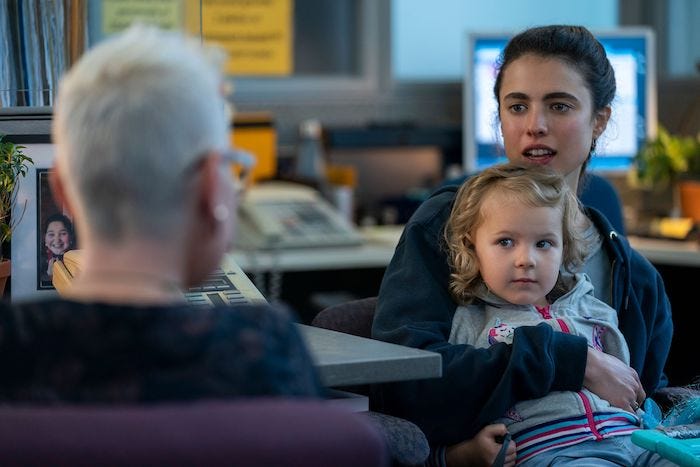
Land chose to write about her senior year of college because, she told the Post, “it was probably the hardest year of my life.”
More than a decade earlier, she had moved from the Pacific Northwest to Montana for two reasons. She wanted to put more distance between her young daughter and the child’s father, whom she saw as a malign influence. And she hoped to pursue her dream of becoming a writer by studying creative writing at the University of Montana in Missoula.
In Class, Land describes how, in her mid-30s, she reached her goal of earning a bachelor’s degree in English, and the story might have been a heartbreaker. It tells how a fiercely determined single mother scraped together the $50,000+ cost of her education with a shaky mix of loans, grants, food stamps, and more, including part-time work as a maid.
Amid all of it, Land had an abortion and became pregnant with a second daughter, born soon after her 2014 graduation. She dealt with hunger, panic attacks, severe scoliosis, post-traumatic stress disorder, and child-support disputes with her ex. Montana temperatures could plunge to 30 below zero in winter, and she could heat one of her apartments to 50 degrees only with help from three space heaters.

You have to sympathize deeply with her pain and admire her grit and willingness to help expose the causes of the oppressive debt carried by millions of college graduates. But how she tells her story — and whether you can believe all of it — are another matter.
In an author’s note, Land says she has changed names and identifying characteristics, “compressed” time and events, and “approximated” dialogue. Those techniques are fair in creative nonfiction if you disclose them up front as she has.
But even reconstructed events need to be credible and well told, and some of Land’s are neither. In one scene she recalls a meeting years ago with a faculty adviser whom she later accuses of sabotaging her application for graduate school. Land writes of the professor:
“She reached for a piece of fuzz on her slacks, picking it off and smoothing the fabric before crossing and uncrossing her feet again.”
How many of us could recall, years later, the exact moment in a conversation at which a professor picked fuzz off her slacks?
Land may well have notes or a memory that allowed her to do that. In context, however, the line doesn’t ring true and serves no useful purpose.
Her writing can also be clunky or overwrought, relying too heavily on speech tags like the cloying “he chuckled.”
Land says her dream of going to college was “one that I questioned if it was affordable to act on” instead of “I questioned if I could afford it.” Sex involved “a delicious burst of tingling warmth deep beneath the surface where his pelvis kept colliding into mine.” You will not be surprised to hear that she “nearly yelled out” a “YES” afterward.
Kafka-esque battles to claim government benefits
The most valuable parts of Class describe Land’s financial perils, including her exhausting, Kafka-esque battles to claim government benefits available to the working poor. With some cynicism and bitterness, she describes her efforts to qualify for federal aid and the shame its use can involve.
One setback occurred when the government kicked her off food stamps after her daughter turned six years old. A rejection letter explained why: Her child was now school age, which allowed her work full time. Never mind that Land had five classes a week, for 15 credits, or that her daughter was in school for only six hours a day.
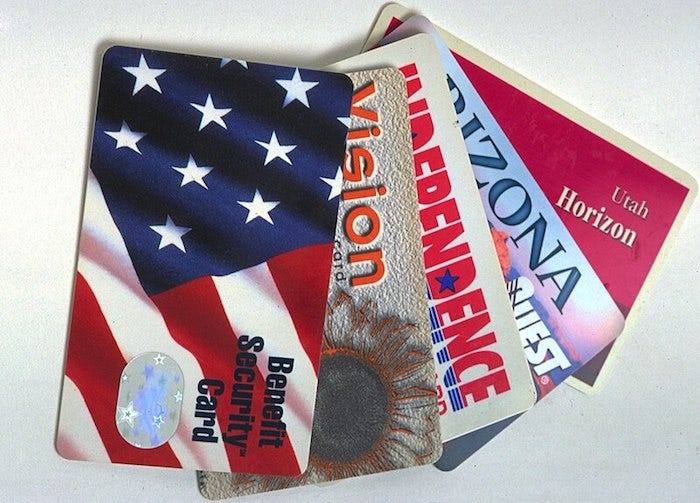
At the end of a month, Land often had only 10 dollars in her bank account and she and her daughter relied heavily on peanut butter. She writes:
“Long-term financial planning is for people who aren’t living in poverty. I didn’t have the time or the energy to calculate how much debt I was in or how much interest I paid every month or how much interest I would pay on my student loans….All I cared about was a continued ability to feed, clothe, and house my kid.”
Land had hoped to get a Master of Fine Arts degree at her university, and late in Class, the program rejects her. She says she knows “with certainty” that her pregnancy with a second child caused her adviser, whom she repeatedly names, to sink her candidacy.
If that’s true, it would hardly be the first time that faculty sexism has hurt a female student. But the professor is among the people Land thanked in the acknowledgements to Maid for “patiently ushering and guiding my written words into coherence with the utmost encouragement and empowerment.” And her inconsistent portrayals of the woman suggest that she hasn’t fully grasped that memoirs, like narrative nonfiction, have what she called a “code of ethics.”
More significantly, to judge by Class, there’s a reason besides sexism why Land might have been rejected by the highly competitive Montana program, which accepts about 1 in 10 applicants: She lost out to better qualified writers.
Her account of her rebuff is one of many in which the facts don’t quite add up or her interpretation of them suggests a lack of self-awareness.
The better writing in Maid may reflect that its publisher held her to a higher standard than did that of Class. Or the new firm may have rushed the new book into print prematurely to cash in on the success of the Netflix series. Either way, if Land had made it into an MFA program that provided more training, a better book might have resulted.
Jan is an award-winning critic and journalist who has been the book columnist for Glamour and the book editor of a large U.S. newspaper. She has taught writing at two major American universities.
You might like another of my stories about making a living as a writer:


,_01.jpg)
.jpg)