
What I’ve Learned From Attempting The Most Difficult German Language Exam Without Any Preparation — And Failing It
I thought living in Germany for 7+ years would be enough

Want to prove you master a language at an advanced level? Opt for a C2 exam.
Certificate holders gain smoother access to universities and jobs. They also have an easier time assimilating in a foreign country.
I thought getting the German Goethe C2 certificate would be doable without too much effort. Especially since I’ve lived in the country for 7+ years.
I failed, so I bit off a larger part of the Bretzel than I could chew.
Here’s what I’ve learned after attempting (and failing) the German Goethe C2 test.
Background
My background in learning German
I “studied” German in high school and university, but I wasn’t exactly a model student who did her homework. I did the bare minimum to get by. As a result, my German barely improved, even after a combined 8 years of language studies.
Upon graduating from university, I spoke German at a solid C1 level — on paper.
This didn’t match reality.
My experience living in Germany and learning German
When I first arrived to Germany in 2015, I deliberately took on translating jobs. I translated German blogs, social ads, newsletter texts, and whatnot into English or Dutch.
I saw these jobs as a tool to get paid to improve my language skills. And it’s cheaper and possibly more effective than any language course.
Practicing the language “on the streets” also helped me understand it faster. I forced my first flatmate to swear they’d only speak German with me. I pledged to never speak English in the supermarket, when asking for directions, and visiting the doctor’s or dentist’s.
As a long-term or permanent immigrant (let’s not be elitist and call ourselves “expats”), assimilating remains a challenge.
- Folks are quick to switch to English the second they hear an accent
- Not everyone has the patience to tolerate your accent, or hear you battle it out with the German cases
- You’ll always be somewhat of an outsider, wondering about those insider jokes, and forever learning about a country’s customs and cultural tendencies
Why I decided to take the Goethe C2 test
In 2017, I held a job as a German-to-Dutch/English translator.
I spoke German with coworkers every day. Business correspondence in the chats, in meetings, and in emails: everything was in German.
The constant, daily exposure to the language gave me the idea to attempt a Goethe C1 exam. I didn’t prepare a thing and basically winged it.
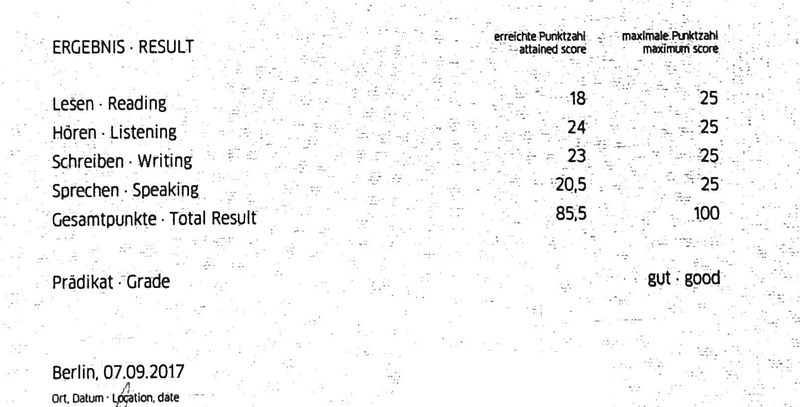
Fast forward 5 years.
I assumed I could replicate this success with the C2 test.
But, I hadn’t been conversing in German with people that much. I had one German friend I occasionally spoke to. I got fired from my previous job because my German wasn’t good enough. And the depth of conversation on the streets never goes further than, “Would you like the receipt?”
I had 5 clear reasons why I wanted to reach for an advanced certificate.
- Finally feel comfortable speaking German. German and Dutch are Germanic languages. They share similarities on vocabulary, verb conjugations, word order, sentence structure, and grammar. The list goes on. You’d think this makes it easier for a Dutch speaker to master the German language. Yet, German is the only language I still feel uncomfortable with. And after 7+ years in the country, it’s getting boring.
- Get access to better jobs and projects. A C2 certificate is proof to potential employers and clients that I’m an asset to their workplace or project. With the certificate, I can back up my claims of knowing how to communicate in their language. This makes their lives easier and me a more attractive candidate.
- Stick it to a German ex. The veins on their head nearly exploded each time I opened my mouth. They couldn’t endure my accent. Should we ever speak again — which I doubt — I want their veins to explode because my language skills have exceeded theirs.
- Extrinsic motivation to force me to study. My language skills are more than good enough to “survive” on the streets. But with this language exam, I needed to break through to the next level.
- I desired an ego stroke. I’m not going to lie: adding language certificates to the list makes me feel good about myself.
Attempting the Goethe C2 test without preparation
Why I didn’t adequately prepare for the test
Firstly, I was being lazy.
Secondly, I was delusional about my skills.
As the exam date crept closer, I kept telling myself I’d start preparing, but I never did.
Tuesday was test day. I took Monday off work to have a long weekend to prepare. But starting to prepare for a big test 1 or 2 days in advance is too late. Especially if you’re supposed to start months earlier.
The night before, I barely slept. I wanted to bail but had already paid the exam fees. I knew I probably wouldn’t pass the exam. But since there was nothing to lose, why not try?
My thoughts and feelings during the test
- I’m so screwed.
- I definitely should have prepared.
- I flushed my money down the drain.
Failing the test
My Goethe C2 test results and how I felt about them
You need at least 60 out of 100 points to pass each module.
My scores:
- Reading: 72 ✅
- Listening: 44 ❌
- Speaking: 45 ❌
- Writing: 56 ❌
That means I only passed 1 module.
Not surprisingly, it’s reading. I’ve read ungodly amounts of books as a child. I still read for fun and find it easy to get absorbed in a good read.
There’s nothing umgangsprachlich (colloquial) about the German you hear during the listening exercise. It’s complex, long-winded, and covers current topics you won’t know of — unless you’ve been listening to podcasts or the news.
I have a thick foreign accent and feel most uncomfortable speaking. And avoiding practice is *not* how you improve a skill.
Writing is not that difficult for me. Had I taken note of the exact formats the exam officials wanted to see, I would’ve had a higher chance of passing this part, too.
Lessons learned
This piece is for those who think they can just wing it.
Maybe you can, but be sure to assess where you’re currently at. Or you’ll be wasting your precious cash on the expensive exam sign-up fees — as I did.
Living in a foreign country alone isn’t guaranteed to improve your language skills by miles.
Without intentional, regular practice, those skills are more likely to stagnate. Also, spoken fluency on the streets doesn’t translate to success on a standardized language exam. It’s more helpful to approach this strategically. Or at least go through a mock exam once a week.
During the next attempt, I’ll be sure to take the test seriously.
That includes making a study plan that covers each area on the exam, sticking to it — and starting a little earlier than 1–2 days in advance.

Become a Member and binge-read my dating rants, relationship reflections, side hustle failures & wins, and comics illustrated by yours truly, for only $5 (affiliate link).
Already a member? Sign up for email updates to never miss a story.


