
What I’ve learned about UX blogging in the last two years
And some thoughts for those too scared to do it
I thought I’d finish up 2021 with a meta-blog — a post about blogging. But not one of those “how to <blah blah> on Medium” things, but rather specifically about the experience and value of writing about the industry we call UX.
I didn’t start blogging until 2020 — many years into my UX career — because I was intimidated by the types of people who rant on LinkedIn about how right they are about everything.
Today I mentor many young UXers who are as scared as I was to start writing. This post therefore, is about not waiting 15 years to find your voice.
Don’t wait 15 years to find your voice
Regular readers will know how I came into UX and my own challenges with imposter syndrome. Whether you are experienced-but-imposting, just starting out, or somewhere in between with more focus on your craft than your ego, one look on any social platform, at the range of shouty UX persons expounding their absolute authority, is enough to send anyone back to their whiteboard / laptop / design file / battered copy of About Face.
But there are immense benefits to writing publicly about the work we do, which is why I spend a fair amount of time in UX mentoring sessions trying to help young’uns do it for themselves.
Note: if you are actually considering writing about UX in order to become internet famous and add to The Shouty, this article probably isn’t for you.

Why should you write about UX?
Anything you write will add to the body of resources available on the internet for the people trying to make things suck less for users.
At the same time, writing helps clarify the UX knowledge in your head, how it is structured and the way it makes sense to you — your individual mental model and schema of all that is UX.
It also makes you a better communicator. Because ultimately in UX work, your job is not to make everyone think you are clever — but to make everyone understand what on earth you are talking about.
And let’s be super clear on this — you do not need to be senior or have a specific and impressive job title to write and contribute to our industry.
What should you write about?
There are so many topics and sub-specialisms in UX world, you could literally write about anything from strategy, to research, to design and beyond.
You could write about your actual day-to-day work (unless you are under NDA, but even then there are ways), or topics you know the most about, or things you are trying to understand.
The main two things are to write about something you care about, and to make sure you research it and use references. This will help the credibility of your article, and grow your brain at the same time.
How can you make it less scary?
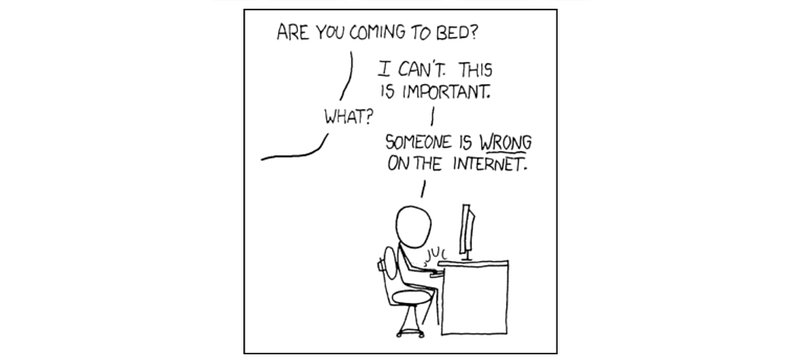
Notwithstanding the benefits and opportunities of writing about UX online, there are some pitfalls that come with the territory. Yes, most UX people are lovely, especially in person, but on the Wild West of the internet it’s natural and sensible to think about what and who else you might encounter.
Here are some of the things mentees and newbies have asked me:
- What if someone writes an attack in response to my post?
- What if lots of people fundamentally disagree with me?
- What if… (yikes) .. I’m wrong?
- What if everyone realises I’m junior?
- What if someone says I can’t write?
There’s no quicker way to kill the enthusiasm of new UXer, or new writer, than sh1tting all over them, and from what I’ve seen, the UX industry of the internet does not think before it sh1ts.
So I say to everyone — if you want to write, write.
But be aware that writing is inevitably putting yourself out there, whatever your topic of choice. So consider how you can make it safe for yourself as well.
Here are some thoughts:
- Start with writing about what you know best — Pick a thing you really know, that you have the most experience of or that you think is quite niche. Even the most junior-junior knows things this old sea dog still doesn’t after 15 years. This will build your confidence initially. Check online first to see who else has written about this and work out how you can add to that knowledge rather than repeating it.
- Be humble — You know something, but you don’t know everything. Write accordingly. Don’t try and be the world’s biggest authority, because someone will come along and correct you pretty swiftly.
- No one knows everything — Just because someone comments, contributes or challenges you doesn’t mean they are right. But they might know more than you. Check out what they propose as an addition to your thinking and if it checks out, consider it a build on your knowledge. But don’t take everything as an automatic correction just because it comes from outside you or someone apparently more senior or experienced.
- Senior people also don’t know everything — It doesn’t matter how mcuh experience you have, you can’t be right about everything. And there are ways to guide the less experienced with empathy (who’d have thunk) rather than arrogance. Personally, I’ve interviewed and hired enough impressive looking CVs to know there’s often a lack of substance underneath. Don’t take someone’s seniority at face value or their comments personally.
- Be clear what is/is not opinion — It’s ok to have an opinion, but be clear what it is based on, e.g. experience, evidence, hypothesis or assumption. This will prevent you from over-claiming something you can’t back up.
- Write what you don’t know, honestly — If you don’t have evidence or experience of something, say it clearly. Even better — do some investigation and write about what you find. Not every article has to be The Ultimate Answer. Lots of mine are just asking and exploring a question for my own entertainment.
- Get someone to review your draft — The industry is full of nice people who want to help, despite the impression I may have given above. So if you are writing outside of your comfort zone and have reached the end of available evidence, or if you just want someone to sense check your writing skills, ask someone to look at it before you hit publish. You’ll learn, and you’ll feel more confident.
- Choose your platform — I write on Medium for many reasons, one of which is that it’s fairly anonymous and I’m among a zillion other UX bloggers. I’m not a big shiny target for everyone to attack. I don’t write on LinkedIn because it is literally the compete opposite of that.
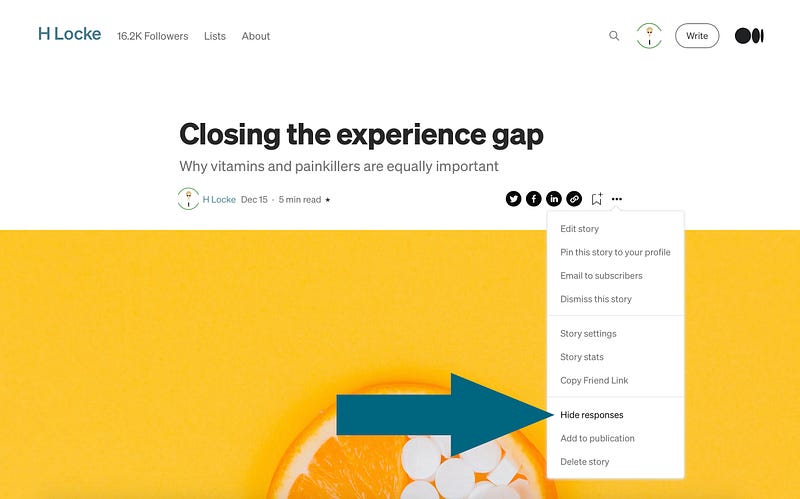
- Disable comments — Yes, it’s lovely to get people saying “love this” repeatedly, but positive or negative, the feedback will impact what you write, how you write and if you write. Choose a platform where you can turn off comments (as well as your narcissistic need for validation) until you are ready to handle the consequences. I’m still doing “hide responses” on Medium 2 years in and it’s one of my favourite features.
Be clear on your own motivation for writing
The most important thing is to know why you are writing and who you are writing for. Not because it helps drive traffic and all that marketing BS, but because it helps keep you focused on your goals, not everyone else’s responses.
For myself, I started writing because it was so much easier to send my mentees and colleagues articles about basic concepts I needed them to get their heads round, than to keep scheduling one-to-one sessions.
Also, I wanted to have a space to increase and iterate on my own understanding of certain areas of UX.
Using blogging as a platform over the last two years has had several positive outcomes for me:
- It helped clarify the key concepts I wanted to share in my own brain
- It made me better at explaining things to other people
- It helped me to expand on my knowledge of those concepts as I went through various resources and references
- It made me feel like I was still learning, even though at some points it seemed the world had Covid-stopped
- It showed me how each UX topic was connected to another through both cross-referencing and sharing
- It gave any person I was training plenty of time to read potentially difficult concepts at their own leisure rather than us attempting to stuff it all into their brains at once
- It allowed for follow up questions from both sides, which improved both my understanding and theirs
- It levelled-up all my in-person mentoring conversations, because I could get both of us into the same mental model before a session, and gave me material to share afterwards
- It built my network and discussions with people who know far more than me — who kindly read my drafts and tell me when I’m wrong (or being a d1ck) in a constructive way.
- As a side-effect, some other people on the internet tell me they find these ramblings useful, and I’ve met some new and interesting people who I’ve occasionally been able to help in turn.
But let’s be clear, I’m still not writing for the shouty people. And I hope never to be one of them. I’m writing for the newbies and students of all levels. and my for my own ever-learning brain.
I’m sure there are people shouting somewhere, I just can’t hear them.
I appear to have accidentally written 100+ articles on many areas of UX — from career development, to IA, prototyping, UI, research methods, the perils of marketing and more. If you’d like access to the full archive, you can join Medium — which also gives you access to everything on the whole of the Medium platform.
Or you can sign up to receive emails when I post new content, which is usually somewhere between 2–5 times/month.
Thanks for reading. Have a lovely end of 2021, whatever you are doing. It’s time to put the post-its down and take a break.