
How anyone can develop a rounded UX skill set
Welcome to the 360° matrix
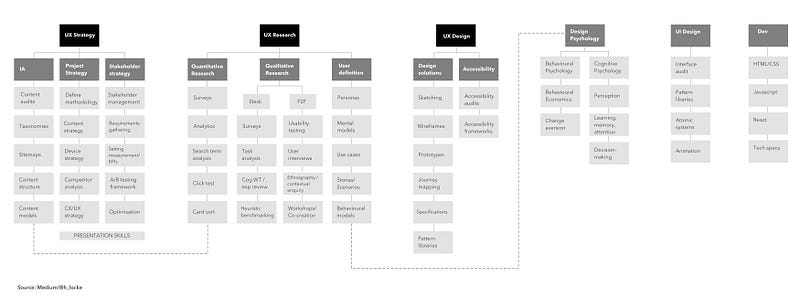
Anyone who has worked with me will have heard me bang on about what I call a 360.
What is a 360?
A 360 is a UXer who has moved outside of one core capability — UX Design, UX Research, UX Strategy, IA, UI and so forth — and has trained themselves, or gained experience, in other areas. They can face into a project from any angle; 360°.
Of course this is not essential in order to work in UX, and specialists are extremely valuable on specialist tasks or highly complex projects. However being a 360, if you so choose, makes you more valuable to an employer, to the rest of your team or as a freelancer — because you can take on more projects and deliver credible and in many cases, excellent results.
How do you get there?
It’s hard work to become one and it’s hard work to train one. But as a hiring manager, you won’t be able to buy them in unless you have All The Money. And as a UXer, why wouldn’t you want to get better at your craft and make All The Money.
Here’s how to round out your UX skill set — without going back to University.

1. Create a skills matrix
Create a chart of all the skills to reflect what you see existing in your UX ecosystem. You can see the one that I made above, but yours might be more dev focused, or more agile focused, or more UI/creative focused. Just remember to map out all the skills you see around you — not just the ones you do every day.
You can do this with pen, or whiteboard or software of your choice. It really doesn’t matter.
You’re welcome to use mine as a baseline if you get stuck.
Make a list of all the skills you think apply or could apply to your UX world. Then perform a card sort, and create a hierarchy or taxonomy (yes, you are doing Information Architecture now. See, I told you it was important). Then turn it into a chart, or what I call, the matrix.
2. Identify where you want to be
Imagine where you want to be on that skills matrix. It’s ok if the answer is “all of it”. Ambition and passion is good.
3. Grade yourself
Use a traffic light system, or code 1–3 (keep it tight, no wiggle room) which reflects your CURRENT ability for each skill in your matrix. Judge your own level by your own standards, or have a line manager or respected peer help you. (If you are male, be more critical of yourself — if you are female, be more generous. Evidence says you need to.)
4. Do a gap analysis of your team or peers
Now do the same for people on your team. Be careful not to let your bias come in here. Again, use a line manager or colleague to help you — you are not critiquing them, you are assessing where your own opportunities lie to learn and grow.

5. Prioritise your first set of target skills
Take the gap between where you are and where you want to be, and take the gaps of knowledge in your team and work out which incremental skills on the matrix. Now you are going to choose
A) Low hanging fruit — 1-2 skills which:
- Will take you in the right direction towards your overarching goal
- Will complement your existing skills
- Will be most likely to generate on-the-job opportunities to practice what you learn in theory
- Have others on the team already got, so that they could support your learning
B) Harder to reach — 1 skill which:
- Does not already exist on your team
- Has an opportunity to add value to a current or future project
- Has a tangible output you can show the rest of your team
- Will stretch you outside of your current skill set.
Example:
I am a researcher. Therefore I will develop:
A1 — Strategic skills to design relevant methodologies across the whole project, to support the sales/stakeholder team
B1 — My understanding of conversational design and start building prototypes to show the team
If you are super geeky, you can plan activities and subjects you intend to study into some kind of calendar. This ensures that you are accountable for your own progress and aware that time is slipping by.

6. Identify the best tools to help you learn
Once you have your list of target skills, start looking for tools that can help you learn. For each subject matter there are different courses, websites and articles available — many for free. There are also nice people on twitter and linked in who might let you buy them a (virtual) coffee for a (remote) opportunity to pick their brains.
And as for books, fortunately past H has already provided you with a very long list of books by subject. You’re welcome.

7. Study your ass off
This is the bad news guys, you still have to insert the information into your brain, and find ways to practice until you gain a certain level of competence. Once again, hard things are hard.
8. Track your progress
Now this is super important — you need to track your progress. Not just that you are studying, but also whether you are getting practice and whether you are turning those traffic lights from red to amber to green.
You can only judge your progress by your own standards, unless you’re lucky enough to have a mentor supporting you.
I recommend for each skill you tick off yourself when you have:
- Consumed and read the theory (at some point, stop)
- Practiced the task once
- Practiced the task twice
- Done it live on a project (that someone has paid for and signed off)

Remember, that you are entirely in charge of your own fate — your own learning speed and your own accomplishments. No one else is going to shove stuff in your brain for you, or give you an opportunity on a silver platter.
Good luck out there. I look forward to hiring you one day for All The Money.
If you found this useful, consider subscribing for free to get email alerts when I post new articles, or you can join Medium for full access to my article archive, plus everything else on Medium.
SEE ALSO: Avoiding UX learning burnout.


