avatarH Locke

Free AI web copilot to create summaries, insights and extended knowledge, download it at here

1913

Abstract

">Not at all. This is not someone who blags their way across multiple skill sets. This is someone who applies concerted effort to the development of their skills and knows their own limits on each one. They know when to say <i>“this is a specialist task — it’s not me”.</i></p><p id="030d">However, it does mean that they have the following:</p><ul><li>A thorough awareness of the full skill set and the interdependencies between them</li><li>Strong empathy for everyone’s role within the team</li><li>Humility regarding their own strengths and weaknesses</li><li>The ability to switch roles from project to project without missing a step</li><li>The ability to answer stakeholder questions with confidence even if outside their current role but again, to defer to others if the subject is too specialist</li><li>The ability to continually learn from others</li></ul><figure id="d607"><img src="https://cdn-images-1.readmedium.com/v2/resize:fit:800/1*FVj9FlFkJab-tMQlnO-RMw.jpeg"><figcaption></figcaption></figure><h1 id="c150">How do you get these people?</h1><p id="da0b">You need to <a href="https://readmedium.com/how-anyone-can-develop-a-rounded-ux-skill-set-7269d4f985e0">train these people and do it well</a>. As I say above — you cannot buy decent 360s off the UX market. If they are cheap they are lying about their abilities. If they are that good, you won’t be able to afford them as permanent staff, and they’ll be frightfully (and rightfully) expensive as freelancers.</p><p id="11f8">The easiest way to build a team of 360s is the following:</p><ol><li>Get one person who is already (or nearly) a 360 to lead the practice</li><li>Build a team beneath them who are partial 360s (1.5–2 core areas already) to cross-train.</li><li>Have juniors coming up from the bottom who are trained across everything from the start.</li><li>Have clear development plans for each individual</li><li><a href="https://

Options

readmedium.com/how-anyone-can-develop-a-rounded-ux-skill-set-7269d4f985e0">Train the hell out of yourselves individually and as a team</a>.</li></ol><p id="e02b">Note: if you’re hiring people, they need to have the correct <a href="https://blog.prototypr.io/shuhari-and-the-mastery-of-the-ux-skillset-9190be1e1b11">attitude towards learning</a>, some <a href="https://uxdesign.cc/why-ux-practitioners-need-resilience-and-how-to-get-more-of-it-5c5b57c44971">professional resilience</a> and <a href="https://blog.prototypr.io/what-makes-a-valuable-ux-designer-9ef18be9f3c7">a collaborative mindset</a> or this simply will not work.</p><p id="6d57">Here’s an example of building such a team from four people. As you can see there are gaps, but the purpose of each individual’s training and development plan is to gradually move them into those gaps.</p><p id="c3e3">And yes, I’ve done this. It took 2 years of careful hiring and training but they were the best team I’ve ever had.</p><figure id="73c5"><img src="https://cdn-images-1.readmedium.com/v2/resize:fit:800/1*PUBgqqTZ0XKOXi6m9dyf_w.jpeg"><figcaption></figcaption></figure><p id="ecb3">Think of the team as a set of elite tools in a very excellent box. You could have one tool for every possible task, or you could have a small set of Swiss Army Knives who each have a slightly different set of attachments. And the good thing about them is that, with care and effort, you can always add more.</p><p id="b93b">But if you do it right, from a team of 4 core practitioners — you should be able to almost handle any project.</p><p id="7aec">If you found this useful, consider <a href="https://medium.com/subscribe/@h_locke">subscribing for free</a> to get email alerts when I post new articles, or you can <a href="https://medium.com/@h_locke/membership">join Medium for full access</a> to my article archive, plus everything else on Medium.</p></article></body>

Building a UX team from scratch

The minimum viable skill set

First off, let me say that I love a specialist. I love the amazing Information Architects I’ve seen solve insane content problems, and the brilliant researchers who can do 8 hours testing and not get Research Brain.

However, I’ve only ever really encountered them on long-term stable projects where the resource requirements are known for at least 6–12 months ahead.

If, like many agency or in-house teams you need one core team of permanent UX staff who can flex across multiple projects, with a sensible staff cost and the minimal possible utter screw up of the project work, then you need what I call a 360.

What is a 360?

A 360 is a UXer who usually has one comfort zone (say UX Design), but has grown themselves (or been taught) beyond that original skill set. They may have trained and practiced incrementally in user testing. They may have a good understanding of the theory and concepts of IA. Ultimately, they can take on multiple roles across multiple projects. They can face into a project from any angle; 360 degrees.

Jack of all trades master of none?

Not at all. This is not someone who blags their way across multiple skill sets. This is someone who applies concerted effort to the development of their skills and knows their own limits on each one. They know when to say “this is a specialist task — it’s not me”.

However, it does mean that they have the following:

  • A thorough awareness of the full skill set and the interdependencies between them
  • Strong empathy for everyone’s role within the team
  • Humility regarding their own strengths and weaknesses
  • The ability to switch roles from project to project without missing a step
  • The ability to answer stakeholder questions with confidence even if outside their current role but again, to defer to others if the subject is too specialist
  • The ability to continually learn from others

How do you get these people?

You need to train these people and do it well. As I say above — you cannot buy decent 360s off the UX market. If they are cheap they are lying about their abilities. If they are that good, you won’t be able to afford them as permanent staff, and they’ll be frightfully (and rightfully) expensive as freelancers.

The easiest way to build a team of 360s is the following:

  1. Get one person who is already (or nearly) a 360 to lead the practice
  2. Build a team beneath them who are partial 360s (1.5–2 core areas already) to cross-train.
  3. Have juniors coming up from the bottom who are trained across everything from the start.
  4. Have clear development plans for each individual
  5. Train the hell out of yourselves individually and as a team.

Note: if you’re hiring people, they need to have the correct attitude towards learning, some professional resilience and a collaborative mindset or this simply will not work.

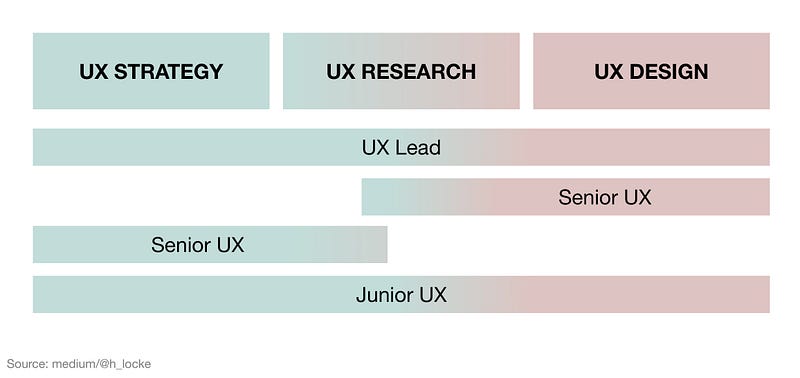
Here’s an example of building such a team from four people. As you can see there are gaps, but the purpose of each individual’s training and development plan is to gradually move them into those gaps.

And yes, I’ve done this. It took 2 years of careful hiring and training but they were the best team I’ve ever had.
Think of the team as a set of elite tools in a very excellent box. You could have one tool for every possible task, or you could have a small set of Swiss Army Knives who each have a slightly different set of attachments. And the good thing about them is that, with care and effort, you can always add more.

But if you do it right, from a team of 4 core practitioners — you should be able to almost handle any project.

If you found this useful, consider subscribing for free to get email alerts when I post new articles, or you can join Medium for full access to my article archive, plus everything else on Medium.

UX
Management
Ux Strategy
Recommended from ReadMedium