
TECH
What Is Web3? And 7 Reasons Why Web3 Will Change the World
Progress all around
People are always a bit surprised that I have such a positive outlook on life. Well, we made a mess. But Gaia and evolution will solve the mess one way or another. However, I can’t wait for that, so I am busy helping her in any way I can.
Web3 is such a way. And I get many questions about what it is and why it’s important. Tim Knowles asked me to tag him in my story about Web3. Here it is. Mostly the question goes a bit like this.
“You are in nature-based solutions, Desiree. Why Web3? Why tech?”
People don’t see how tech will make a good world for all our grandchildren. Tech for many people in my tribe is a dehumanized way of living life with AR/VR and metaverses selling them stuff they don’t need.
This is how I see it.
I’ll explain the terms. And give 7 short reasons why Web3 is the most important changemaker of all at the end of this story.
Ask me questions about details if there are parts you don’t understand. Because there’s so much to tell.
And I really don’t know how much you already know… Have a look at our YouTube channel Abundance 4 ALL for more explanations.
Citizens First
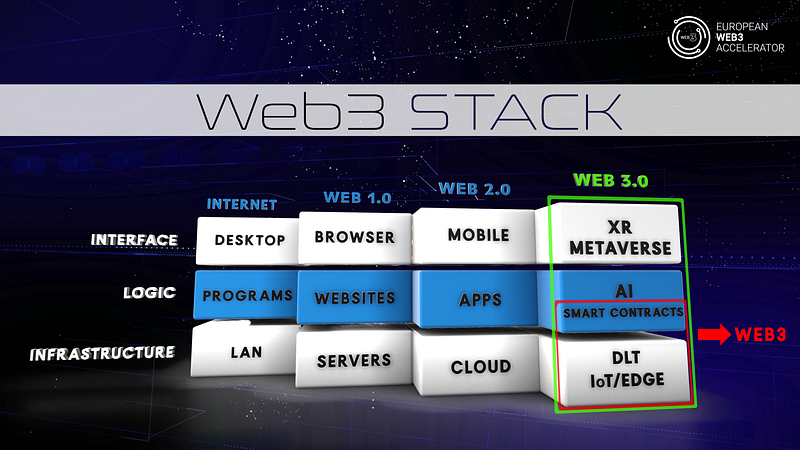
Let me explain some terms first. A picture says a thousand words. The picture at the top of this article is made by my partner in Blue Hearts Network, Tom de Block, and his team of experts.
Tom is the Chairman of the Alliance of IOT and edge computing. AIOTI in Brussels.
Some people forget that the internet has not been around for so long in life. When I started my professional life, we still had telex. Then came the fax. I saw the first computers appear with MS-DOS. MS-DOS was an infrastructure (an information road) operated on a LAN. Local Area Network. Old-fashioned like hell… Really hell…
It worked with codes we had to put in ourselves.
Lots of remembering codes…
Computers were big boxes of hardware back then. Very unstable in their software. Lots of waiting and crashing and losing my work. Printers were making lots of noise and the paper had strips with holes at the side you had to rip off.
And phones were still the kind with a cable and a turning disk with holes to put your finger in. The first mobile phone I remember well. It was a ‘car phone’. Super heavy and big in my car. But you could at least carry it with you… Mobile… Look at where we are now.
The best things in life have minimal material and are light…
Internet, virtual, and openness are changing the world big time. We see what before we could not experience. We have to get used to openness especially. Live with it. Integrate it into our meaningful lives.
Openness is here to stay…
No use being Don Quixote and fighting windmills…
Governments try to curtail us all now by making a Big Brother kind of 1984. It’s a first reaction to gain control of what is unknowable. The future. But it’s stupid of course. And unfair. Citizens are intelligent people. And we have the same openness and knowledge now that the government has.
We just learn from YouTube…
People like Julian Assange are big heroes from my perspective. Whistleblowers. Flipping the coin and using openness against manipulating, corrupt govs to educate other citizens.
In Holland, we have a journalist platform Follow the Money. Money trails don’t lie. Corruption and stupid gov decisions are finally getting out in the open…
We just have to decide for ourselves what’s common sense and what is not
All citizens are now busy opening the ‘beerput’ and letting the stink out. What is beerput (a hole full of shit) in English? Cesspool?
I at least know where my loyalty is.
I’m always on the side of ALL citizens…
Web 3.0 and Web3
Now, about Web3. It is the new internet. Embedded in Web 3.0.
Some people make it so difficult with all these terms, so then I’m happy with my friend Tom who makes everything clear in one simple picture.
Web 2.0 is clear by now? We all work with it, don’t we?
Mobile, apps, and cloud. The shift from Web 1.0 has not been totally finished yet, but it has come a long way.
Let’s have a look at Web 3.0 now.
Interface: XR and Metaverse
With XR we mean AR and VR.
AR = Augmented Reality.
AR is when images appear in the physical space next to us. We can look at virtual texts or images in front of our eyes. They are projected in space, not on a wall. I wrote about a whale coming out of a floor in Japan. Holograms. Normal in the future. And now used for immersive art, explanations in museums, and others.
We don’t need a wall to project images anymore.
AR can also be what Tom and I and our team do. We make an Ava, an Augmented Virtual Assistant you can load on your phone in an app. It works like the pokemon go games.
You can do quests. Collect goodies.
Combine challenges with education and inspiration.
You point your phone at something and Ava appears. She talks to you. You can talk to her. She’s funny. And smart… And we use her for education and inspiration. To connect the past to the future. What do I do personally?
I write the scripts. You talk to me behind the scenes. I’m on the team of Blue Hearts Ava…
In Greece, you can walk through the ruins and see how people lived. We can experience whole towns or ships. The Titanic…
We can learn from the past to create a good future…
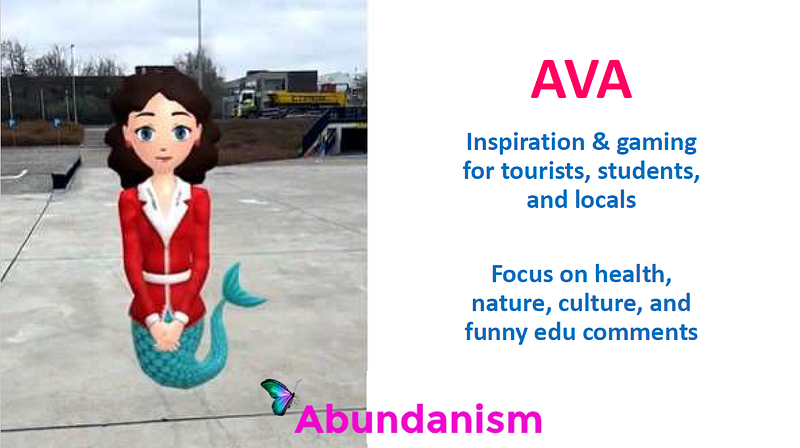
I also like the fact that still objects can come alive on your phone. You can point at graffiti of a dragon and the dragon starts moving on your phone. We can also make stuff appear out of nowhere.
Like the Blue Heart picture in this article.
VR = Virtual Reality
VR is one step further than AR. You need a headset blocking off reality. It is used to make immersive experiences and for trauma healing. People with vertigo step into the abyss in their minds without danger to their physical well-being and they heal their fears that way.
Metaverses = communities and online markets
You can get an immersive experience and you can interact with people and buy stuff. Facebook calls itself Meta now. They are building a version of a metaverse. A marketplace. A virtual market. But also the gaming giants and Jeff Bezos (Amazon) are into it the metaverses.
Many small metaverses have already appeared and I like them best. I’ll tell you some more about them soon.
AI = Artificial Intelligence
AI is a system (a big cloud of words and meanings coded in 1 and 0) that teaches itself to be smart. Machine learning. It is the bot that answers you in the helpdesk of any service provider nowadays.
She has preprogrammed answers and tries to be more specific every time in reaction to your human answers. She (AI) learns on the go. Like we do.
AI is for instance ChatGPT. A conversation you can have with your computer answering your questions.
AI is the words-to-image websites like Dalle-E and Nightcafe, StarryAI, and others
AI is used in all kinds of ways nowadays. My professional world is full of AI. We analyze, synthesize, and redesign complex systems. Qualitative human thinking first. Checking with AI to make sure we have not overlooked possible negative side-effects of a certain solution.
AI is a tool… Nothing more, nothing less.
Like with anything, you can use AI for good things and you can use AI for bad things. You can make drones to go to war. You can make drones to harvest food out of a food forest.
The latter is the good version and how we make sure the land will not be compacted any further so the microbes can breathe and they solve our nitrogen problems...
Smart Contracts = the transaction
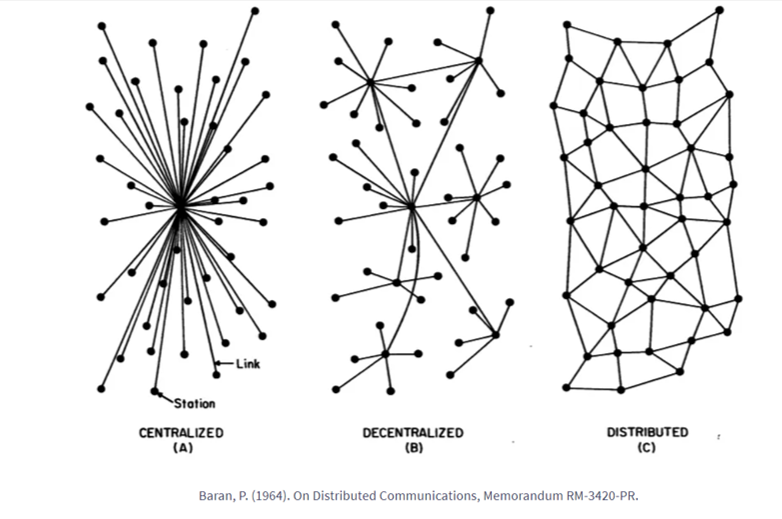
You can imagine that everything is action and reaction. Feedback loops. It can be about information. Or digital money. Smart contracts are agreements. The deals. The knots in the system. Here is a picture explaining the different ways to knot the knots.
Web3 & Why
Until this part, it’s called Web 3.0.
AR, VR, Metaverse and AI.
A bit confusing in terms, but Web3 is part of Web 3.0. And Tom and I and our teams are creating systems with Web 2.0 and Web 3.0 together. Combined with nature-based solutions, of course. Always ecosystem restoration in our projects.
We are living in complex systems on a complex planet. I’m a knowledge girlie and I love to have all knowledge handy. I ask questions all the time to my phone or computer websites or ChatGPT
… and poof… I know more…
It’s all about daring to ask questions
… and not being afraid to appear stupid…
I have never had that disadvantage. I don’t care what other people think of me. So, I just ask. I’m curious.
I also experience places I have never been to before. With Zoom/Teams/Googlemeet/Whatsapp we don’t have to fly so much.
Global trade can be done by computer. Global communication becomes easier with translating apps.
Babylonian speech problems might be in the past… Or are they…?
I do love it all though! It’s evolution. And the computer is like a chess partner. Looking ahead to the future. I look through the system and the confusing words, and I make my next move.
Prrrrrrrrrrrrr…. always on the move, purring like a catty with contentment.
I always have to think critically about what is true and what my next move will be in the real world, of course.
They want me to think Julian Assange is a State Enemy. But of course, he isn’t. He is just using planetary evolution (openness & systems thinking) against our manipulating governments instead of them using openness to control us.
That’s flipping the switch. Flipping the feedback loop. For me, Julian is a hero! But if you disagree, I’d like to hear your comments of course.
Computers make it possible to finally combine biological, physical, and virtual. And the world is dynamic and volatile because of it. Openness. We have to deal with it as we deal with all other challenges. Floods. Wildfires. Hurricanes. Compacted soil. Dirty drinking water.
We are all just looking at the same horizon from a different angle.
It’s as if the world has fastened its pace and leveled up the game of living meaningful lives. I like a challenge.
Let’s do the next level!
So, what is Web3? Terms Explained
After AI, we see smart contracts. Where AI is just a strand of information looping and learning, smart contracts are the connections. The transactions. The trade.
Smart contracts = an automatic digital transaction between 2 parties without a third party in between.
No bank. No government. A contract. An agreement.
Smart contracts are still in the logic of the internet.
But then we get to the infrastructure. And this is where it will really get interesting. In real life, we are working on roads that clean and infiltrate water so we will have malaria-low cities and can deal with floods.
With computers, we have roads for information and communication too.
And they are organized in certain ways. Look at the Baran-picture again. It’s like a city differently organized. In Europe, we have cities made from a core with curved roads. In America you have angular roads and the distances are different to get from point A to point B. That’s math.
That’s Superformula (new math 2003) and how biology makes shapes and defines growth paths. 1000+ possibilities. We just have to choose what fits our lives.
DLT = Distributed Ledger Technology
“Distributed ledger technology is a platform that uses ledgers stored on separate, connected devices in a network to ensure data accuracy and security. Blockchains evolved from distributed ledgers to address growing concerns that too many third parties are involved in too many transactions.” — Investopedia
Okay, so we know a little bit more when we read this. Please, look through the difficult words and ask when you don’t understand. DLT was first. DLT is a ledger. What’s a ledger? Well, remember household economics by your grandma? My grandma had a little book to note down income and expenses. That’s a ledger. A money book.
IOT = Internet of Things, everything is connected
What’s this? IoT is the new world where you can switch on your lights with an app. Your fridge knows when it’s empty and it will make shopping lists for you. It’s the easy life in which all objects are connected.
If, in future, all objects are antennas like this, nothing will ever be lost anymore. The Spatial Web has a good vision of this. And the circular economy will be a piece of cake. We can reduce (minimum materials), design stuff modularly and scale up and down capacities quickly. We can reuse like a madwomen…
Although, we never will of course. Let’s be realistic… People are lazy… :-) And lazy people do the best inventions… eventually…
Edge Computing = local calculating power. Close to the source.
“Edge computing is an emerging computing paradigm which refers to a range of networks and devices at or near the user. Edge is about processing data closer to where it’s being generated, enabling processing at greater speeds and volumes, leading to greater action-led results in real time.” — Accenture
Why did I go into computers as a nature-based solutions girlie?
Remember how the Regeneration is all about LOCAL? Well, local is how nature organizes stuff. Local is what we need. Think global, act local. Be inspired global, buy local. Love your online friends from all around the world, but hug the one next to you.
Computers for me are a simple choice. I’m a complex systems designer. A living systems designer. Workable economies and resilient societies. A fair and sustainable world. And good systems are only good if the feedback loops go right BY DESIGN.
Computers are the reality of the current era.
So, I need to be IN computers to humanize tech and change the mechanical world. And it helps that I’m a beta. I know about nature. I observe nature. Just like you do. Biologists and ecologists are all beta techies.
Am I a biologist? Not really. A permaculturist, yes. Ecology is just about infrastructures, flows, and feedback loops. So YouTube and some courses got me far. And economies are my study way back in the 80s. The moment I realized that economy and ecology are the same thing, it happened to me.
Oikos. House. Our planet. Our home. Knowledge of the home (ecology). Management of the home (economy). Everything became simple after that.
Tadadadadadadadada… big insight… big enlightenment…
What are the biggest changes necessary in tech?
- Humanizing
- Health in the center of everything
- Go back to the core. The root. The middle all the time
- Understanding WHAT deeper layered problem you are trying to solve and not creating extra problems in the process of solving
- Seeing through the system to create Abundance 4 ALL. All humans, all species, and all complex flow systems (rivers, mountains, etc.) because healthy rivers are needed to have healthy drinking water
- Fair business model creation
Life can be as simple as breathing and drinking water… Healthy complex flow systems… Healthy rivers and soils…
7 Reasons Why Web3
If we can’t imagine the world of the future, we can never create a good future. If we don’t understand humans and accept realities, we can never be a leader. If we don’t understand HOW we can create Abundance 4 ALL, all is lost.
So, why Web3?
- Infrastructures are the most important changemakers of today. In the physical space of cities and villages, it is the roads, trains, and waterways that can clean the water and infiltrate it. It’s the solar roads that make sure we do not need batteries in cars anymore and can stop destruction by mining. Less is more if we design for functions. In systemic designs, the infrastructures are Web3
- Lazy people are innovative people. People are lazy. They just want a fun life. And the best inventions have always been done by lazy people. Look at permaculture. Farming for lazy people. Put a piece of cardboard on the soil, and 30 cm of compost, and voila, no more hunger… Easy growth of food… Global Goal #1 solved in one line of explanation. Everyone can start doing it HERE & NOW
- Imagine a peer-to-peer world without banks taking money. Now, banks are making debts bigger by charging interest. The new world has short chains. Everything local. And no consultants or middlemen to make things expensive. Simple life is Web3 living with demurrage instead of interest in the systems. Good systems are fair and sustainable BY DESIGN
- Imagine a new democracy. With a long-term vision. And voting rights for ALL. We can code it right now… So, I educate coders on the ethical aspects of infrastructures and algorithms.
- Imagine a digital twin of the earth. Predicting tsunamis. Detecting a small fire before it becomes a wildfire. Making our cities and rural areas adaptive and resilient to climate disasters
- Imagine we can see the unseeable like the oceans. We can understand the flows. Solve plastics problems. And clotted seaweed blooms that block the light for sea species
- Imagine an internet that uses little energy. Algorithms that are fair with good feedback loops. Calculating power with Superformula (math 2003). No big data centers are needed anymore. It’s all possible.
And I love working on it!
Tell me why you love working in tech. Tell me if you can visualize the future of our grandchildren. Tell what you do every day to spread peace and fairness and understanding across the world.
And please, also tell me if you want more of this. More tech explanations? Fair business? Economy, society & city change? Health in the center?
Tell me. Let’s talk…
I’m the founder of the science think tank Abundance 4 ALL. Nature & Culture. Economies & Societies. Healthy cities & rural areas. YouTube Channel — Abundance 4 ALL Living LAB on Mondays and educational downloads
Thank you, Gaia, for giving me Wild Writing © Désirée Driesenaar, 2023