
What Is the True Meaning of Healing?

The possibilities that studying myself as an anthropologist would a culture, or a game-designer the players of his/her games and by that finding ways to modify the game design so that the players enjoy it — the game and life, really — offer, never fail to amaze me.
Recently I discovered that I have osteoarthritis, and that this was responsible for the discomfort I experienced, and my reduced participation in the daily yoga-workout game (as I like calling it) I had previously enjoyed for over half a year. I then understood that labeling myself lazy for not working out was not helpful, as laziness wasn’t the core reason.
“Osteoarthritis is the most common form of arthritis, affecting millions of people worldwide. It occurs when the protective cartilage that cushions the ends of your bones wears down over time. Although osteoarthritis can damage any joint, the disorder most commonly affects joints in your hands, knees, hips and spine.” — Mayo Clinic
Shortly after, I realized something that might appear quite strange at first.
I became aware that every time I told someone about my hurting joints and they said, “Get well soon,” I had the urge to answer (or even scream), “I can’t get well! The internet says there’s no cure for it!”
Of course, I wanted others to wish me well. I wanted me to be well! Very much so. But still, there was this resistance.
Fortunately, I didn’t follow this urge to scream and thanked the well-wishers as best I could, confused by my resisting feeling inside.
When I became aware of it without judging, I was very surprised about my apparent anger when others wished me to get well soon. It seemed as though I wanted to keep the pain around, to justify the suffering.
Wow, that discovery was very interesting. Didn’t I complain about not enjoying the pain and hating the suffering? I did, but when the wishes went in the same direction, for the suffering to be removed and me to be free from pain, I resisted? Hm.
What could have been the reason for that? Did I have to search for those reasons?
Maybe something along with the formula:
Nothing is more desirable than to be released from an affliction, but nothing is more frightening than to be divested of a crutch. — James Baldwin quoted in Maybe You Should Talk to Someone by Lori Gottlieb
To read this quote, sounding like a universal truth, was a relief. So, many felt as I did. But, of course, the reasons could be different for every one of us, and they could be multiple.
Remarkably, anthropologists, don’t look for reasons. The awareness is enough to undo the knot.
Awareness occurs when we observe ourselves non-judgmentally. Ariel and Shya Kane, whose work I quote often, define awareness as follows:
A nonjudgmental, non-preferential seeing. It’s an objective, noncritical witnessing of the nature or what we call the ‘isness’ of any particular circumstance or situation. It can be described as an ongoing process in which you are bringing yourself back to the moment, rather than complaining silently about how you would prefer this moment to be. — Ariel and Shya Kane, Practical Enlightenment
So to be aware, I didn’t have to do anything complex or difficult. All I needed to do was to look around and observe. This observation included seeing and listening without validating what I saw or heard. It was about discovering anew without comparing to what I already knew. Such seeing and listening brought to any moment a newly experienced crispness and freshness.
That also applied to my health conditions. Seeing myself non-judgmentally, revealed that I was upset about my situation. Again, the reasons for that might have been multiple. But the fact was, I was upset. It was like bringing light into a dark room. Until then, I lived through the upset, but I didn’t see it non-judgmentally and didn’t clearly and honestly say (illuminated), “Huh, I am upset!”
That realization brought the next question, though. What did being upset mean, anyway? I searched online and found the following definition for being upset. We are then
“unhappy, disappointed, or worried.” — Oxford Dictionaries
What could the reasons be for being unhappy, disappointed, and worried? It was, of course, hard to grasp all possible ones. I did realize that. But was there perhaps one main source for them? Or one that is true for many who are upset? Here is what Robert Maurer said on that:
Do all upsets come from fear? We don’t know for sure. However, based on the research, I suggest that this is the most useful way of looking at them. — Robert Maurer, Mastering Fear
I could see now that the emotions I had when somebody wished me to get well were most probably the fear about what could happen if this pain went away. What would happen then, was unknown to me. I knew the pain. I didn’t like it, but I had got to know it, at least some of its facets. But the unknown was scary. Would feeling better mean that I would be able, and have to, move more, do more? What if that caused even more pain?
Nobody could answer these questions for me, and nobody can know that for sure. So why think it?
Well, I couldn’t stop my thoughts from appearing and my mind from fretting. And as soon as these thoughts were there, the moment was gone.
But I could start being curious in the next moment, about what would be the next, closest step to take.
I could also see those thoughts as an indicator, a little light-emitting diode, or a blue light and a loud siren, going off when something was amiss when a part of my brain wanted to draw attention to the fact that action was needed.
When I look non-judgmentally now at how I felt and thought then, I realize that in those moments of resistance when my little red lamp (or the big blue light with a siren) went off, I was afraid that healing would cause more pain. I see now how strange and paradoxical that sounds. I am also aware now that I was upset about not being able to get rid of the pain completely. I felt like my body was “fooling me” with only partial healing.
After all, my body was sending alarm signals more and more often as I aged, which seemed to me like my healing attempts didn’t work. Or they worked only temporarily.
Was such a temporary relief worth it if the pain would inevitably come back someday, and most likely in an unexpected form? Shouldn’t I just carry on with the pain and try to get used to it, or get some pain-killers to put the alarm system off? Why care about the cause if there will just be another someday anyway?
A sudden realization hit me as a series of photographs in time; memories flashing through my mind in answer to these questions. First, of my parents taking care of my cuts, scratches, and blisters, and then of me helping my children with theirs.
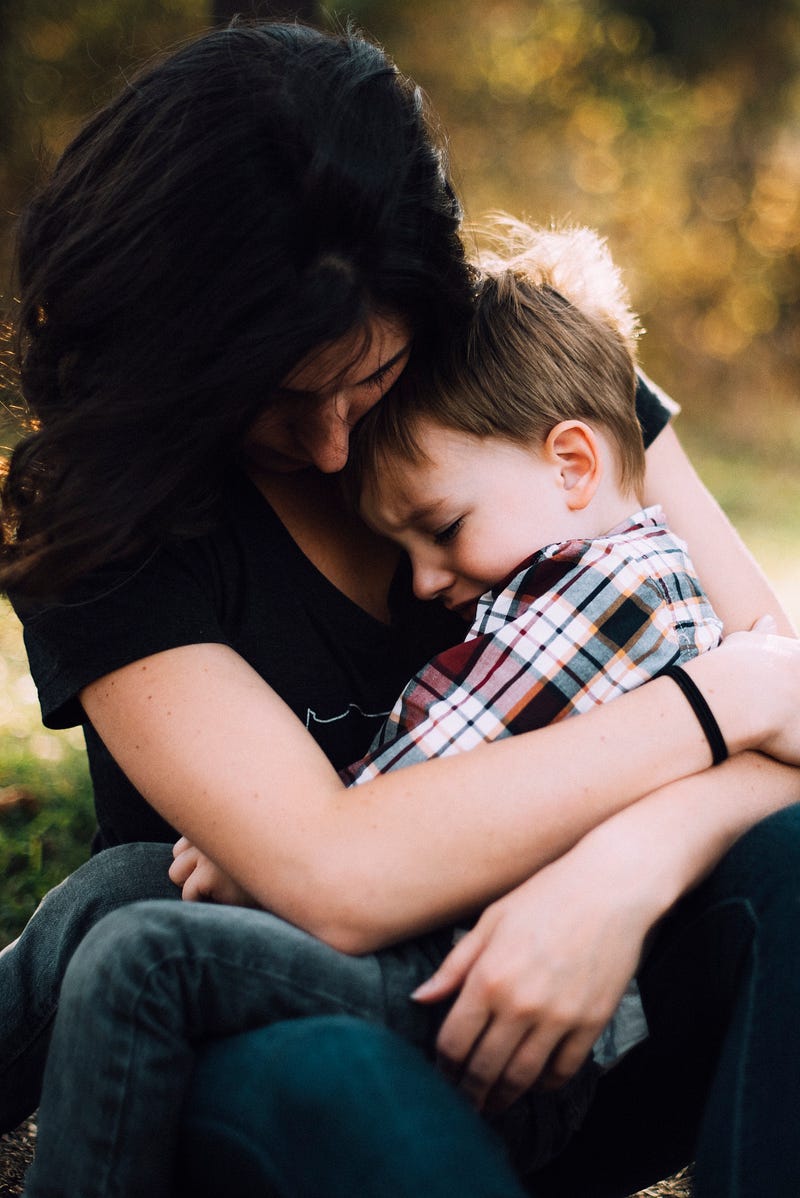
Here is what I became aware of through this slide show of memories: When we have an open wound, we clean it, put some balm on it, and cover it if necessary with a plaster or a band-aid, all aimed at helping our bodies to heal the wound. We don’t carry on playing in the mud and putting more dirt on it if the pain increases. We clean it up and take gentle care of it.
If we can’t do it ourselves, we ask for the help of a professional. But we do something to help our bodies to heal. And… to live.
At some point, we won’t be able to heal anymore. But until then, we can support ourselves in healing, both physically and emotionally.
Others do wish that for us often, with all their hearts.
As I unveiled that unsolved resistance and became aware of what the real name of the health navigation game is, namely, the Healing Game along with the Play and Have Fun Game, I realized that I wish that not only for all my loved ones, and to all people in general, but I wish it for myself as well.

This was an excerpt from my book Gameful Healing: Almost a Memoir; Not Quite a Parable (Gameful Life Book 2). I hope you enjoyed reading it, and it inspired you to look both gently and honestly at your fears and resistance, and perceive them as signals that can help you to find the path toward healing.
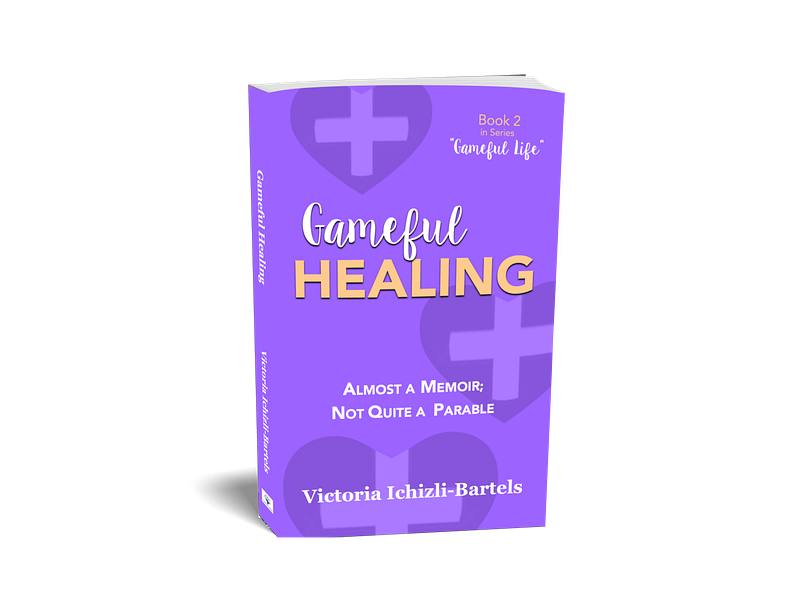
This is a story about learning to navigate health conditions without judgement; making progress towards healing in small, incremental steps; and approaching those steps with a fun, gameful attitude.
What is one of life’s biggest delusions?
The belief that you are invincible and will live without ever becoming ill. And that if you overcome one challenge, you will never be challenged again. And to believe those who say they are never sick, or never have any problems, and to compare yourself to them.
It is also a delusion to believe that your discomfort is something strange, that should be fought against.
Victoria could fill a whole book with her delusions. But they are not the main characters of this particular story, although they make an appearance.
Some time after learning that a person striving toward tolerance could be completely intolerant to many things (especially foods), Victoria embarked on an adventure to explore the world of challenging health conditions, and herself within it, gamefully.
She drew inspiration from games, play, and anything that resembles the two, as well as learning from those who live their lives in a fun and enlightened way. In the process she created games and fictitious characters to explore her present and her past, uncovering the amazing unity between herself, her mind, and her body.
Topics addressed in this memoir:
- Food intolerances (sensitivities) and allergies toward gluten, lactose, milk protein, fruit sugar (fructose), other sugars and carbohydrates, sugar alcohols, nuts, seeds, and others,
- Medical conditions such as alpha thalassemia minor, Bell’s palsy, gluten ataxia, eye condition not corrected by glasses or contact lenses, perfume sensitivity, cramps, joint pain, and osteoarthritis,
- Dealing with chronic pain and multiple health conditions,
- Dealing with worries and anxiety for one’s own health and life,
- Dealing with fears and concern for one’s children and how they might be affected by hereditary conditions,
- How to study one’s medical conditions, and the thought processes, feelings, and reactions you might have towards them, anthropologically, in other words, non-judgmentally and with interest,
- How to apply kaizen in mastering health challenges one little step at a time,
- How to use games as inspiration for bringing joy and fun into healing processes, both in how to approach them and how to appreciate each step of the way,
- How the synergy of anthropology, kaizen, and gamification unfolds and empowers while navigating multiple medical conditions, especially those not visible to others,
- How to trust and listen to one’s body and to truly listen to and appreciate the well-meant advice of others, while remaining true to oneself, which can be discovered moment by moment,
- How to turn healing and life into fun games, and how to be both the designer and the player of these games,
- What Self-Gamification, Self-Motivational Games, and Fun Detecting Antenna are and their positive impact on continuous and progressive healing.
Check out the book here: Gameful Healing: Almost a Memoir; Not Quite a Parable (Gameful Life Book 2).