
What is the Great Red Spot? Where is it located and what secrets does it hide?
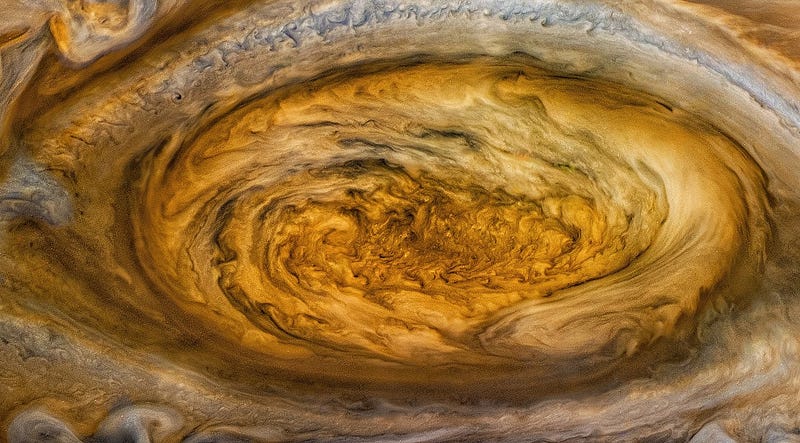
The largest storm in the Solar System is the size of Earth. It has been raging on Jupiter for at least 150 years (observation time), and probably much longer. It is so huge that it can be observed from Earth through telescopes. The powerful atmospheric phenomenon has lived up to its own name — it is the Great Red Spot.
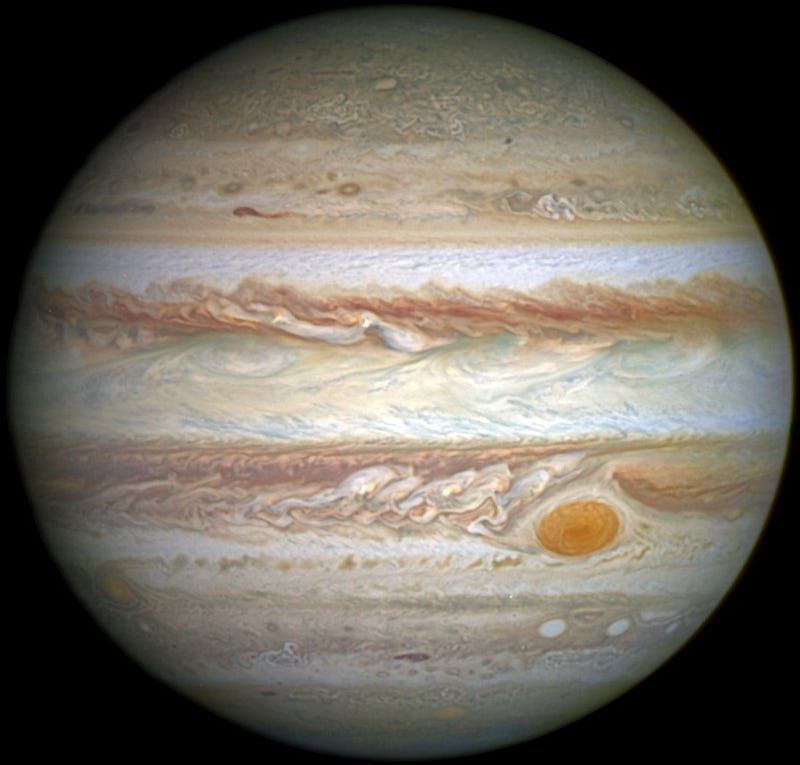
Jupiter is one of the solar system’s most beautiful planets. Images taken by various probes and telescopes — from Voyager 1 to the Webb Telescope — show the globe covered with thick horizontal stripes in various shades of beige. Sometimes smaller and larger ovals, usually white, appear between them. These are storms, which can be very short — as they are on Earth — or very, very long.
Among the circular vortices on Jupiter’s surface, a large spot in the southern hemisphere stands out. 22 degrees below the equator spins a powerful anticyclone — the Great Red Spot. The counterclockwise rotating storm is sometimes called, because of its shape, the Pancake. It has a reddish tint, which, however, sometimes changes. The Pancake on Jupiter can both brighten and darken.
How old is the Great Red Spot?
On Earth, the record in terms of duration went to Hurricane John. In 1994, this powerful tropical cyclone roamed the Pacific Ocean for 31 days. It first traveled from the eastern Pacific to the western Pacific, and then returned to the central Pacific again. In total, it covered more than 13,000 kilometers, hardly touching land.
The month-long storm is impressive, but it is nothing compared to the age of the Great Red Spot. The anticyclone on Jupiter has been regularly observed since 1831, with continuous observations since 1879. It is likely — though not one hundred percent certain — that it was also seen by Robert Hooke in 1664 and Giovanni Cassini in 1665. If one were to assume that what Cassini called the “permanent spot” on Jupiter was Pancake, the storm on this gas giant has been raging for more than 350 years.
Why is the Great Red Spot so long-lived?
What makes the Great Red Spot prove so durable? At least two reasons can be pointed out. First, on Earth, powerful hurricanes weaken as they reach from the ocean over land. On Jupiter, however, there is no solid land. This gas giant may have a nucleus at its center and an ocean of liquid hydrogen above it. However, even higher up there are only kilometers of atmosphere. The Great Red Spot therefore has nothing to brake on.
Second, this storm is a bit like a factory wheel, spinning on two transmission belts that move in opposite directions. In the case of the Great Red Spot, there are two jet currents. The current below the Spot, the eastern one, is weak. However, the one above it — blowing west — is very strong.
“The Great Red Spot has proven to be so stable and long-lived because it has been wedged between two opposing jet currents,” said Glenn Orton. He is a member of the Juno probe science team, which photographed the anticyclone several years ago.
Will the Great Red Spot disappear?
In 2018, there were alarming headlines in media around the world. They proclaimed that in the near future the Great Red Spot could disappear completely. In ten years the storm was expected to make a circle, and in twenty years it would be gone altogether.
Will this actually happen? In fact, this large anticyclone has been shrinking since regular observations of it began. Back in the 19th century, it was so large that, scientists estimate, it could hold three or even four Earths. At the time, it stretched 56,000 kilometers. Since then, however, the Great Red Spot has been shrinking all the time and is now roughly the diameter of the Earth.
There is another catch. Well, the intuitive recognition of the anticyclone as a flat object is misleading. Scientists have pointed out that as the surface area of the anticyclone shrinks, the storm gets taller and taller — like clay being molded by a potter on a spinning wheel. So while it’s getting rounder and rounder, there’s no certainty at all as to how it will fare.
Secrets of the Great Red Spot
The speed of the anticyclone’s rotation varies — depending on where the measurement is taken. Last year, scientists announced that winds blowing on the edge are accelerating. Between 2009 and 2020, their speed increased by 8 percent, exceeding 640 km/hr. The closer to the center of the storm, the calmer it is.
Why the Great Red Spot is reddish remains a mystery. Scientists are trying to track down which of the chemical compounds that make up the clouds on Jupiter acquire such a color under anticyclone conditions. The best candidate so far has been ammonium hydrosulfide, one of the three most important components of clouds on Jupiter.
In 2018, astrochemist Mark Loeffler conducted 200 tests in which he bombarded the compound with simulated cosmic radiation. The experiment yielded a rather interesting result. At temperatures close to those of the Great Red Spot, ammonium hydrosulfide turned greenish. So it is not solely responsible for the color of the anticyclone.
Loeffler has published a paper suggesting that under the influence of ultraviolet radiation, reddish chemical compounds form in the anticyclone. These may be so-called tholins, present, for example, on the surface of Pluto.
The Great Red Spot has another interesting property — it is extremely noisy. Due to its size and speed of rotation, it generates an extremely strong acoustic wave. It rises above the storm and at an altitude of 800 km above it dissipates into the upper atmosphere.
And in the process, it heats it up to gigantic temperatures. Scientists have counted that in the region of the upper atmosphere above the anticyclone, the temperature can exceed 1,300 degrees C. This is several hundred degrees Celsius more than the temperature of other upper parts of Jupiter’s atmosphere.
Source: Space.com [1] and [2], Icarus, Nature, ScienceAlert, NASA
Cool that you made it to the end of this article. I will be very pleased if you appreciate the effort of creating it and leave some claps here, or maybe even start following me. It would be nice if you also left a tip! Thank you!


.jpg)
.jpg)