
What Is Tantra?
An attempt to simplify a rather robust spiritual path
What is the first word that comes to your mind when you hear the word “Tantra”? For many of us, that word is “sex”, while for others is the idea of an erotic massage. Even though the word has gained extreme popularity, this fame has not come with an understanding of what it is about.
Tantra is expansion of consciousness leading us to connect to our real divine Self and liberation from illusion. That is the high goal, and a goal that is shared with many other spiritual paths. So, how does exactly tantra do it?
There's a series of books in hinduism called tantras, exposing knowledge, techniques and practices of the path. These books have led to differentr tantric paths, many times contradictory to each other. In other words: there's not a single "tantra". There is a diversity of Hindu, Jain and Buddhist Tantras.
Tantra is esoteric and scientific. We tend to think of religions as rigid institutions. But apart from the simplified religious teachings one gets in an open church, religions also have mystical arms. Islam has the sufis, Christianity the gnostics, Judaism the kabbalists. We could say that Hindu has Tantra and Buddhism has Vajrayana (tantric Buddhism).
Much of what we call “Tantra” in the West when it comes to sexual exercises comes from Taoism and Shamanic traditions. These practices are not covered in this text.
Once widely celebrated in India, Tibet, Assam, Kashmir, Nepal and all around the Himalayas, much of Tantra was suppressed and disappeared during the years India was under the British Empire. It is a powerful path, one that does use sexual energy, but not for lust and egoic reasons: rather, it sublimates sexual energy to higher energy centers, to awaken our divinity.
Tantra as a Spiritual Tradition
According to David Frawley, “Tantra can perhaps best be defined as an energetic approach to the spiritual path”. It might not say much to many, but it points out that it is a spiritual practice using energies.
Being a spiritual tradition, Tantra is about exploring our humanity, the divine, and our consciousness. It is more concerned about self-transformation and spiritual realization than shortsighted pleasure.
The Tantras are broad life manuals. They cover the creation and the destruction of the universe, worship of the divine, attainment of life goals and powers, meditation practices for self-realization, among others.
One of the issues is that we tend to read books that other Westerns have written, and don’t read the scriptures. Many of the Tantras are not even translated into English.
The relation of Tantra to Hinduism and Buddhism also points out another issue: Tantra is not “one”, either. Just as there are multiple lineages of Hinduism, so are there multiple lineages of Tantra. Many scriptures are conflicting with each other. Some will tell you to abstain from sex, wine, meat, fish, and grains (or money). Others will tell you to dive right into them.
It is confusing if we go for it using our rational mind. Important is that Tantra is an initiatory tradition and respects the lineage. It is not something one buys a book and follows its exercises, for the energy of the teachings come through transmission of energy from a teacher to a student. Not something one goes to a retreat with someone who is called tantric but has not been given permission to initiate others. With books and different professionals, we can learn much about being more loving and self-accepting, how to work on ourselves, etc. But that is not necessarily Tantra.
Meaning you can take a technique from a book (that actually might not be adequate to where you are on the path now or your energetic constitution) and have much small results compared if you had gotten the same exercise from a guru, for when this person teaches you, it comes with an energetic transmission, an activation, so to speak. If this doesn't make sense to you, it will when you actually experience it.
It is quite normal for us Westerns to not have a guru, and it is true we all have an inner guru. But discerning over all the voices we have within is tricky for most of us. While our ego is very smart and talks constantly, the heart whispers.
I am now with a Tantra guru who says he has had 68 gurus in his lifetime. His point is: we change gurus as we grow and our needs change. But we need a guru. Someone more connected to source and to the lineage to guide us in our path. We are all in different moments of our journey and have different needs; what a guru does is connect to our own energy and guide us through the work.
This connection to source is what makes spiritual lineages working with energies to be traditionally transmitted orally. Therefore be mindful of consuming exercises from books. The guru infuses the teaching of the scriptures with his experience and direct connection to source.
As a spiritual path, the goal is self-realization, merging with the absolute. The main tools are ritual (pujas and fire offerings), mantra, pranayama (breathing exercises), and meditation. It is also a devotional practice, where the practitioner worships the Goddess in her variety forms, and God in variety of forms.
Some lineages will be more about the practices listed at first, other lineages will be more about the devotional aspect. Some use these techniques only until the practitioner reaches a stage where any kind of outward action limits her, as it keeps her mind bound to the external world. This is most certainly not an easy stage to get.
“The practitioner of Tantra aims at stopping the unconscious flow of micro-cosmic forces by getting control of the functions of breathing, which represents the outward aspect of vital energy. The initiate must master the breathing process until it becomes a most responsive and subtle tool.” Varahi Tantra
Mantras & Yantras
In most spiritual traditions, words are seen as holding immense energy. The power of the word is even depicted in the Bible when it is written: “In the beginning was the Word, and the Word was with God, and the Word was God.”
Words carry the energy of the idea/feeling/archetype behind that word. Everything is nothing but vibration. That is the power of the word. That is the idea behind the extensive use of mantras. And again, that is one of the important aspects of having a guru: because mantras are so powerful, we don’t choose one we want just because. The guru channels from spirit what is the energy that is to be worked by you.
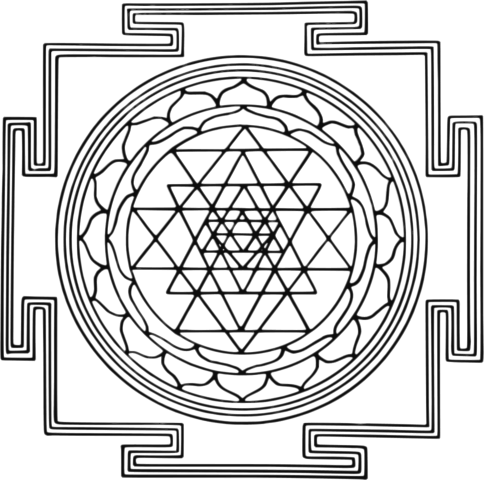
Besides mantras, there are yantras, and these two components work together: mantras being the sound-form representation of a deity/energy, and yantras its visual representation.
“The Yantra is ensouled by the Mantra and the personal deity is the expression of the personal Mantra. As the body us ti the Jiva, as oil is to a lamp, so is Yantra the established seat of all divinities.” Kularnava Tantra
The Goddess
Tantra tends to worship the Goddess, but there are sects that focus mostly on Shiva and Vishnu. Traditionally it is seen that male and female powers go together, and support each other. The Goddess’ consort is Lord Shiva, and most journeys start with devotion to one of their sons, Ganesha, the holder of the mysteries to the root chakra.
Yet the worship of the Goddess has a special place. She is the bliss of Being. She is worshipped as Shakti, translated as “power”. This is the power that comes from the void, from silence, from peace. It is a power from within, the power of nature, our innate power of being, and not a power that asserts itself on something. It is about recognizing the power of our consciousness.
By connecting to the energy of the Goddess, Tantra aims at energizing the Shakti dormant in us, so she can rise and merge with Shiva, peace. Again, males and females are just as important and go hand-in-hand.
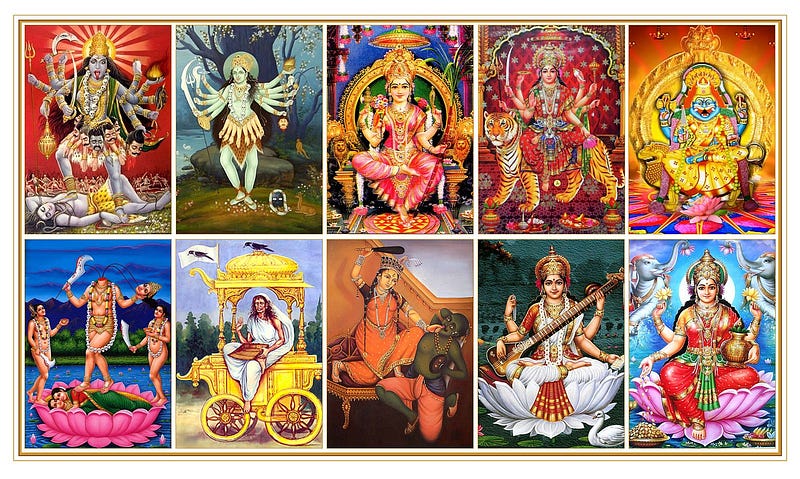
The Goddess has ten aspects, the Dasha Mahavidyas, or “Ten Great Knowledge” Forms of the Goddess, depicted on the picture of this article. They are archetypes, representing the deeper truths of life. The famous Kali is one of them. They are not there to console us; they are provocative, multi-layered, and propel us to go deeper.
Tantra and Sexuality
Tantra has much to do with sexual energy, but not necessarily sex between people (although it can also include it). The point is that sexual energy is pure life energy force. We come from it and we all have it within us, without depending on anyone else. This force brings us creativity, pleasure, willingness to live. Tantra practices help us harvest that energy, often without anything but our own bodies. The truth is, most of us don’t know how to handle this energy alone, let alone with someone else.
According to David Frawley, the connection of Tantra to sex and kundalini is compared to the West view of yoga with a focus on asanas and exercise: the physical side is emphasized, even though that is a small part of classical yoga. All postures of yoga are only a preparation for meditation and to what comes from meditation. In his view,
"Tantra is not a glorification of ordinary sexuality, though it is unafraid of this force and is able to see the cosmic power working behind it.”
Tantra is about transmuting energies so that we can ascend. Sexual energy is the core energy of our existence, and therefore is the energy Tantra works with. To transmute energies, Tantra does not focus on suppressing energies (such as emotions) or on indulging in them. That is because these two actions dissipate and repress the energy, making it harder to work with them.
This transmutation of sexual energy is done through the powerful energy of Kundalini. The Serpent Power of Kundalini is in itself a form of the Goddess and therefore it should be revered.
These days we have a taste for mixing different traditions together, fusing things, trying a bit of everything. Sure, this can be fun. But it cannot be compared to the deep understanding and embodiment that comes from unpeeling multiple layers through deep practice. Spiritual practices require much self-discipline and restraining for those who want to expand.
Your Body, Your Temple
In Tantra, our bodies are sacred. They are our temples, a microcosmos of their own. That makes Tantra a body-positive philosophy, much different from many other traditions. At the same time, we are not our bodies, and so Tantra asks to not over-identify with the body.
The body is a sacred vehicle with a beautiful intelligence of its own. If we connect to it and hear it, it can teach us in our path. But the body is not our true Self. It is through the body we gain experience and enlightenment, and for that, we are to take good care of it as the most sacred temple.
“Here in this sacred body are the sacred rivers; here are the sun and the moon, as well as all the pilgrimage places. I have not encountered another temple as blissful as my own body.” Saraha Doha
Emotions
Emotions are seen as trapped energies that need to be released, as tools for spiritual growth. Tantra asks us to relate to emotions as forces of nature and to use them as a way to relate to archetypes, the Divine within us.
On the other hand, we are not our emotions and therefore should not be attached to their expression. The work with emotions is to understand their play in consciousness, and not be stuck in emotionalism. Again, it is not about suppression, but how we relate to them so we are not attached to them. We are not our emotions. They are a tool.
Although I practice Bhairavanand Tantra through the guidance of a guru, I am far from being a specialist and am taking baby steps. This text reflects what I have learned up to this point.
The fact that there is no single Tantra lineage can create much confusion and desire to simplify it. This “simplifying and packaging with a sexual take” is also what causes cultural appropriation. As a spiritual practice dealing with what one cannot see, embracing our inability to put it into black and white definitions is part of what is. When we least expect, things start to click.
Tantra is a practical approach: it is about direct experience and personal relationship with cosmic reality in everyday life. Tantra provides us with tools to experience truth ourselves. It sees consciousness as the only reality. As a practical spiritual approach, it involves a lot of willingness and work.
Hi, I am Aline Ra M, spiritual guide, energy worker, and tea lover.
Ready to start on your journey?