
What’s REALLY Beneath That Beard?
A Christmas lesson

In 2014, the news caused me to cringe and question society.
In March, the City of Rockford demanded that a church stop sheltering homeless people at night. The temperature was 20 degrees.
In early November in Fort Lauderdale, Florida, two pastors and a 90-year-old man were arrested for feeding the homeless. They faced up to 60 days in jail and a $500 fine for resisting an ordinance that places restrictions on public food sharing.
On the flip side, however, a Los Angeles woman, who had been homeless, and her friend now distribute potato pies, protein bars, chocolate chip cookies, and water to the homeless on Skid Row.
Why such drastic differences in how we treat those in need?
Because far too many people lack compassion for those in need, the same values and morals embodied by the original Santa, or St. Nicholas.
But Who Was St. Nicholas

The ancestor of modern Santa Claus dates back to a Greek named Nicholas who was born some 280 years after Christ. According to St. Nicholas Center, Nicholas’s wealthy parents died in an epidemic while he was still young. Following his Christian upbringing, Nicholas used his whole inheritance to assist the needy, the sick, and the suffering; and he grew to become the Bishop of Myra, a small Roman town in modern Turkey.
Nicholas was not fat, nor was he jolly. He didn’t dress in a red suit trimmed in white. He probably didn’t smoke a pipe. According to National Geographic, Nicholas had a reputation as a fiery, wiry, and defiant defender of church doctrine.

The Roman Emperor of the time persecuted Christians and exiled and imprisoned Bishop Nicholas. The prisons were so full of bishops, priests, and deacons, there was no room for the real criminals — murderers, thieves and robbers. The Roman Emperor was forced to release Nicholas and others in the year 325.
Nicholas rose to prominence among the saints because he was the patron of so many groups, ranging from sailors to entire nations.
When Nicholas died in December of the year 343 in Myra, he was buried in his cathedral church. A liquid substance, said to have healing powers, formed in his grave and fostered a growth of devotion to Nicholas. The anniversary of his death, December 6 (December 19 on the Julian Calendar), became a day of celebration.
The Shaping of Modern Santa
In Santa Claus: A Biography, University of Manitoba historian Gerry Bowler wrote that “by about 1200, Nicholas became known as a patron of children and magical gift bringer.”
Many stories and legends have been told of St. Nicholas’ life and deeds showing him as a revered protector and helper of those in need. Probably the best known is the story of the three young girls who are saved from a life of prostitution when young Bishop Nicholas secretly delivers three bags of gold, which can be used for their dowries, to their indebted father.
St. Nicholas’s selfless generosity is something we need to nurture in our current society. It is this generosity that motivates us to drop money in the Salvation Army’s red kettles, buy a new toy to donate to toy drives, collect non-perishables to contribute to a food pantry, or buy a pair of mittens and clip them on a mitten tree.
In 1809, Washington Irving’s book Knickerbocker’s History of New York first portrayed a pipe-smoking Nicholas soaring over the rooftops in a flying wagon, delivering presents to good girls and boys and switches to bad ones.
In 1821 a poem entitled “The Children’s Friend” further shaped our modern Santa and associated him with Christmas. According to Bowler, the poem took “the magical gift-bringing of St. Nicholas, stripped him of any religious characteristics, and dressed this Santa in the furs of those shaggy Germanic gift bringers.”
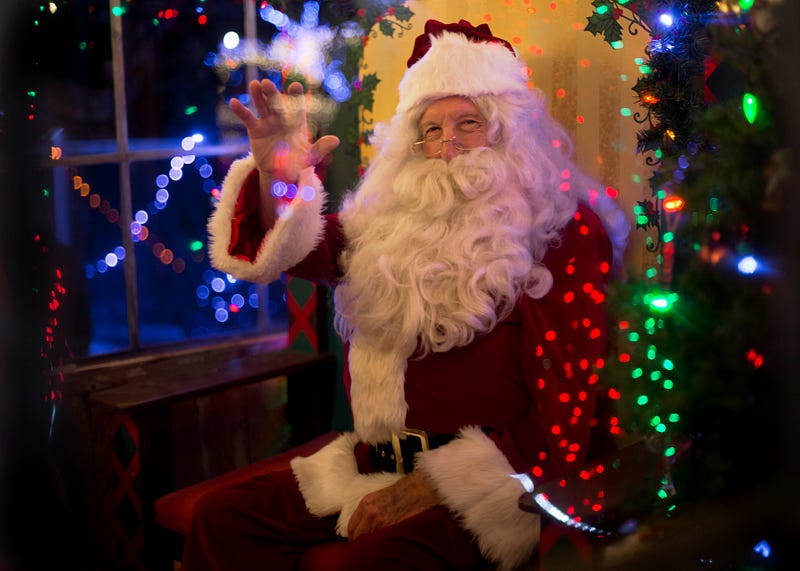
Clement C Moore in 1822 wrote “A Visit from St. Nicholas” also known as “The Night Before Christmas” for his six children. Although he had no intention of adding to the Santa Claus phenomenon, Santa to this day has been described and depicted as the plump, jolly man who rides a sleigh pulled by eight reindeer.
Santa’s Bells
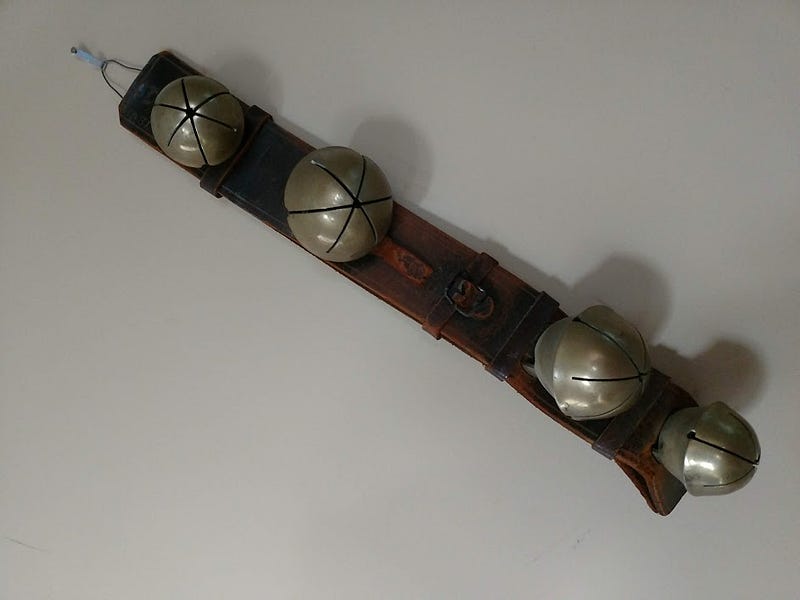
When I was a child, I was always excited about Christmas and Santa’s visit.
Unlike some of the parental Santas today, the Santa of my youth didn’t bring everything you asked for. Instead, I remember him bringing an apple or an orange, some candy, a color book and crayons, and other things that could have been described as homemade.
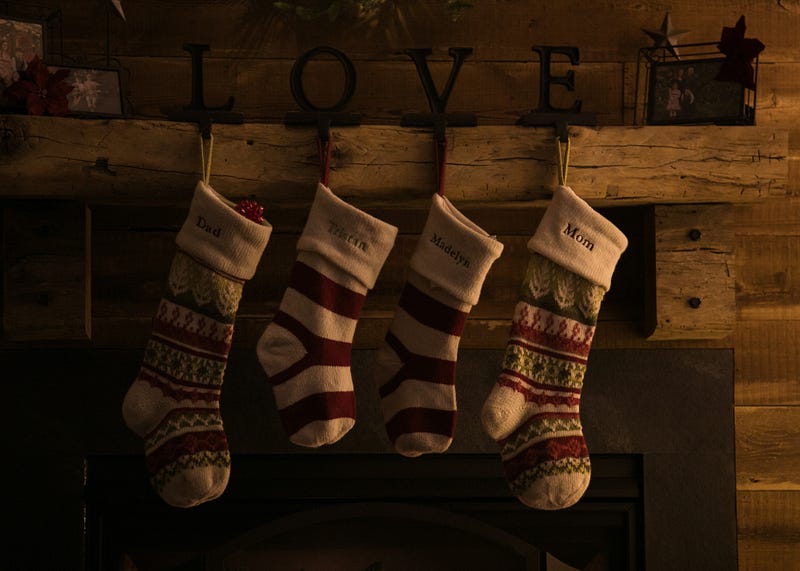
One Christmas Eve just after we got home from church services, I hung my stocking on the back of my little red chair and placed a plate of cookies and a glass of milk on the seat for Santa and a carrot for his reindeer.
As I was getting ready for bed, I remember hearing sleigh bells outside.
“Mom! Dad! Listen! Santa’s sleigh bells. I heard Santa’s sleigh bells. Get to bed and turn out the lights or he won’t stop. Hurry!”
A few years later, when I asked my parents about the bells, they denied that they had rung them. In fact, as I thought about it later, neither of them could have been ringing those bells outside because they were right there in the room with me.
My Sound and Lights Technician as Santa
When I had children, I admit that I perpetuated the Santa Claus myth. Santa brought simple things that usually weren’t mass manufactured. We bought the toy for a needy child and dropped change in the bell ringer’s bucket. But I must also admit that I was driven, one year, to use Santa as a child behavior specialist.
The Thanksgiving weekend found my oldest a stubborn and defiant six-year-old. He declared he didn’t believe in Santa anymore. I let it slide as I began the seasonal decoration of the house.
Monday found the four of us back to our everyday routine. At the faculty lounge lunch table, we talked about our Thanksgivings and our plans for the Christmas holiday. We were all parents with children of varying ages, so I voiced my frustrations with my oldest. Many shared how they had dealt with their own children when they stopped believing in Santa, but Arnie, a good friend and the man who we rented lighting and sound equipment from, smiled. As we walked down the hall to my classroom, we shook hands on our agreement. I was to bring my boys to CherryVale Saturday.
I convinced my boys that it was necessary to get started with our Christmas shopping: in those years, we celebrated with three different extended family branches as well as our immediate family members. David’s younger brother, Daniel, wanted to go to the center of the mall and see Santa. I was grateful that my firm squeeze on David’s hand alerted him not to tell his brother that Santa wasn’t real.
Since the line wasn’t that long, we rode the escalator down to the first floor. When there were two families in front of us, I leaned over to my six-year-old and asked him to go up and talk to Santa first. I could feel him stiffen in irritation and hear defiance in his voice.
When the little boy in front of us got on Santa’s lap, I tried one more time. “Please, David. You don’t have to sit on his lap, but at least go up and talk to him.” As I stood up, Santa gave the little boy who had been in front of us a coloring book and the child was joined by his mother.
Santa turned back to look at the next person in line. “Well, David, it’s so nice to see you,” Santa said looking at my son. “Come on up and talk to me.”
David’s eyes grew as he looked at the gentleman sitting on the throne style chair. He had long curly white hair and a white mustache and beard. David looked at me and then back at Santa. “David, I hear you haven’t been treating your brother very nice. Come on up and talk to me.”
David slowly walked up and sat on Santa’s lap. Santa whispered in David’s ear, and I saw small nods from the child. David was extremely quiet and compliant when he stepped away from Santa. In fact, David was a model child through the excitement of the Christmas season.
I smiled thankfully at the Santa in the red suit whose long curly hair, beard, and moustache had been bleached for the season.
You may think I was a horrid parent for perpetuating the myth of Santa with my children, but I see it differently, for I still believe in Santa.
I think Francis P. Church said it best in his response to Virginia, an 8-year-old who wrote to him when he was the editor of the New York Sun Times in 1897.
Virginia wrote: I am 8 years old. Some of my little friends say there is no Santa Claus. Papa says, “If you see it in The Sun, it’s so.” Please tell me the truth, is there a Santa Claus?
In his response Church wrote:
Yes, Virginia, there is a Santa Claus. He exists as certainly as love and generosity and devotion exist, and you know that they abound and give to your life its highest beauty and joy. Alas! how dreary would be the world if there were no Santa Claus! It would be as dreary as if there were no Virginias. There would be no childlike faith then, no poetry, no romance to make tolerable this existence.
No Santa Claus! Thank God! He lives and lives forever. A thousand years from now, Virginia, nay 10 times 10,000 years from now, he will continue to make glad the heart of childhood.
You can tell me that Santa isn’t real, that since I am a responsible adult that I shouldn’t lie to children about the existence of Santa.
I believe that it is the myth of Santa that propels so many to drop a coin in the Salvation Army bucket, hang a pair of mittens on a mitten tree, and donate food during the Thanksgiving and Christmas holidays.
Like the last lines of The Polar Express suggest,
At one time, most of my friends could hear the bell, but as years passed, it fell silent for all of them. Even Sarah found one Christmas that she could no longer hear its sweet sound. Though I’ve grown old, the bell still rings for me, as it does for all who truly believe.
SOURCES
“Who is St. Nicholas?” St. Nicholas Center
“From St. Nicholas to Santa Clause: the surprising origins of Kris Kringle” National Geographic
“Yes, Virginia” (a reprint of the original article) The New York Sun
Wait!
Before you go . . .
If you like my writing or got something out of it, why not join Medium as a paying member. As a member, you have unlimited access to my articles as well as the work of other talented writers.
Check out Rebecca Kojetin’s articles for writers at Ink & Keyboard. You can also subscribe to Ink & Keyboard’s newsletter The Writer’s Notebook.
Thanks for reading. If you enjoyed what you read, here are a couple other articles you might enjoy.


