
We Are Now the Elders
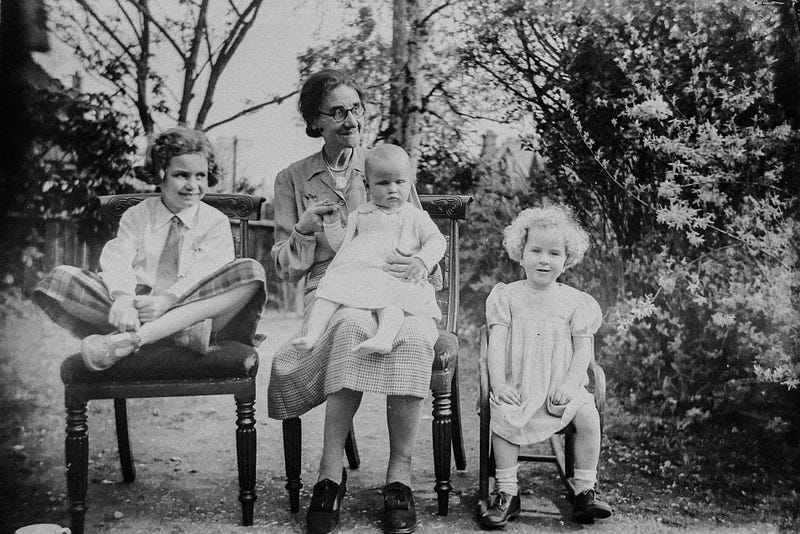
I grew up in a strong extended family that got together several times a month. Although I am an only child, I never really felt alone. I mean, when your aunts and uncles and cousins are always around, you’re never really alone.
That feels like ages ago, and in a few days, I will begin my 61st trip around the sun. Now, sometimes, since family has multiplied and spread out across the continent, I really do feel alone. It happens that way in families: we grow up, we multiply, and we spread out.
But, I know, I am never more than a phone call or a letter away from those in my family who mean so much to me.
HOW DID I EVER GROW TO BE AN ELDER?
(A bit of family history)
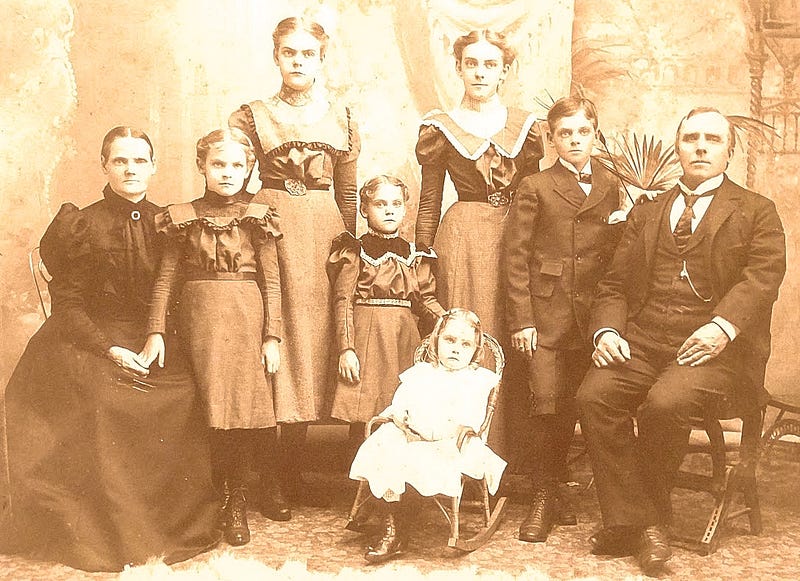
My grandmother (She’s the one in the rocker.) was the youngest of six children born to Hans and Lena. The only son passed away before I born, and three of the sisters never married. That left my grandmother, Edna, and her sister, Amy, to continue the family line and family traditions. Add to that, the aunts and uncles who are the siblings of Hans or Lena. The extended family grew, but stayed close.
My mother was an only child, but Amy had two daughters, Louise and Margaret. From there the family multiplied: Mom had me, but Louise had four children and Margaret had three; in addition, Alice and Emil (related to Lena) adopted two.
As a child, I remember getting together all the time.
We got together for birthdays. We got together for weddings and funerals. We got together for anniversaries. We got together for New Year’s Day, Easter, Memorial Day for the parade and a picnic (the family home was only a few blocks from the city parade route), Fourth of July, Labor Day (another picnic and parade), Halloween, Thanksgiving, and Christmas Eve and Christmas Day. In addition, we were together at church, church functions, and church camp.
It was impossible to escape family, but I never wanted to.
As my cousins and I grew older, we left for college or joined the military, and many eventually moved away from Northern Illinois. As my generation married and had families of our own, our numbers grew; and as our children married and began their families, we have outgrown the ability to comfortably fit everyone in most houses.
As we grew, we celebrated with four generations in attendance: my grandmother and her sister, my mother and her two cousins, myself and my cousins, and our kids.
As my grandmother’s generation aged and passed away, the task of maintaining traditions fell to my mother and her two cousins. As lives and schedules developed complexity, my mom rallied to maintain the family traditions, especially for Christmas.
As the extended family grew in size and became more spread out across the country, the number of get-togethers began to diminish. Our family is now spread coast to coast and border to border with some relatives across the pond in England and Sweden.
Now, as an extended family, we get together for weddings, funerals, and the occasional baby or wedding shower.
My Aunt Lou was the last living relative of my mother’s generation to pass away. At her funeral, my cousin’s wife hugged me and uttered a stark realization: “We are now the elders.”
How did I ever get to be an elder? Wait! Where did the last 60 years go?
WHAT DOES IT MEAN TO BE AN ELDER
The word “elder” creates an image much like the black and white images of people in the late 1800s and early 1900s: a person dress in the best clothes they probably owned, sitting up as if they have a rod instead of a spine, and rarely a smile. It sends shivers down my spine.
I don’t (and can’t) fit into that picture of an “elder.”
To me, being an “elder” means that I am responsible for keeping family connected, keeping the family history and artifacts, and sharing the extended family with my own children.
I am working on being an elder of the family. I send Christmas cards with a letter inside about family, and I receive one from most of the family as well. I work to remember to send birthday cards, and I make phone calls to keep in touch as well.
I NEVER want my family to feel like it is estranged.
I read so often about family members who don’t get along or don’t see each other because of some forgotten grudge. Not in my family. As I was growing up, I remember tensions and scuffles at times, but
I also remember being expected to apologize and to get along — or at least pretend to get along.
So, I’d like to leave you with three life lesson that I have learned from growing up in a close extended family.
#1. Family can be as important to your existence as air.
#2. For extended family relationships to work, you have to go out on a limb and communicate. Sometimes that might mean an apology; sometimes that might mean listening with an open mind.
#3. Even when your family spreads out across the country or the world, it is important to keep connected. Much of social media has made keeping connected, or re-connecting, so much easier.
Rebecca (Becky) spent 34 years in a teaching career, but when she retired in 2014, she picked up her pen and pursued her passion to write. As a high school English teacher, Becky held the philosophy that she wouldn’t give any writing assignment that she personally wouldn’t or couldn’t do. That philosophy strengthened and broadened her own writing.
In addition to publishing her writing on various platforms, Becky also blogs at Life is for Living, a blog to encourage, motivate, and help others live the best life possible. As an extension of Life is for Living, she also publishes a weekly newsletter, Let’s Chat. (Check it out HERE.) Life is for Living also has a social media presence with the group Coffee on my Porch. (Check it out HERE.)
After teaching writing for 34 years, Becky began Ink & Keyboard, a blog for writers at all levels. She supplements what she writes on the blog with a subscription newsletter, The Writer’s Notebook (Check it out HERE.) and the social media group Ink & Keyboard (Check it out HERE.)


