What is an atom? It is supposed to be indivisible, yet it is made up of elementary particles
The matter around us is not continuous. It consists of microscopic particles, which only together form a whole. Here we come to the atomistic theory, the foundations of which were already laid in the philosophical currents of antiquity. What is an atom? What is it made of and how is it formed? Is it divisible? These and other questions are answered below.
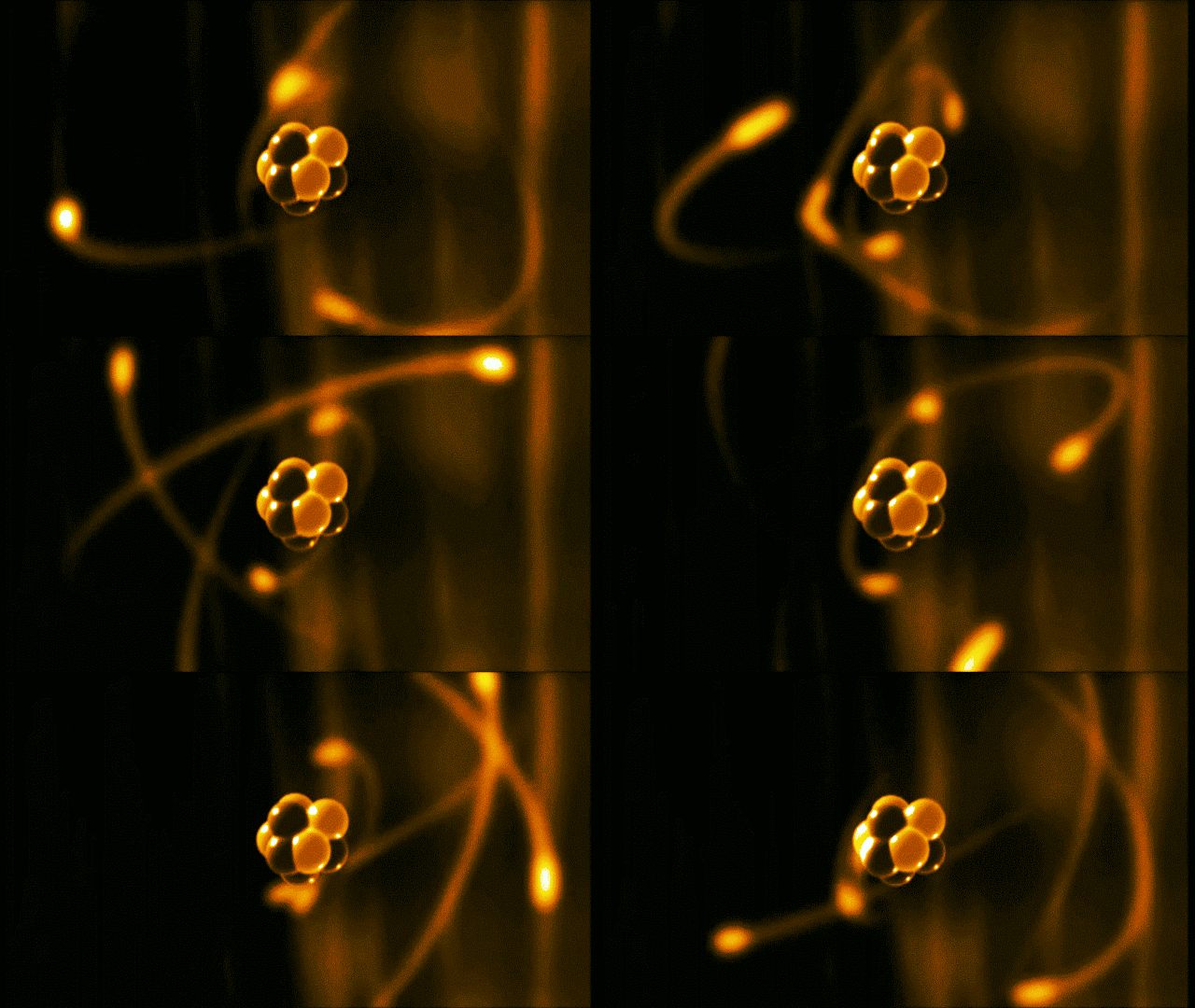
Man has been trying to understand the structure of matter since time immemorial. Already in antiquity the prevailing view was that everything around us consists of tiny particles that cannot be divided. Its author was said to be Democritus. However, it was not a theory based on experience, but only a philosophical concept. The world had to wait until the 19th century for scientific confirmation of the structure of the atom.
What is an atom?
The word “atom” comes from the Greek (átomos) and means something that cannot be divided. Although the nomenclature has survived from ancient times to modern times, today we know that its essence has nothing to do with scientific facts.
What is an atom? All elements are made up of atoms of one kind. Carbon is made up of carbon atoms, and lead is made up of lead atoms. Importantly, no matter which element they form, the atoms are made up of the same particles. They differ only in terms of their number. This is enough to create chemical elements that exhibit completely different properties.
What is an atom made of?
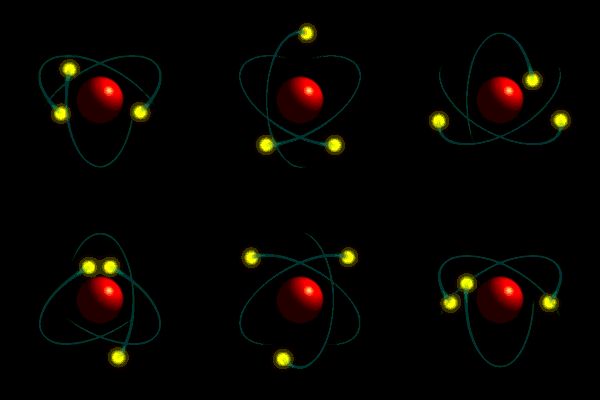
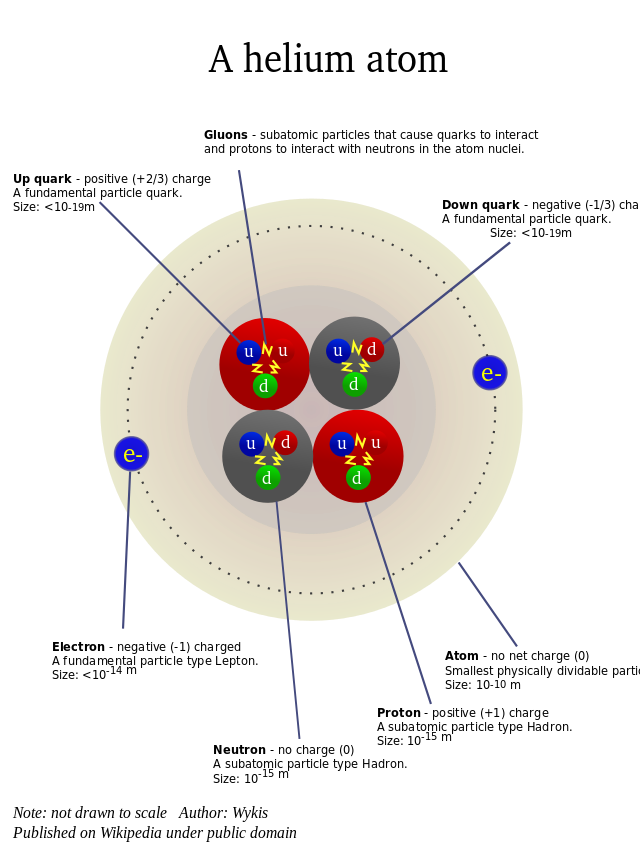
An atom is composed of electrons and a nucleus. The majority of the atom’s mass is concentrated in the nucleus, while electrons occupy the remaining space around it. The atomic nucleus is made up of two types of particles called nucleons — positively charged protons, and electrically neutral neutrons. In most cases, the number of protons is equal to the number of electrons in the atom, except for the simplest form of hydrogen.
Literally every particle mentioned determines the existence of matter. Atoms are electrically inert (otherwise they become ions) precisely because of positive protons, which balance negative electrons. Neutrons, on the other hand, act as insulators of positive charge. They balance the repulsive force of protons and thus prevent destabilization of the nucleus.
Is the atom divisible?
The very translation of the word “atom” indicates the indivisibility of this particle. Today we already know that the assumption on which the atomistic theory was initially based is wrong. Since atoms do not have a uniform structure, this means that they are divisible.
The first to speak of the divisibility of the atom was in 1815. William Prout. The English physician assumed that all atoms are made up of hydrogen atoms. His hypothesis was rejected, but later experiments proved that he was not wrong about divisibility itself.
A breakthrough in atomic structure research came in 1897, when Joseph John Thomson determined the charge-to-mass ratio of negatively charged particles in cathode rays. Another turning point is dated to 1898, when the Curie couple discovered polonium and radium. Research aimed at separating observable amounts of radium proved that the emitted radiation consisted of ionized helium atoms (so-called alpha particles), electrons and X-rays. The atom split into parts and new elements were formed as a result.
How is an atom built?
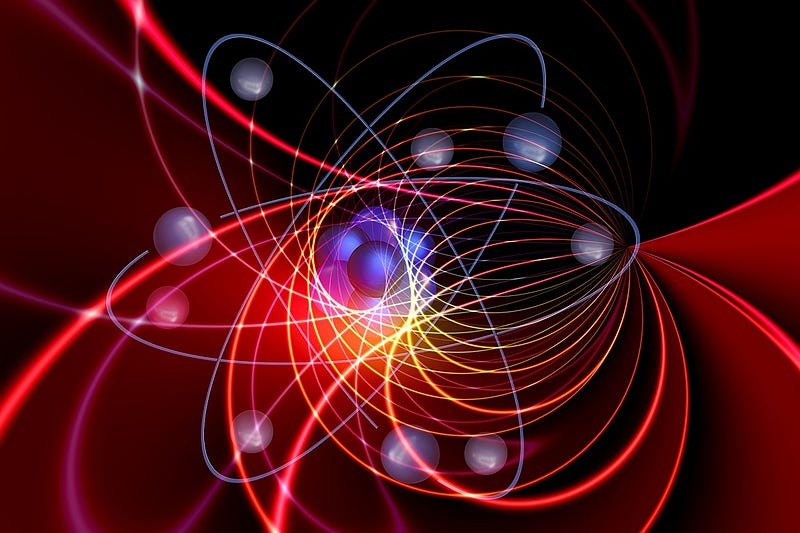
Over the years, many theses have been developed on the structure of the atom. One of the earliest was proposed by William Thomson, the discoverer of absolute zero temperature and the second law of thermodynamics. Later, his model was further refined by the aforementioned Joseph John Thomson. In their conception, the atom was to have the structure of a positively charged sphere in which negatively charged electrons move, arranged symmetrically with respect to its center.
Ernest Rutherford proposed a different model. Based on the experiment of scattering alpha particles (i.e., helium nuclei) on gold foil, he concluded that their flux was largely scattered by gold atoms, which contradicted the assumptions of Thomson, who pointed to negligible electrical interactions. Rutherford assumed that the positively charged nucleus is the center of the atom, and negative electrons orbit around it.
However, this so-called planetary model had a significant weakness. According to the assumptions of Maxwell’s electrodynamics, electrically charged particles that continuously move around a particle charged with an opposite charge give off energy in the form of electromagnetic radiation. Thus, the planetary model could not be right, because according to its assumptions, after a certain time the electrons would fall on the nucleus, leading to destabilization of matter.
Niels Bohr concluded that Rutherford’s model was correct, but that it was wrong to use the assumptions of classical physics. In his work, he concluded that electrons do not emit energy continuously, but occupy orbits with well-defined distances from the nucleus. Bohr assumed that an electron can only accept or give off specific amounts of energy, or quanta. This is supposed to lead to a change in its orbit.
More work followed:
- Louis de Broglie’s theory of the corpuscular-wave nature of elementary particles,
- the introduction of wave functions to elementary particles by Erwin Schrödinger,
- the introduction of the concept of probability density by Max Born,
- the introduction of the indeterminacy principle by Werner Heisenberg.
These helped create the image of the atom that science still uses today.
How is an atom formed?
To be able to explain the process by which atoms are formed, we need to go back to the beginning of the Universe. Shortly after the Big Bang, the entire Universe was filled with clouds of quark-gluon matter. As their density began to decrease, the Universe began to expand and cool. Following this, the energy of the particles began to decrease. These began to merge with each other. Quarks formed protons and neutrons, and these formed atomic nuclei. These particles began to capture electrons, which led to the formation of the first atoms.
Initially, only the lightest elements, such as hydrogen, helium and lithium, existed in the Universe. Slightly heavier elements, such as oxygen, carbon and iron, were formed only when stars were formed, inside of which there is energy to allow this process to occur. Anyway, this is how elements are still being formed in space.
What about elements heavier than iron, like gold? These were formed in the wake of supernova explosions. The great energy of massive stars allowed matter to spread throughout the Universe. Some of it formed new celestial bodies, including Earth.
Is there anything smaller than an atom?
The atom is often associated with the smallest particle of an element. This is quite an understatement because an atom is indeed the smallest particle, but it retains the properties of an element. There are smaller objects in nature. The very fact that the atom is not a particle with no internal structure clearly indicates that something smaller must exist, and this is indeed the case.
Smaller than the atom are elementary particles, that is, particles from which atoms are made. The atom itself consists of a nucleus and electrons orbiting around it. The atomic nucleus consists of neutrons and protons. However, these elementary particles are also divisible. They include “d” and “u” quarks.
There are also other types of quarks, possible to produce in laboratory conditions. Properties similar to electrons are exhibited by tauons, muons and neutrinos. There are also bosons, photons and gluons, which are responsible for the interaction between all particles. One cannot fail to mention the Higgs boson — the particle responsible for the non-zero mass of other particles.
Who discovered the atom?
Finally, it falls to explain who actually discovered the atom. In 1808 John Dalton created the modern atomistic theory. The English scientist assumed that matter is made up of indivisible atoms — elastic balls of microscopic size.
Until the 19th century, many scientists doubted the validity of Dalton’s assumptions. Only the kinetic-molecular theory of gases, developed by Maxwell and Boltzman, made it possible to accept the validity of the assumptions of the atomic structure of matter. Further evidence came in 1827, when Robert Brown observed the continuous motion of flower dust particles suspended in a liquid (Brownian motions). The work of Lukas Bodashevsky was also not insignificant.
Cool that you made it to the end of this article. I will be very pleased if you appreciate the effort of creating it and leave some claps here, or maybe even start following me. It would be nice if you also left a tip! Thank you!