
The Kuiper Belt’s Strange Behavior and Planet 9 Hypothesis
The strange behavior of ice bodies in the Kuiper belt may suggest the existence of Planet 9. However, its search has failed. Perhaps because they were looking the wrong way.
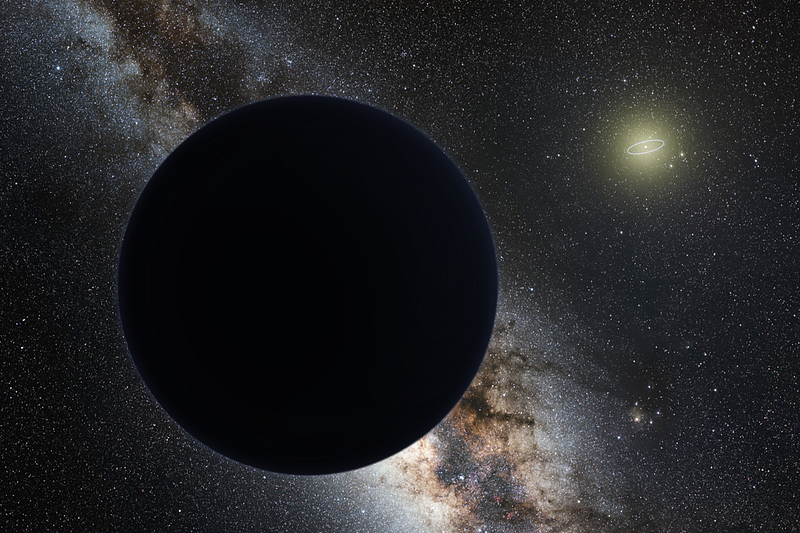
There is no evidence for its existence. Nevertheless, interest in it has been growing since a paper appeared a few years ago that suggested Neptune was not the last globe in the solar system. The reference was to an object dubbed Planet 9, which is thought to circle the Sun at a distance several hundred times that of Earth.
Astrophysicist Man Ho Chan of the Chinese University in Hong Kong, in a paper to appear in the Astrophysical Journal https://arxiv.org/abs/2301.13471, suggests that instead of chasing (across the sky) the planet itself, it would be better to focus on looking out for specks of heat emitted by its moons. “In such remote and cold corners of the solar system, there can be only one source of heat”, he claims. It’s the tidal heating generated by the gravitational interaction occurring between a moon and its parent planet.
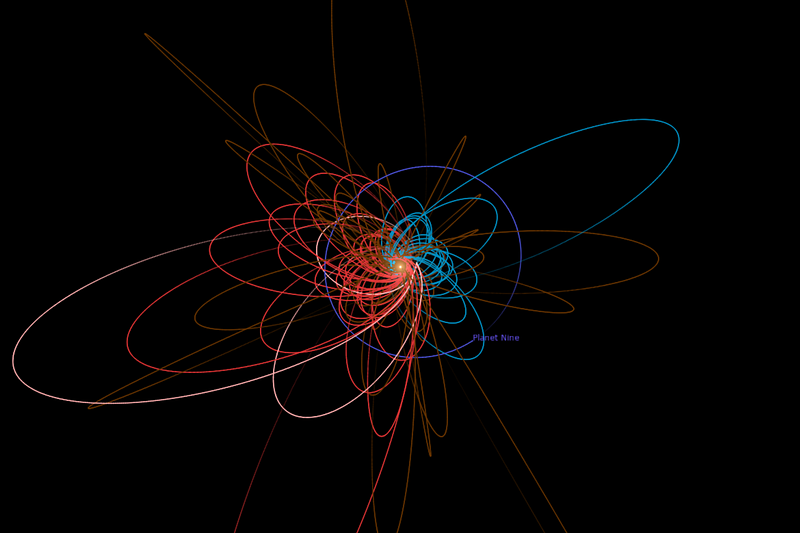
The existence of the ninth planet is a matter of debate among astronomers
Planet 9 made its debut in the professional astronomical press in 2016. Researchers at the California Institute of Technology — Mike Brown and Konstantin Batygin — have pointed out what they believe is the strange behavior of some of the small ice bodies that make up the Kuiper belt.
The belt extends beyond the orbit of Neptune, the last planet currently (after dethroning Pluto) orbiting the Sun, some 4.5 billion kilometers away. It may contain, according to various estimates, tens of thousands to tens of millions of small objects. The most distant of them orbit at a distance of 7–8 billion km from the Sun. Collectively, they are referred to by the term cubewano — from the English pronunciation of the first discovered asteroid from this area named “QB1”.
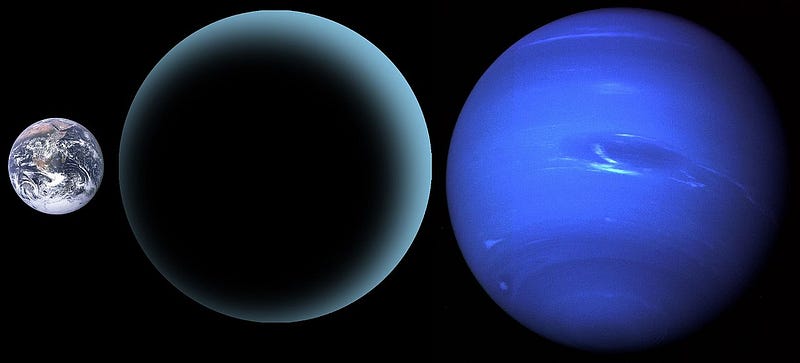
Brown and Batygin concluded that some of the known objects from the cubewano zone move in groups in similar orbits, the shape of which suggests that they may be under the gravitational influence of some large celestial body. According to the researchers’ initial calculations, the newly discovered entity, dubbed Planet 9, may have a mass around five times that of Earth and be situated at a distance of 40–50 billion kilometers from the Sun, roughly ten times farther away than Neptune. In a subsequent publication, in 2021, they corrected this distance, bringing Planet 9 slightly closer to the Sun, but it was still tens of billions of kilometers.
So far, the search for Planet 9 has ended in failure. Astronomers speaking out on the issue were divided into several groups. Some argued that Brown and Batygin hastened their statistical analyses of cubewano asteroids, because only a fraction of them are still known. Others suggested that the planet in question is in fact a small black hole, or a cloud of dark matter, or a so-called rogue planet that traverses the cosmic skies by paths known only to itself. The chance of tracking either of these freaks of nature is close to zero, it was stated.
How to look for Planet 9? Io and Enceladus give a hint
Man Ho Chan believes that the standard hunt for Planet 9 in places where it should theoretically be easiest to spot could turn out to be looking for a needle in a haystack. After all, the probability is that it is moving non-standardly — in an orbit that is not circular, or near circular, but strongly eccentric (elongated), and, in addition, significantly deviated from the plane of the ecliptic (the circle on the celestial sphere “circled” by the Sun).
What remains? “Looking for the moons of the hypothetical globe”, postulates Man Ho Chan. He estimates that if Planet 9 is actually five times more massive than Earth, there could be up to 20 satellites orbiting around it. This would be quite a sizable cluster under the gravitational influence of the globe, which would launch a tidal force on its moons. We know it well from Earth — the Moon’s attraction generates tidal forces on our planet. Such a force, however, is most powerful on small celestial bodies located in the vicinity of bodies much more massive than them. In the interiors of the former, such strong deformations and frictions of matter are then generated that it is heated up very strongly as a result.
An example is Io, a moon of Jupiter known for its tremendous volcanic activity. At the same time, Io is also attracted. Subjected to these varying pressures, it is constantly deformed in different directions, and the amplitude of deformation can reach tens of meters.
The same factor is responsible for geysers shooting up to 100 kilometers high from the surface of Enceladus, Saturn’s small moon. Although Enceladus is cold and icy on the surface, there is no shortage of heat inside. Silica dust ejected by some geysers, along with ice particles, could have formed at temperatures exceeding 90°C, according to experts.
“An identical mechanism may be heating up the interiors of Planet 9’s moons, and it is this heat that we should be looking for far beyond the Kuiper belt,” Man Ho Chan advises.
Such a heat signal, according to the scientist, could be detected by the giant, and recently further enhanced, ALMA radio astronomy observatory consisting of 66 antennas set up on a desert plateau in northern Chile.
Cool that you made it to the end of this article. I will be very pleased if you appreciate the effort of creating it and leave some claps here, or maybe even start following me. It would be nice if you also left a tip! Thank you!


