avatarDark Energy Articles

Free AI web copilot to create summaries, insights and extended knowledge, download it at here

2963

Abstract

s place in their interiors balances the gravitational force that “squeezes” the star. As a result, celestial bodies such as the Sun remain stable for billions of years.</p><p id="7f8e">The Sun has been a main sequence star for about 5 billion years. It will remain so for about 6.5 billion more. During this time it is not expected to undergo any major changes. But later it will undergo a rapid transformation — and become a red giant.</p><h1 id="e7ff">What are red giants?</h1><p id="85a9">Scientists estimate that in the case of the Sun, hydrogen will be the fuel of the thermonuclear reaction for about 12 billion years. However, the amount of it stored in the star’s core is limited. <b>At some point it will run out. </b>Only the product of nuclear fusion — helium, which is heavier than hydrogen — will remain in the nucleus.</p><p id="33b0">Nuclear fusion with hydrogen will continue to occur — but no longer in the dense nucleus, but in the star’s surface. The process will accelerate, and the star will begin to shine more and more strongly. The released energy will cause the outer layers of the star to expand. The celestial body will significantly enlarge its circumference — in the case of the Sun, by up to 200 times. “Swelling,” however, will cause the temperature on the growing surface of the star to decrease and the object will turn red. A star at this stage of evolution is just a red giant.</p><figure id="d638"><img src="https://cdn-images-1.readmedium.com/v2/resize:fit:800/1*qsYp_KN0ZUM3j6rcYSWlVA.jpeg"><figcaption>[Photo: Baperookamo, <a href="https://creativecommons.org/licenses/by-sa/4.0">CC BY-SA 4.0</a>, via <a href="https://commons.wikimedia.org/wiki/File:Red_supergiant_star_artistic_recreation-bpk.jpg">Wikimedia Commons</a>]</figcaption></figure><h1 id="89a1">When does a star become a red giant?</h1><p id="1e8f">This whole process applies only to stars of relatively small mass. Scientists estimate that stars whose initial mass is between 0.5 and 8–10 solar masses will turn into a red giant.</p><p id="6cd8">What happens next to the red giant? As the outer layers where the thermonuclear reaction takes place expand, the helium nucleus is compressed more and more. Eventually, the star’s nucleus will become dense enough that helium fusion will begin to occur in it. In this process, helium will begin to fuse, forming the heavier elements carbon and oxygen.</p><p id="8c69">The ignition of the helium nucleus in a star with a mass close to that of the Sun can be very violent. When the temperature of the nucleus exceeds 100 million kelvin,<b> a so-called helium flash will occur.</b> Helium nuclear fusion will spread rapidly throughout the nucleus, and for a brief moment — for the Sun it’s a few minutes — the power of the reaction will match that of all stars in the Milky Way.<b> The Sun will then shrink to about 10 times its current size.</b></p><p id="0ed8">For stars with a mass of more than 2.5 solar masses, he

Options

lium ignition proceeds more smoothly. On the other hand, for the most massive stars — whose masses start at 10 solar masses — many other heavy elements, up to and including iron, are formed in the core during the fusion process. Red supergiants sometimes end their lives as <b>supernovae</b>.</p><figure id="b406"><img src="https://cdn-images-1.readmedium.com/v2/resize:fit:800/1*8imL-FS8hCNxKFqkrEwhrw.jpeg"><figcaption>Supernovae — [Photo: License, as on date of upload: ‘Creative Commons Attribution license (reuse allowed)’ , <a href="https://creativecommons.org/licenses/by/3.0">CC BY 3.0</a>, via <a href="https://commons.wikimedia.org/wiki/File:Supernova_(CGI).jpg">Wikimedia Commons</a>]</figcaption></figure><h1 id="851f">How will the Sun die?</h1><p id="63df">The end of the Sun, however, will be much gentler. For millions of years it will be a red giant, in whose core carbon and oxygen will be formed from helium. When the helium is exhausted, the star will gradually become less and less stable. It will begin to pulsate, increasing in size and brightness, and the subsequent pulses will become stronger and stronger. Eventually, the sun will discard its outer surface, which will turn into a planetary nebula. What will be left of the star — as of any other red giant of similar size — will be a very slowly cooling core. That is, <b>a white dwarf.</b></p><p id="d08d">Observations of Mira, have fascinated astronomers for centuries and continue to do so. Among other things, because by following it, one can see what the declining stage of the red giant’s evolution looks like. Mira and other variable stars similar to it, or myriads, are just before discarding their outer gas layers. In 2007. NASA announced that a tail, resembling a comet’s braid, was trailing behind the dying Mira. It consists of oxygen and carbon, matter that the star has been losing for 30,000 years.</p><div id="2627" class="link-block"> <a href="https://readmedium.com/webb-telescope-has-taken-new-images-of-the-pillars-of-creation-one-of-the-most-beautiful-objects-724790fda073"> <div> <div> <h2>Webb telescope has taken new images of the Pillars of Creation, one of the most beautiful objects…</h2> <div><h3>27 years after the Pillars of Creation were first photographed by the Hubble Telescope, the same structure has appeared…</h3></div> <div><p>medium.com</p></div> </div> <div> <div style="background-image: url(https://miro.readmedium.com/v2/resize:fit:320/1*jyEz2uSi_twpSVhXUpuITg.jpeg)"></div> </div> </div> </a> </div><p id="cf0a"><b>Cool that you made it to the end of this article. I will be very pleased if you appreciate the effort of creating it and leave some claps here, or maybe even start following me. It would be nice if you also left a tip! Thank you!</b></p></article></body>

What is a red giant? What secrets does this type of star hold?

When the hydrogen fuel that powers the thermonuclear reaction inside the Sun runs out in a few billion years, our star will turn into a red giant. What will happen then?
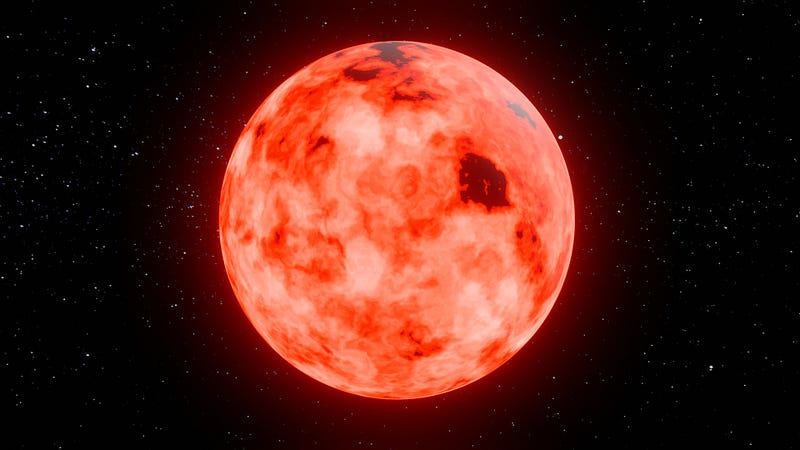
[Photo: KKolaczynski, CC BY-SA 4.0, via Wikimedia Commons]

Residents of seventeenth-century Gdansk, a city in Poland, who strolled along Korzenna Street, passed three unique townhouses along the way. The houses belonging to a wealthy brewer had a massive superstructure on their roofs — a wooden pavilion and an adjoining huge terrace. On the latter stood a pillar several meters high, supporting an unusual device called a telescope, which belonged to the master of the house.

John Hevelius, a brewer from his grandfather’s great-grandfather and an astronomer by passion, conducted regular astronomical observations from the terrace above his townhouses on Korzenna Street. Since the mid-17th century, he had been interested in a certain unusual star in the Whale constellation. This star regularly changed its brightness, and to a very significant degree. It could be so bright that it could be effortlessly seen with the naked eye. Then its brightness waned, as if it was fading. And finally it became barely visible even with a telescope. Changes in the star’s brightness occurred periodically, every 330 days or so.

Hevelius observed the star for more than a dozen years. He described it in his work “Historiola Mirae Stellae,” published in 1662. From this publication comes the name of the star that is still used today — Mira or Miraculous (from the Latin word for just this adjective). Mira, or Omicron Ceti, is the first known variable star: a red giant at one of the last stages of evolution.
Mira star animation — [Photo: Merikanto, CC BY-SA 4.0, via Wikimedia Commons]

What is a main sequence star?

Although stars vary in brightness and luminosity — as well as many other important parameters — 90 percent of those we see in the sky are so-called main sequence stars. This is the term for stars in which thermonuclear reactions are underway. Stars of the main sequence are, when viewed over a long period, in equilibrium. The continuous transformation of hydrogen into helium that takes place in their interiors balances the gravitational force that “squeezes” the star. As a result, celestial bodies such as the Sun remain stable for billions of years.

The Sun has been a main sequence star for about 5 billion years. It will remain so for about 6.5 billion more. During this time it is not expected to undergo any major changes. But later it will undergo a rapid transformation — and become a red giant.

What are red giants?

Scientists estimate that in the case of the Sun, hydrogen will be the fuel of the thermonuclear reaction for about 12 billion years. However, the amount of it stored in the star’s core is limited. At some point it will run out. Only the product of nuclear fusion — helium, which is heavier than hydrogen — will remain in the nucleus.

Nuclear fusion with hydrogen will continue to occur — but no longer in the dense nucleus, but in the star’s surface. The process will accelerate, and the star will begin to shine more and more strongly. The released energy will cause the outer layers of the star to expand. The celestial body will significantly enlarge its circumference — in the case of the Sun, by up to 200 times. “Swelling,” however, will cause the temperature on the growing surface of the star to decrease and the object will turn red. A star at this stage of evolution is just a red giant.
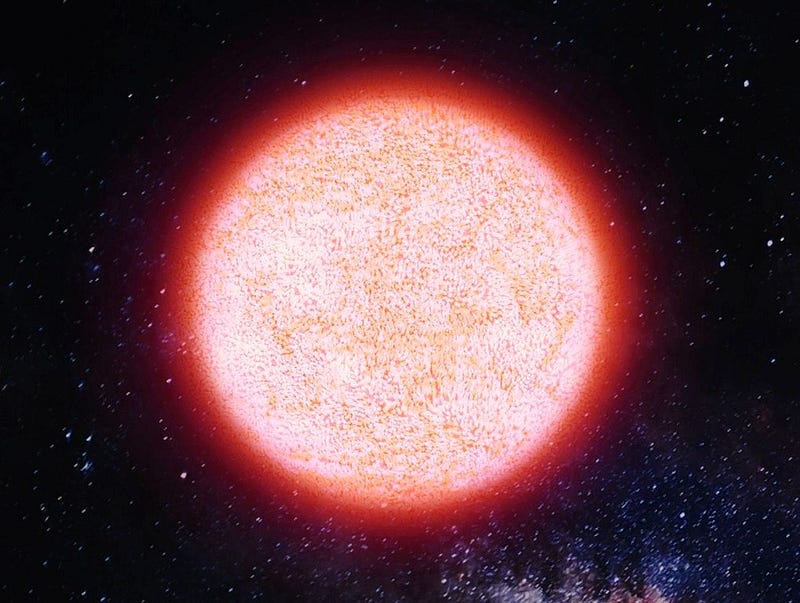
[Photo: Baperookamo, CC BY-SA 4.0, via Wikimedia Commons]

When does a star become a red giant?

This whole process applies only to stars of relatively small mass. Scientists estimate that stars whose initial mass is between 0.5 and 8–10 solar masses will turn into a red giant.

What happens next to the red giant? As the outer layers where the thermonuclear reaction takes place expand, the helium nucleus is compressed more and more. Eventually, the star’s nucleus will become dense enough that helium fusion will begin to occur in it. In this process, helium will begin to fuse, forming the heavier elements carbon and oxygen.

The ignition of the helium nucleus in a star with a mass close to that of the Sun can be very violent. When the temperature of the nucleus exceeds 100 million kelvin, a so-called helium flash will occur. Helium nuclear fusion will spread rapidly throughout the nucleus, and for a brief moment — for the Sun it’s a few minutes — the power of the reaction will match that of all stars in the Milky Way. The Sun will then shrink to about 10 times its current size.

For stars with a mass of more than 2.5 solar masses, helium ignition proceeds more smoothly. On the other hand, for the most massive stars — whose masses start at 10 solar masses — many other heavy elements, up to and including iron, are formed in the core during the fusion process. Red supergiants sometimes end their lives as supernovae.
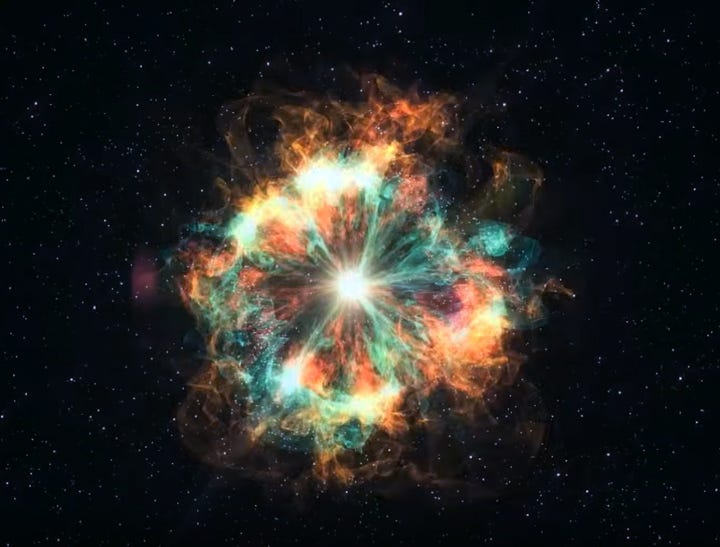
Supernovae — [Photo: License, as on date of upload: ‘Creative Commons Attribution license (reuse allowed)’ , CC BY 3.0, via Wikimedia Commons]

How will the Sun die?

The end of the Sun, however, will be much gentler. For millions of years it will be a red giant, in whose core carbon and oxygen will be formed from helium. When the helium is exhausted, the star will gradually become less and less stable. It will begin to pulsate, increasing in size and brightness, and the subsequent pulses will become stronger and stronger. Eventually, the sun will discard its outer surface, which will turn into a planetary nebula. What will be left of the star — as of any other red giant of similar size — will be a very slowly cooling core. That is, a white dwarf.

Observations of Mira, have fascinated astronomers for centuries and continue to do so. Among other things, because by following it, one can see what the declining stage of the red giant’s evolution looks like. Mira and other variable stars similar to it, or myriads, are just before discarding their outer gas layers. In 2007. NASA announced that a tail, resembling a comet’s braid, was trailing behind the dying Mira. It consists of oxygen and carbon, matter that the star has been losing for 30,000 years.

Cool that you made it to the end of this article. I will be very pleased if you appreciate the effort of creating it and leave some claps here, or maybe even start following me. It would be nice if you also left a tip! Thank you!

Space
Science
Life Lessons
Physics
Universe
Recommended from ReadMedium