
Webb telescope has taken new images of the Pillars of Creation, one of the most beautiful objects in the Universe!
27 years after the Pillars of Creation were first photographed by the Hubble Telescope, the same structure has appeared in stunning new images from the Webb Telescope. They allow scientists to study a unique part of the Eagle Nebula in greater detail than ever before.
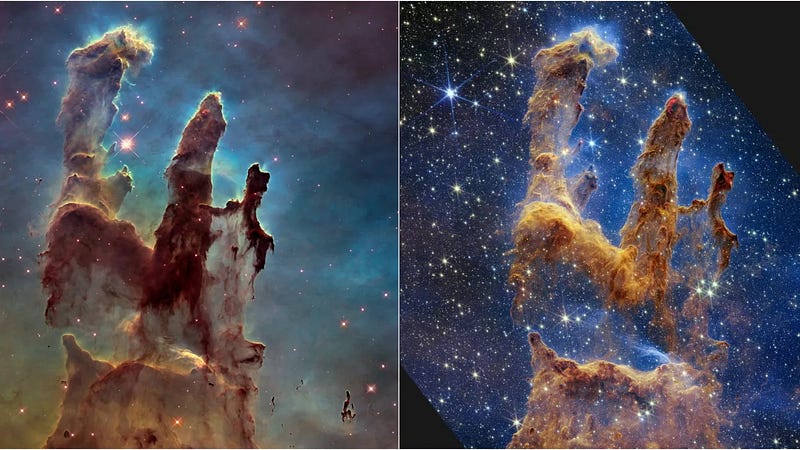
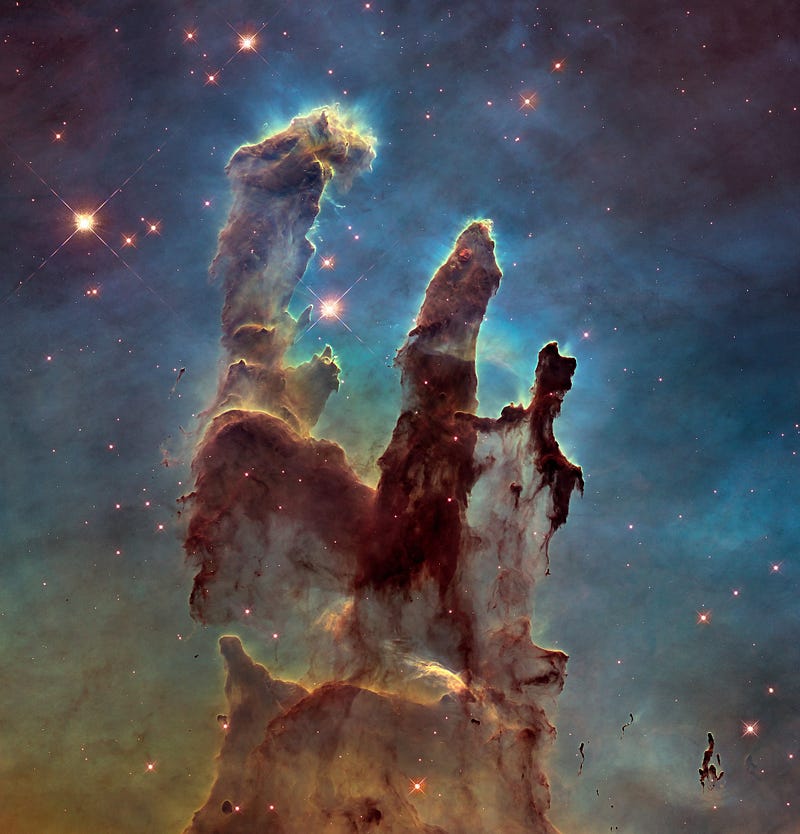
One of the iconic photos of the cosmos was taken in 1995. At the time, two astronomers from Arizona State University published a photograph created from the assembly of 32 shots taken by the Hubble Telescope. It depicted a section of the Eagle Nebula — a “stellar nursery” 6,500 light-years away from us, the area where young stars are formed.
The photo in question has been dubbed Pillars of Creation. It shows three massive columns of dust and gas, lit up at the edges, against the backdrop of the dark blue cosmos. The structures resemble the thick fingers of a giant, arranged as if slowly opening a hand. Their height is spectacular — the “finger” furthest to the left measures 4 light years.
Pillars of Creation — the most beautiful photo of the cosmos
The Pillars of Creation are very impressive, and not only for scientists. The photo has gained iconic status. This piece of space was photographed many more times later, both with the Hubble Telescope and others. In 2007, the Spitzer Telescope was pointed in the direction of the Eagle Nebula. On the other hand, in 2012. — Herschel Space Observatory.
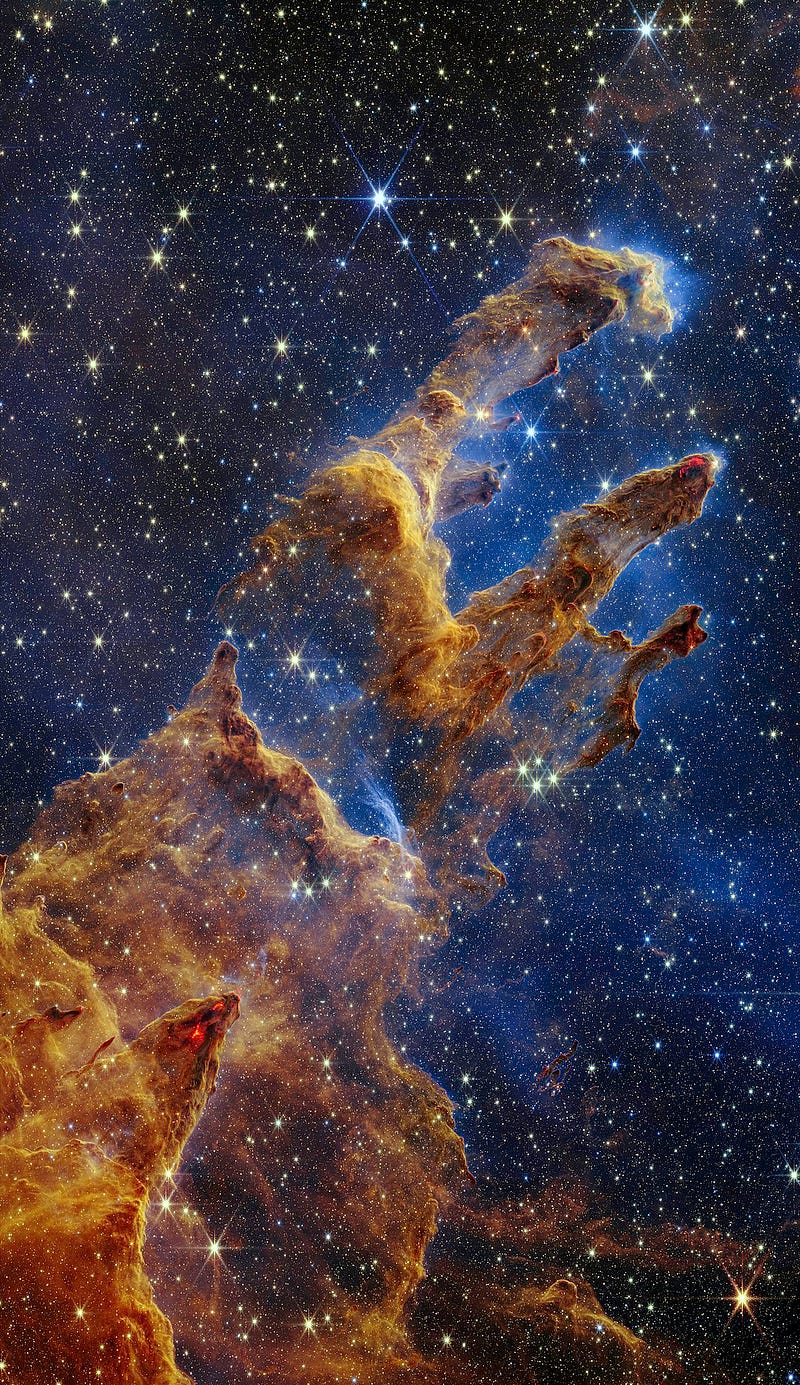
It didn’t take long for the Pillars of Creation to start being observed by the Webb Telescope as well. The spectacular results of these observations have just been shown — images showing the Pillars of Creation with previously unavailable accuracy. As we have become accustomed to, the use of this state-of-the-art telescope has made it possible to see completely new details in the well-known shots.
Red balls at the tips of the fingers
This is also the case this time. Photographs of the Pillars of Creation taken by the Webb Telescope, for example, show intense red spheres. One should look out for them, for example, at the tips of the second and third pillars.
What it is. Young stars.
“Photographs taken with the help of the NIRCam camera are directly pulsating from their activity,” writes esawebb.org. “It is estimated that these young stars are only hundreds of thousands of years old.” Thus, the Webb Telescope has managed to virtually capture their birth.
How are stars born?
Scientists estimate that there are several hundred stars in the entire Eagle Nebula that are only 1–2 million years old. Stars are formed when dense clusters of matter form in clouds of dust and gas — such as those that make up the Pillars of Creation. When a certain critical mass is exceeded, the matter begins to collapse under the influence of gravity. It heats up and attracts even more surrounding material, giving rise to a protostar.
Eventually, at some point, a jet may shoot out of it. That is, a jet of hot matter that will collide with the remnants remaining in the area after the star was formed. The effect will be like that which can be observed on water on which a boat is sailing. In the case of the apexes of the Pillars of Creation, it manifests itself as wavy lines that look like lava. These are the eruptions coming from newly formed stars.
Webb Telescope and its advantages
The Webb Telescope — like the Spitzer Telescope and the Herschel Space Observatory — takes infrared images. This is especially important if you want to observe regions such as the Eagle Nebula. Visible light — which has a shorter wavelength than infrared — scatters on dust particles. Infrared radiation, on the other hand, penetrates them, making it possible to record more detail when conducting infrared observations.
This is all the more important because regions such as “star nurseries” are of special interest to scientists. By studying them, they can test whether prevailing theories of star formation agree with observations.
Source: ESA, Science Alert
Cool that you made it to the end of this article. I will be very pleased if you appreciate the effort of creating it and leave some claps here, or maybe even start following me. It would be nice if you also left a tip! Thank you!


