
What is a Data Architect?
Tasks, Obligations and why this Role is in Demand

In smaller companies, the tasks of the Data Architect may be taken over by a Data Engineer or an IT architect. The larger the company and the larger the team, the more likely it is that the employees will specialize in a particular area, so that there will also be a Data Architect.
Tasks
Data Architects overlook the entire IT infrastructure landscape and are responsible for the following processes [1]:
- Placing data infrastructure like ML Services or Data Platforms into the IT landscape of the enterprise with respect to the IT Governance.
- Defining and, if necessary, building solutions for use case requirements, including Data Warehouses, Data Lakes or Data Lakehouses.
- If necessary, responsibility for topics such as security and access control.
- Further development of the existing systems in the direction of the Cloud so that they are scalable and can withstand Big Data.
Working Environment
As mentioned above, the tasks may be taken over by a Data Engineer or IT architect. Otherwise, the Data Architect works closely with them to build systems that fit into the infrastructure. They will also work together to further develop the infrastructure and interfaces. The Data Architect will also need a good connection to Data Scientists and Analysts if they want to deploy their models or dashboards. Furthermore, they can be part of an agile team and often work with a product owner.
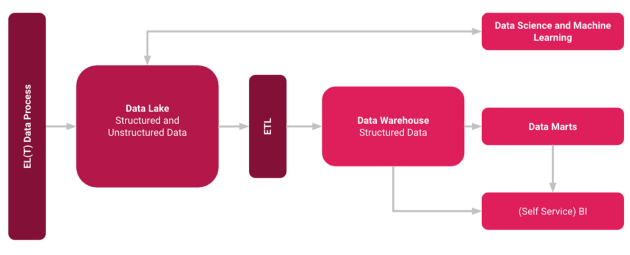
Data architectures as above are the goal of Data Architects . Often the prerequisite is the Cloud which allows modern systems like Data Lakehouses. Here, Data Warehouses, Data Lakes, ML services and other tools are conveniently linked and build on each other. This enables a faster realization of projects and data-driven products.
The Data Architect is a Strategic Role
The task area of the Data Architect is, especially in comparison to database administrators, more visionary, conceptual and strategic than practically oriented. Data Architects design schemas to accelerate a company’s workflow and then cast their often very idealistic concepts into practical forms. They are also tasked with implementing and helping to develop the specifications of general IT governance.
Summary
I hope this article has shown you in a nutshell what Data Architects are and what their tasks are. Also, it should become clear that as companies become more and more data-driven, their relevance for business is getting bigger and bigger. The demand for data architects is therefore likely to remain high or even increase.
Sources and Further Readings
[1] Dr. Kilian Semmelmann, Was ist Data Science? Definition, Aufgaben, Prozess und Beispiele (2021)


