
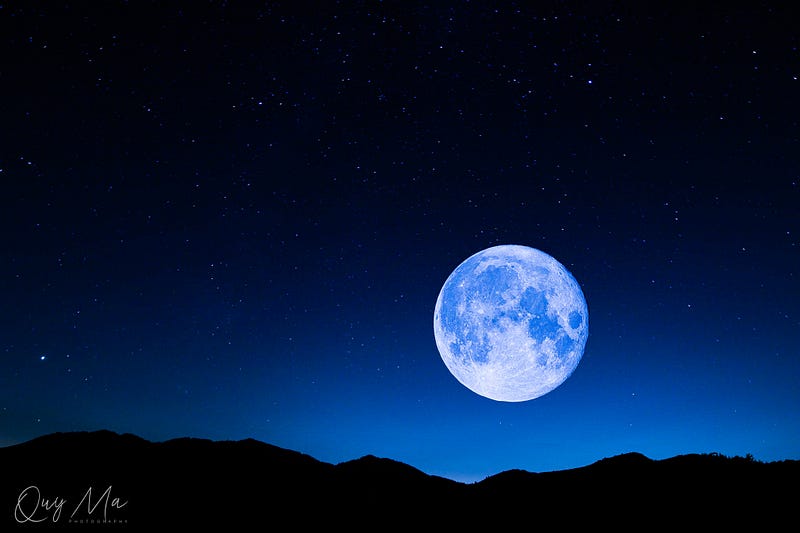
What is a Blue Moon? And is a Blue Moon Really Blue?
It’s not. But it’s still awesome.
Blue Moon? What is it?
What is a blue moon? I asked myself that question when I saw a CNN article referring to it. The article was titled “When you can see the rare ‘blue moon’ this August 21–23” and explained what it was and when you could see it.
I google “blue moon” and looked at some images. “Oh wow,” I thought to myself when I saw a few beautiful pictures of a blue moon. I went to Instagram and browsed a few more pictures before seeing a photographer remark that the blue moon in his picture was filtered. That’s when I realized the moon isn’t really the color blue.
There are two instances of a blue moon. The first is a rare phenomenon that happens when we see a fourth full moon in a given season. This blue moon is called a seasonal blue moon. Typically, a season has three full moons. The second is when a second full moon happens in a calendar month. This event is called a monthly blue moon.
What we saw this past weekend of August 21–23, 2021 was a seasonal blue moon. A seasonal blue moon “happens about once every 2.7 years” on average.
Is a Blue Moon Blue?
But what about the color of a blue moon? Is a blue moon really blue? The short answer is no. A moon turning the color blue is extremely rare. According to Sky & Telescope, the moon can turn blue when “volcanic eruptions or forest fires send lots of smoke and fine dust into the atmosphere.”
For the past few weeks, there has been lots of smoke filling Utah night skies. Ironically, the Utah skies had just cleared this past week, giving way for us to observe the nice full blue moon. But without the forest fire smoke, no moon was blue this weekend. If that was the price to pay for clearer, cleaner skies, then not seeing a truly blue moon was okay with me!
However, it still sparked my curiosity and imagination. I wondered how I would have seen a moon that was blue this past weekend. Seeing different interpretations of a literal blue moon by many different photographers inspired me to make my own take.
I grabbed my equipment to go shoot the moon. I didn’t need to go far — just in my front yard. The moon was very bright and illuminated the street as I stepped out of my house. I looked up at the sky. Despite reading about the blue moon not really being blue, I still was half-hoping it was. “Oh, well,” I thought to myself. “The moon is still beautiful.”
I snapped away.
Blue Moon over Utah Wasatch Range by Quy Ma
Picture was taken August 2021, Utah with a Canon EOS Rebel SL1 and RedCat51 telephoto lens.
To see more of Quy’s astrophotography: Instagram @quymaphotos


