
What I Saw On Google Search Results Page # 18

Today, I was browsing Google for some UI inspiration for my ongoing project.
Specifically, I was searching for a website whose name I had forgotten to bookmark.
I was trying different keywords based on its features that I remembered.
I ended up clicking every page of the Google search result for the term: Create icon online with tint.
When I reached page #18, I was welcomed with reCAPTCHA monster:
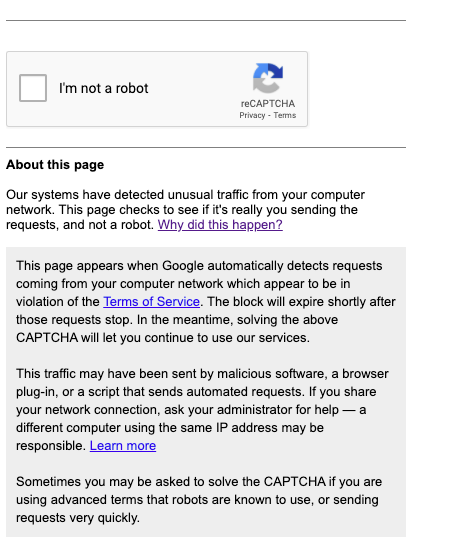
Already exhausted in desperation, it took me some time to grasp the fuller meaning of it. I couldn’t believe my eyes. Was I on Google.com?
It was indeed Google showing it to me. This was Chrome browser. I wasn’t logged into my Google account though, or it would have been a different story.
I felt compelled to change my mental context. The UI search could wait.
Upon clicking the Terms of Service, I was taken to a megalith document that described how Google did business. Maybe it was there, deep down in the gigantic links labyrinth that Google is, but I couldn’t find it.
Exhausted, I ticked the I’m not a Robot, and I was taken to 4x4 grid photo collage displaying cars. The images were extremely low quality (almost blurred). After 4 failed attempts, I managed to get past the CAPTCHA filter.
I had to break for lunch. I was frustrated. Not only my work was unfinished; I was also distracted.
Why Those CAPTCHAs Appeared Anyway?
Past lunch, I revisited the link that got me the CAPTCHA — just to inspect the content of the message. Upon clicking Why did this happen? — I was taken to a page that said Google detected some suspicious network activity from my IP.
Traffic lights — my easiest encounter with CAPTCHA
I took some 10 minutes detour to inspect my mac for malware. All clear, when I revisited the link, the CAPTCHA still appeared despite I had cleared it before. The link was dumb — it didn’t detect I had already answered the CAPTCHA.
I decided to try it one more time. This time, I was welcomed with series of better quality images showing random vehicles. It took me 3 attempts to clear the hurdle.
Finally came the traffic lights — my easiest encounter with CAPTCHA during my online life filled with 13527 sign ups.
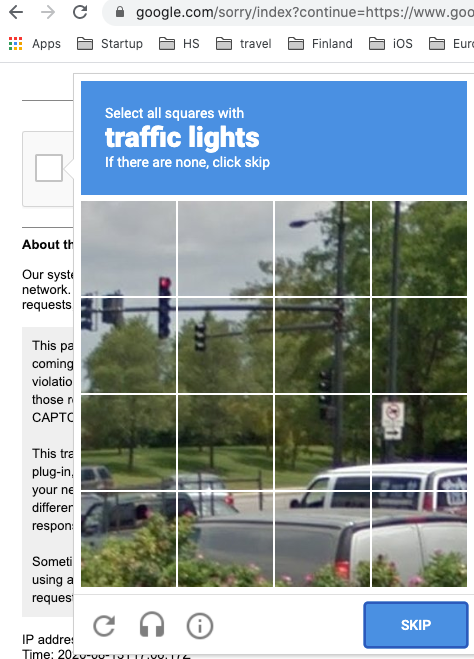
They were so easily discernible that every time they appeared, I called my son to click it for me.
Initially, he felt joyous doing it. But lately, he has been scowling at me for thinking it was some wonderful exercise.
He also asked why a computer couldn’t identify it if it showed up in almost every PC game he played.
So I Decided To Google The Problem:
I came across a stiff but enlightening discussion on Google support thread. Google basically admitted that it happened mostly when one used VPN to circumvent some network access restriction, but it was clearly not the case.
Which human would go past #17 page in search result (in less than a minute) these days?
I or my network provider had not undergone any configuration changes between my clicking #17 and #18 pages of the search result. Maybe Google thought my browsing habit was unusual: Which human would go past #17 page in search result (in less than a minute) these days?
To Google servers, I was probably orchestrating a DDoS — a cyberattack that could cripple servers with indefinite number of requests in short time.
When I broadened my Google (!) search about Google search CAPTCHA — I came across an article that confirmed the same. But I wasn’t satisfied. After all, I had done this in the past at least a hundred times, without any CAPTCHA wall.
Then I came across a page that claimed that this is how Google tests it’s driverless AI.
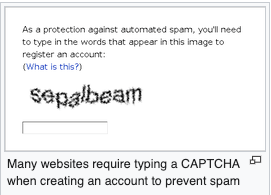
😦 That explained why all images belonged to vehicles, roads and traffic lights.
Just like illegible pages of books that earlier CAPTCHA flaunted to accomplish Google Books project.
In other words, on the road images of all qualities captured by WayMo’s cameras could be fed to Google Search engine, which will flaunt those images to search desperados like myself, telling them they did something suspicious network operation to deserve this.
Until they solved it with squinting eyes and restless brains, no free search results anymore.
Solved images will be fed back to Waymo’s AI engine as positive images: Car images it thought to be of cars were indeed cars (minus a few trucks), and so on.
But That’s What They Call Crowdsourcing:
In a nutshell, it is this:
- Waymo cannot differentiate between a car and a tree
- As a result, Google.com tells users it cannot differentiate between a human and a robot.
- Screwed up UX = AI tax paid by users. Giving back to Google for 20 years of web evolution — what can be more romantic?
It is crowdsourcing in its purest form, used to populate the most crucial component of data science: Data.
The problem is, in this case, it is ambiguous. And also on the offensive line (suspicious network activity, you hacker!), without any doubt.
Privacy is the cheapest commodity everyone exchanges for utility.
Crowdsourcing concept as a tool to collect data isn’t new.
Waze, a GPS app, heavily relied on crowdsourced traffic data collected from its in-transit users. In 2013, Google bought it for $966 million, making all of its 100 employees millionaires.
How much Google may have earned from this data is no one’s guess. But after all, it’s all been disclosed with one tick privacy checkbox. And many companies have done it honestly, reasonably and shamelessly.
And privacy is the cheapest commodity everyone exchanges for utility. Until they collectively know it’s too late.
Where Does This Put Google On Search Pedestal:
There was a time when Yahoo and Alta Vista were the only search engines. Search wasn’t a daily habit, and Google wasn’t a verb.
When Henry Ford made cheap, reliable cars people said, ‘Nah, what’s wrong with a horse?’ That was a huge bet he made, and it worked.
Elon Musk
Then Google came up with Pagerank.
Pagerank was a life-changing technology that could be sold to premium searchers for $10 a week.
But Google adopted a different business model. It chose to democratize the web mushrooming with new online shops and blogs. This unique business model of selling keyword rankings yet allowing rank for relevance fueled the Internet.
In late 2001, I heard about Google for the first time. I visited it just for the sake of taking a look. I instantly loved the Page 1 minimalistic UI, followed by rocket-speed search results unimagined in those days.
That first page UI hasn’t changed much these days.
UX has, unfortunately.
Serious stuff gets submerged, while fluff rules the rankings.
Today, a simplistic Google search on How to start a startup yields a bulleted list that seem to follow Google’s guidelines. My 15 year old nephew tells me it’s the stupidest thing he ever saw.
Make a business plan….
Secure appropriate funding….
Surround yourself with the right people….
“Anyone who followed AMP could rank #1 without deep diving into real stuff. That’s how serious stuff gets submerged, while fluff rules the rankings.” he said.
AMP — Accelerated Mobile Pages — is Google’s open standard. It is a format which, if followed by a website, can help Google parse it faster, thus saving some power (environment, anyone?) + precious $$$. In return, the website gets a higher ranking compared to non-compliant website.
AMP isn’t infamous without reasons. It also helps Google display stuff from media website inline, thus digging into their revenues. Companies small and large and CMS sellers (Wordpress et al) had to hire AMP developers just to retain their presence on the web, or devote their time after rankings taking away attention from their real digital businesses.
Conclusion:
If it is free, you are the product.
— Popular wisdom
I stopped thinking more. After all, it was just a CAPTCHA, used by thousand other websites that often blocked me from signing up.
(Spoiler: In 99% cases, they lost me)
It was serving a purpose, sure. But for whom — I wasn’t sure.
I typed duckduckgo.com in my address bar, and hit enter. Then I typed the same search term I was trying in Google for my project UI.
Scrolling on Page 1, clicking More Results a few times brought me to the site I was looking for.

Somehow, the tranquil feeling that filled me clicking the Duckduckgo More Results button reminded me of how I felt when I saw I’m Feeling Lucky, back in 2001.


