
Secret Sauce of Building a Billion Dollar Startup

Every year I attend startup conferences. They are replete with novel business ideas.
Kids fresh out of universities have amazing things to display: Immersive educational apps, facebook games, smart vehicle sensors and 3D imaging software for factory planning.
Indiehackers.com, a community of solo entrepreneurs that got sold to Stripe, often features founders who share product + marketing ideas and monthly revenue growth. IH founder Courtland Allen summarizes what makes most founders successful:
- Startup success doesn’t happen overnight
- Most successful businesses focus on enterprises instead of consumers
But that is about average startup success.
What makes a business extremely successful in a game-changing way?
How can startups increase the probability of turning into the most promising megaliths?
What do the modern world’s extremely successful companies have in common?
It Is Not the Idea or Execution:
And not even the founders’ drive or persona.
Maybe those things are important, in making a few million and sell out to a shark.
They all say the idea isn’t enough. They all say the devil is in the details. And yet, even great executions fail when they happen before time. In fact, execution casts such a wide net around every startup process, that it is difficult to pinpoint real reasons behind the startup failures.
Was it a product bug? Was it a failure of the company culture? Or was it the overspending by management?
Successful companies do not rely upon just these two factors. They rely upon a third factor that acts as a multiplier to idea and execution.
When you buy a Sony headset from your nearby electronic store in a small town, you add to Sony’s profits. What made you do so? Was it the founder’s idea? Was it the headset design specs made by engineers?
For every single Sony, there are ten better headset makers whose names you have never heard. In fact, Bose has a premium quality product line to attract rich customers.
Yet, in your small town, it’s Sony that’s available to you, and you will proudly buy it without hesitation.
It’s the simplicity of Sony’s outreach. Imagine the complexity with which it dealt with every business outlet to make it available in your small town.
It’s called a business model.
Business Model # Supply Chain:
Before you dwell too much on Sony, let me tell you: this is not about creating a great supply chain. What Sony did was to set up a supply chain, but the concept involved is much bigger than just the supply chain.
The supply chain is an important aspect of Sony’s business model.
For a startup that sells digital products/services, defining the business model has a different meaning. It may include a supply chain, or it may be fully online and automated.
The key thing is the business model, not the supply chain.
Business Model # Marketing:
You have a digital product/service. You sell it online or visit businesses that could buy it.
In both cases, you put out ads, generate leads, go to summits and talk to people.
But that’s marketing.
But isn’t marketing the silver bullet to maximize your business outreach? That’s what Sony did. That’s what every brand does. Make it a household name, and every hawker in the street will sell to you that brand — even its fakes.
The thing about marketing is, you can’t sell 100 headsets even if they are perfect clones of Sony’s. Even if they are better than Sony’s, you need a lot of luck outsmarting an established brand.
Good marketing is part of your business, not the business model.
What is a Business Model?
Today’s big tech companies (whose products you can’t do without) rely on their smart business models. That list includes Google, Apple, Amazon, Facebook, and Microsoft.
Their secret sauce of success is their business model, which does something very few companies can do:
Their business model is part of the product, and it is part of the marketing. Yet, it is beyond both of them.
It’s like a soul that inhabits your body and mind.
A good business model is what enables you to interweave marketing with the product. It empowers you to ingrain marketing inside design.
Business model is very complex to derive, yet it looks deceptively simple to your stakeholders and customers.
It’s like a movie that turns blockbuster by word of mouth.
But it’s much more than that.
For now, this isn’t entertainment. (even if we use Youtube as an example of a successful startup)
The Secret Sauce Which Is Not So Secret:
When Cambridge Analytica surfaced, millions of social media users became aware of how their data was being treated by Facebook. It wasn’t that they never saw a facebook ad before.
But the revelation made them actively aware of the fact that Facebook wasn’t just ad-supported. It was an ad-centered platform.
Before that, they simply viewed it as a cool way to connect with their friends. Doing this, Facebook grew so huge that it could not be destroyed even past scam-ridden legal exposure.
If you are thinking this is about encouraging to steal users’ data, no, that’s not the point I am driving.
It’s about the power of the multiplier effect that the business model holds over idea and execution.
In the olden days, businesses went out to local customers and sold their products/services.
With advanced communication and transportation, the supply chain was introduced. This way, local outlets sold their products. In making small sums for themselves, those outlets ended up creating the brand for the makers.
What was the takeaway?
Local outlets, combined with product manufacturing and distribution created much powerful business model.
In tech world, to do this affordably, you need a newer business model. If you design something in California and manufacture it in Taiwan, you need a shipping company that ships to a country that generates the most demand. You need cost-effective cargo contracts. You need volumes huge enough to steal dirt-cheap shipping rates.
Or, you need a price tag that a premium customer would pay for. That could offset the hefty shipping to make it available in the smallest town.
How many features and innovations would make that sale viable for your ideal customer? You are back to product design.
The 3 Ingredients of Profitable Business Model:
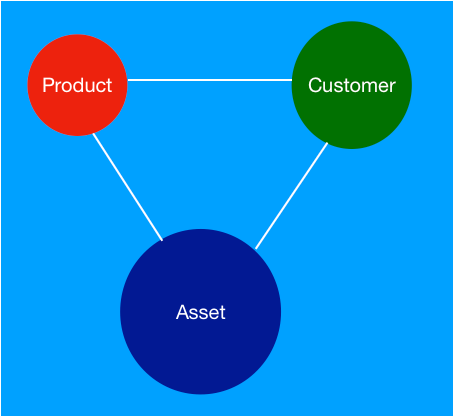
A product is what you sell to your customers. Product sale generates revenue.
Assets are what you acquire, either through investment or by hard work. More assets you acquire, more you do it in line with your offerings, more you can sell.
Genius but rookie founders often build their assets quite late in their business life cycle. When they realize it’s the most crucial part of their business model, it is too late.
Google’s Pagerank was its founders’ research paper. The idea was innovative. The execution was spotless.
Imagine if Google founders sold Pagerank as-is. Every user pays $0.001 per Google search. Were they crazy? Why allow free searches? Servers weren’t cheap in those days.
OK, that was too much. Maybe, users would get 1000 monthly free searches. Above and over it, they would pay $10/month.
Instead, they decided to build yet another thing on top of their product: their asset.
Every successful business follows this secret formula:
Value of Asset > Value of Customers > Value Product.
Assets are what bring customers to products.
What was Google’s asset?
Organic rankings. Their website data, freely accessible by billions every day.
But isn’t that Google’s product?
Hell No!
The search was their tool for consumers who wanted to find information from relevant websites.
Google’s customers are advertisers. Their product is Adwords.
People who search are Google’s consumers, not customers.
Search function (billions of visitors) & Organic rankings (billions of websites) are Google’s assets.
Empowering those assets resulted in enriched CTR offerings to its customers, and keyword auctions skyrocketed their revenue to billions.
And why those assets grew?
A fair search result spot without paying a dime was Google’s dart that hit the bull’s eye. In the early days of the web, every website got a level-playing field in getting discovered by consumers.
When competition increased, AdWords paid handsome ROI on their marketing dollars. It was win-win for both Google and website owners.
I do not recall seeing Google’s ad in print media during its inception period. For that matter, I haven’t seen its ad even on Yahoo.
When you empower your assets, they speak to your customers on your behalf.
When you design your product so that multiple actors could benefit from using/selling/marketing your offering, there is nothing in this world that could stop you from creating a billion-dollar empire.
That product could run in losses for months or years.
But when it rains, it pours, and life becomes impossible without it.
OK, but That Could Only Happen in Marketing:
We all have that infamous example of Facebook. To this day, legal troubles notwithstanding, facebook ads have crazy conversion rates.
But that doesn’t mean asset-building only applies to the advertising companies. The fact is, older businesses did it in the form of partnerships, retail channels, and buyer-supplier relationships.
Amazon:
Consider Amazon. They started out with selling books, then gradually expanded to every retail artifact in the world, even taking heavy losses.
While selling local seller’s products, offering them warehouse + payment solutions, Amazon filled up its huge oil barrels (remember? Data is the new oil). Today, it has mostly digitized retail. It knows exactly what is being sold in every part of the world.
Yesterday, sellers and buyers bathed in heavy Amazon discounts. Today, sellers are at the mercy of Amazon offering them online space. A few negative reviews could remove you from the Amazon shop.
Shoppers’ choices shrink every time a local book shop shuts down, while Amazon is already selling product search rankings.
Amazon is a classic example of assets paying out compound returns.
Apple:
Apple came out of its shackles past Steve Jobs’ return but wasn’t quite Apple the Great. iPod’s success was a booster dose it needed for its next big innovation.
When they launched the iPhone in 2007, the world was in awe of a device that could make a phone call, browse the internet, and set up a few reminders.
But what did Apple do to convince the world to buy a newer smartphone when the cellphone revolution had already happened, and worthy players had already won?
It wasn’t an innovation enough to win over the world. Increased productivity with softened thumb-typing — how much would you pay for that in 2007? But you did. Not just once, not twice, but every other year, year after year, till now.
A classic case study on how you generate demand for a novel, premium product without market research.
Customers don’t know what they want until you show it to them.
-Steve Jobs
With what did they achieve that? With Apps. Apps and Games.
The smartphone wasn’t Apple’s invention. But it was Apple who turned a smartphone into a thousand devices.
And how did they do it on such a bigger scale? By introducing the App Store. The first of its kind which offered 70% of its consumer revenue to developers.
Apple partnered with millions of developers to let them earn their dues. It opened its classy, secure hardware platform that was behind the curtains.
It made it sound fair to the point that they flocked to it with their best creations.
App Store developers became Apple’s unadvertised assets who advertised iPhones with on own budgets and websites.
Following the App Store introduction in 2008, to save the remains of the bigger pie, Google rushed to announce Play Store in Oct 2008. Those were the years of the app gold rush. Amazon even fought the legal battle to claim the title App Store for itself.
Microsoft:
In the 70s and 80s, Microsoft sold Operating Systems to PC makers like IBM. A part of its strategy was to allow piracy for home users. Their reasoning was to nurture newly formed home-based PC users.
When those free users grew young and worked in companies, they were overly reliant on Microsoft applications (MS Office). As a result, organizations couldn’t do without Windows licenses.
Microsoft leveraged Windows as an asset and sold applications as their products, keeping it afloat even past IBM era.
Business Model Is Not How You Market or Make, It’s How You Live:
It’s how you design your product. It’s also about who you sell to. It’s also about whom you share your profit with.
It’s about who you empower.
Those empowered end up building your asset bases. They do it in the proportion of what they get from you.
Youtube did it for video makers. Udemy and Pluralsight did it for teachers.
This isn’t about hiring the best talent.
This is about sharing your profits with the most meritorious out there, who live in the shadows and don’t have the means or courage to change the world in their own big ways.
A business model is how you design. It’s how you sell. But it’s also how you grow from zero to billions. It defines every atom/bit of the product/service you sell. It defines their interactions. Your success depends upon how much you give back without burning your own profits.
A business model is how you build your most precious assets.
A business model is how you live your business.