
What I Learned From Building 9 LEGO Speed Champions Cars
Nine hours, nine cars, nine major conclusions…
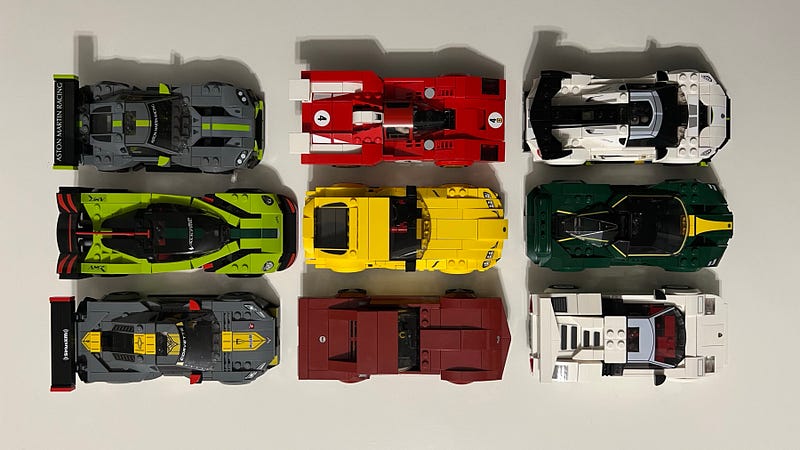
Alright. Over the last few weeks I was on a mission. I wanted to build back-to-back a bunch of LEGO Speed Champions cars and see if these otherwise small sets are worth getting into. Traditionally, I’ve been a huge fan of large sets — the larger, the better, in fact — but I wanted to remove that bias. As a LEGO reviewer, I felt that I’m underserving both potential and existing fans by ignoring these smaller sets just because of their size and piece-count.
I also suspected that by building back-to-back many Speed Champions sets, I would learn a few more things about LEGO itself, this series and what it has to offer. Needless to say, I have learnt a lot. Initially, I planned only to build five cars, but ended up building nine! Keep reading and you’ll understand why.
LEGO isn’t expensive
I have never been more sure about this. Perhaps LEGO isn’t the cheapest of toys out there, but anyone claiming they’re overly expensive, clearly hasn’t done their homework or spent more than two minutes on the LEGO aisle. LEGO can be very affordable and can offer great value for money.
The Speed Champions are probably one of the best and most affordable sets for their size. Each car is about 250 pieces, and you get that for less than 20 bucks. In my view, that’s a pretty good deal even at official prices. Keep an eye on them, and you could get these even cheaper at third-party retailers. The larger sets that contain two cars often get down-priced from 40 bucks to 35, or even 30, making each car cost just around 15 bucks.
No better way to build cars
I am stating this as someone who loves massive Technic sets, and chief among those being the supercars like the Porsche or the Lamborghini, that building Speed Champions cars is kind of actually more fun. The large Technic sets can become quite an exhausting building experience because of their sheer size and technical complexity. You do get an awesome-looking car at the end, but after 10 hours of build-time, you’re happier about finishing than the result itself.
The Speed Champions flips that upside down. These cars are fairly easy to build, they’re just as great to display, and the attention to detail for each design is actually quite admirable. You need very little space because they’re small enough, and you keep being focused on the awesomeness of the build and the intriguing building techniques and pieces you get, instead of gradually getting exhausted by the building experience.
LEGO is gaining evolutionary velocity
Having played with LEGO for nearly three decades now, I can really see the evolution of the company and its designers. Remembering what we had back in the 90s, compared to those cars, these are infinitely more advanced. The funny thing is, most of it is still achieved with fairly standard bricks. Sure, there’s a wider variety of them, but very few so-called “exotic” pieces in these sets. I would say about 50–60% of pieces are repeated across the cars, except maybe in a different colour.
Those wishing back the classic lego age should really take a look at these sets. Other than the stickers — which I do find annoying — these are probably the sets that contain the least amount of “specialised” parts that LEGO nostalgics hate so much. I think they’ll find the experience quite eye-opening. Looking back at 80s and 90s sets, those now almost feel embarrassing, knowing that LEGO could have done this stuff all along. But then again, that’s how evolution happens, right?
Very clever building techniques
I hinted at this already, but I think it’s worth highlighting again. The Speed Champions sets, besides being great to look at, will actually teach you countless cool techniques you can use going forward for your own MOCs.
Needless to say that building these sets to the accuracy the designer intended can only be done with SNOT building techniques and clever use of jumpers and angled pieces. The way I see it, LEGO designers are stating that anything that fits, is a legal building technique, and I am delighted to see that, as there were far too many fans out there bashing MOC designers when they found a new way to connect bricks to each other. Speed Champions ends that debate once and for all.
One hour of build-time is all you need
Here’s the thing. For some of us, building LEGO sets is not just a hobby, it’s also an act of rebellious relaxation. We want to keep the child inside us alive, and we want to find excuses to remove ourselves from the daily mundane or stress. Of course, that’s not always an easy task.
The Speed Champions sets allow for this better than most other LEGO sets out there. All you need is an hour, perhaps even less. You open the box, the bags, you flip through the pages of the instruction manual, and soon enough you have a finished creation in your hands, one you’re happy to display but equally happy to take apart and mix its bits with all your other LEGO.
The bottom line here is that within an hour or less, you have de-stressed, you got the near-instant gratification of seeing a finished set that actually looks great, and ended your day or week on a positive note.
It becomes addictive
Remember, I said I wanted to build five cars, but ended up with nine, yeah? Indeed. Due to their affordability, these are easy to pick up and not think twice about the cost. That however also means you’ll buy more of them than you initially thought you would.
Building just one or two Speed Champions cars is enough to get hooked. Because they’re fairly easy to build, but intriguing enough not to become a boring experience, these sets will make you want to buy more of them. The fact that there is an entire series, also doesn’t help. Having two will make you want to collect all of them for the foreseeable future. Beware. Affordable sets can become an expensive hobby too if you buy them by the dozen!
Still not enough female representation
It’s not all great news, though. While LEGO is certainly trying, it still has plenty more to do around inclusivity, and by that, I mean a little more variety around the minifigs. Out of the nine cars I built, only two of them had female driver minifigs. I doubt that’s good enough.
I am not suggesting LEGO start doing 50–50 on their Speed Champions and add an equal number of female minifigs, but rather something entirely different. What, I think, needs to happen is include with every car, two minifigs or, at the very least, two heads and two kinds of hairpieces. Let the customer decide who they want behind the steering wheel — Jane or John.
Vintage replicas are the best
If you filter down to the Speed Champions sets on the LEGO site, you will notice something. LEGO designers somehow manage to design the vintage cars better than the modern, contemporary ones. This is not necessarily a critique to their abilities, but rather that there appears to be a bit more passion going into the vintage replicas.
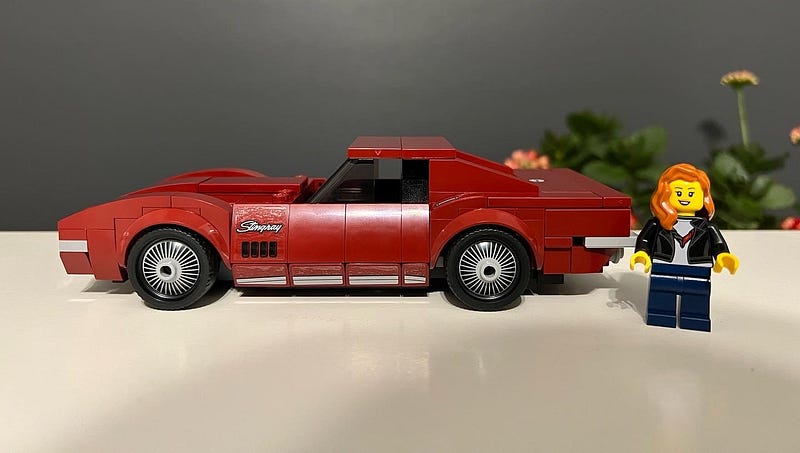
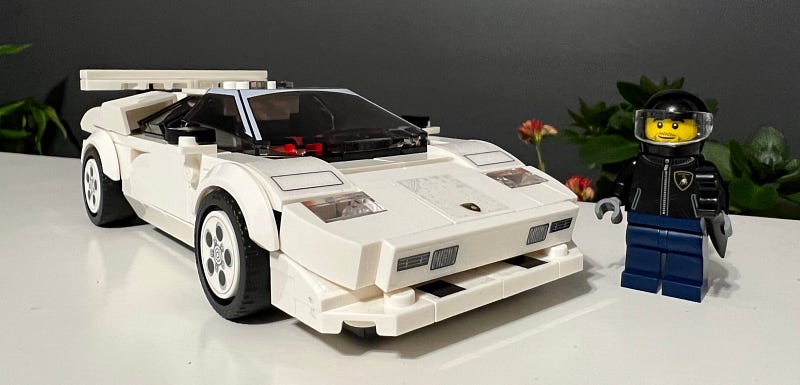

Looking at the Lamborghini Countach, the 1968 Corvette or the 1970 Ferrari, all three of them just feel a little more polished. Maybe the straighter lines help designers achieve more when architecting these replicas, but looking at the upcoming 007 Aston Martin and the 1970 Dodge Charger, I can see again the same extra attention to detail. If that’s truly the case, I would love to see a classic Ford Mustang. Would look bloody amazing in LEGO!
Excellent variety of pieces
Here’s the thing. If you want to start a LEGO collection and build MOCs, perhaps the Speed Champions are a great place to start. Not just because they’ll give you ideas, and teach you remarkable building techniques, but also because you’ll get an impressive variety of pieces.
You’ll have a ton of minifigs, all sorts of bricks and plates of various shapes and sizes. Tiles too by the bucket, which will enable you to build smooth surfaces. Slopes, angled plates, wheels, transparent bricks, wind-shields of various shapes and sizes, bendy bits and even a few Technic parts. If you’d take all these nine cars and mix them all up in a box, you’d have over 2500 pieces to build virtually anything you like, and all for less than 160 bucks.
Did I get you excited?
Good! Because I will review each and every car of these nine I built, over the next couple of months, so to stay tuned all you need to do is subscribe, follow me and my publication Bricks n’ Brackets and you won’t miss any of them!
Attila Vago — Software Engineer improving the world one line of code at a time. Cool nerd since forever, writer of codes and blogs. Web accessibility advocate, Lego fan, vinyl record collector. Loves craft beer!


