
What I Learned About Life, Love & Sex From My Great-Grandfather
Two writers, a century apart, trying to understand the workings of the human heart
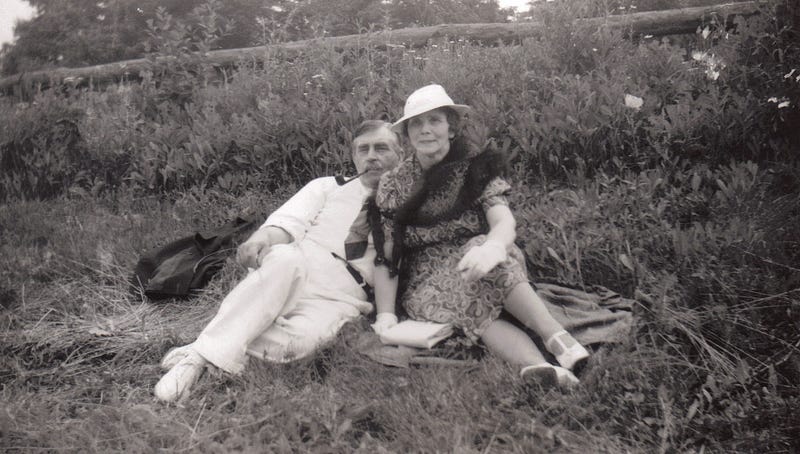
My grandfather died in 1994, when I was 18 years old. I was obsessed with genealogy at the time and was thrilled when I discovered Grandpa’s boxes of old photos, family journals, and genealogical notes.
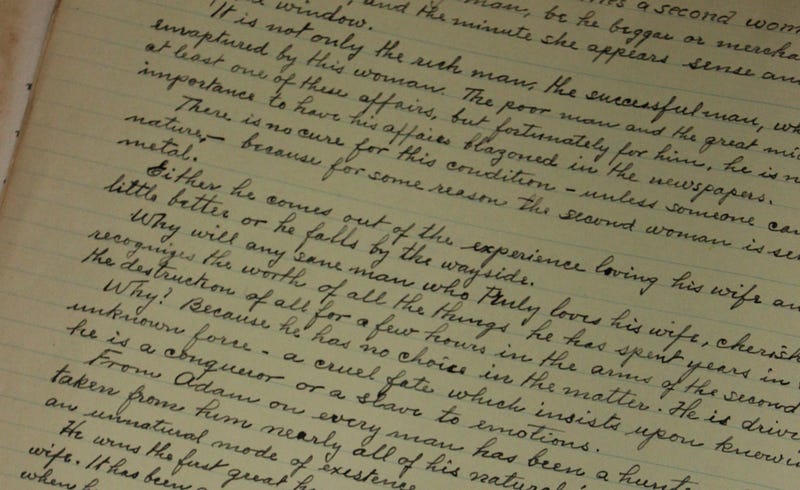
One of the most fascinating finds was his father’s — my great-grandfather’s — journal. It was filled with musings on society, economics, social observations, and notes about love…and sex. Yes, sex.
Some of it, I could not read. My great-grandfather brought his family to America around 1920, from Denmark. He, his wife, my grandfather, and my grandaunts and -uncles were fluent in many languages — Danish, Norwegian, English, French, German, Latin — and they often wrote or spoke in multiple tongues.
What Great-grandpa wrote in English, though, I read over and over. Oddly, I wasn’t able to grasp a better understanding of his personality by reading through his journal. My opinion of him vacillated quite violently. Was he a sexist, privileged, wealthy, overly-educated man who treated women like a commodity? Was he a curious philosopher whose sexism was simply a product of his time, his culture?
He died long before I was born and my grandfather never spoke of him. So who was this man who felt as compelled as I did to scribble away about sex and love in his notebooks?
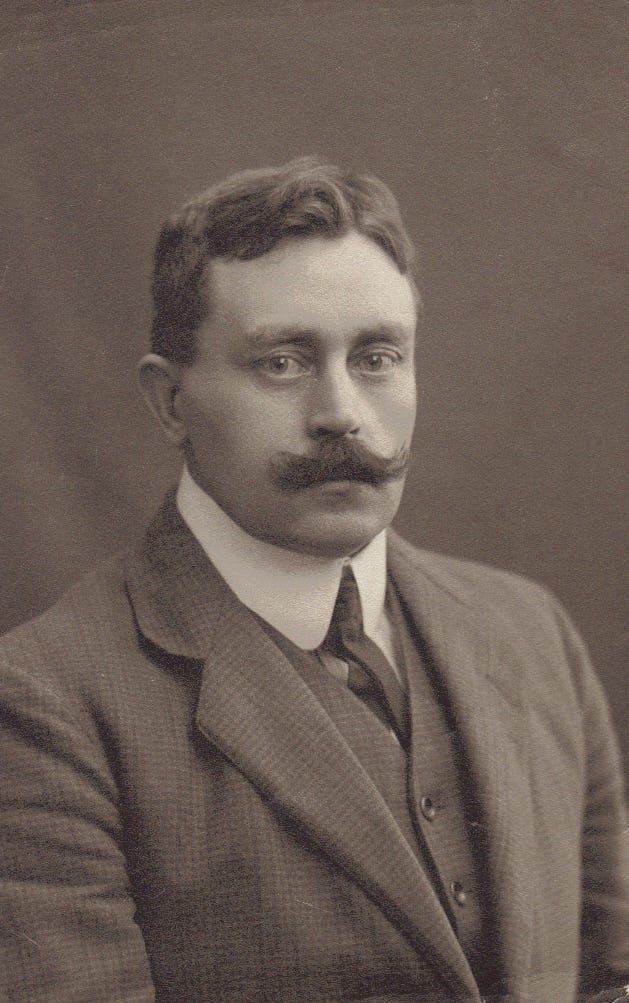
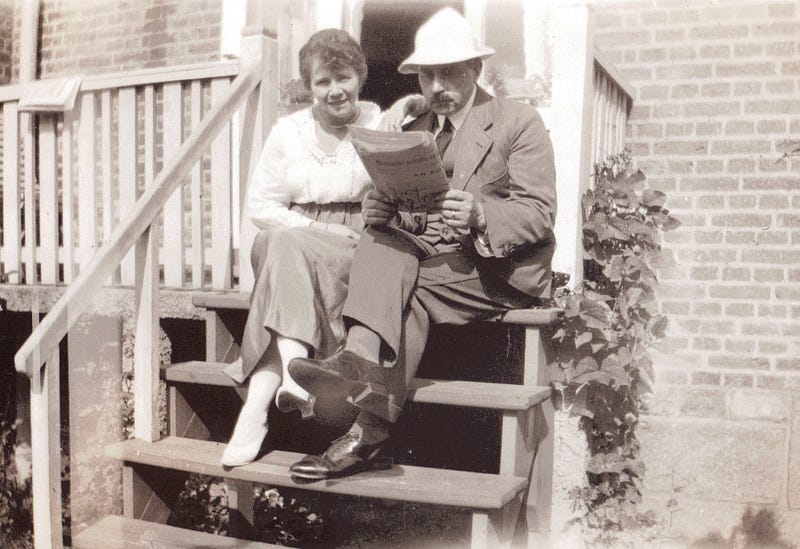
His name was Anton. He was born in Copenhagen in 1873, one hundred three years before my own birth. He married a young woman from Norway, named Louise. Her family was in the business of making copper pots and kettles.
Together, they had four children — two girls, then two boys, just like my family.
We know they lived a good life in Denmark, but after their eldest child died at the age of 21, they made the decision to come to America with the remaining three.
I know all the facts, but I want to know more. What was their life like? Were they happy? What went on behind closed doors?
A Good Wife
I have a fascination with love stories. Not for the typical reasons. I’m not trying to look for confirmation that “true love is real” or couples can “make it.” I’m interested in how humans express love, what love looks like in different moments in history, how humans choose to define love and relationships.
So of course, I would love to know how my great-grandparents felt about one another. Were they in love? Did their well-to-do parents orchestrate the marriage for financial or social reasons? How did they fare in their long marriage?
Great-grandpa Anton appeared to want a sensible, good wife — such a cliché, I know, but to be fair, it was a very different time. In one of his journals, he wrote:
One of the funniest things about the cult of modern beauty is that while it is encouraged on the theory that it will hold husbands, its devotees lose theirs with alarming regularity. Beauty culture for hobbling straying husbands is largely a failure. A lot of women who depend on it now suffer from diminishing alimony returns as well as from plucked eyebrows. If they had coaxed along their husbands half as hard as they did their complexions, they could have had a comfortable fireside seat cinched forever. But they were so busy enhancing their charms that they had no time to practice the arts of the good wife.
The “cult of modern beauty” is still alive and well and I love to write about it just as much as Great-grandpa…but not for the same reasons. I think the cult of modern beauty is just as dangerous as the cult of the good wife. (Sorry, Great-grandpa.)
The Hunter
The older I get, the more open-minded I become about relationships. I grew up around monogamous couples, and yet rarely saw that model work in the long run. Are affairs inevitable in this structure? Or does it stem from multiple factors?
My great-grandfather also appeared to be fascinated with the topic of infidelity, though he came at it from a very different perspective. Men, he surmised, were hunters, and collecting women was their natural instinct.
In his essay called The Second Woman (in which I have made appropriate grammatical corrections), he wrote:
Into the life of every man…comes the second woman, and the minute she appears, sense and reason go flying out of the window.
Why will any sane man who truly loves his wife, cherishes his family, recognizes the worth of all the things he has spent years in building, chance the destruction of all for a few hours in the arms of the second woman?
Why? Because he has no choice in the matter… From Adam on, every man has been a hunter.
He wins the first great hunt when he finds the woman whom he makes his wife… Then the second woman makes her appearance. It may be her sexual lure which first attracts him — it may be an intellectual attraction, pleasantly natural. No sooner does the second woman appear than visions of a new hunt creep back into his mind… And he deceives himself that the affair is entirely innocent, so he is inclined to deceive the woman — either he poses as an unmarried man or he tells her his wife does not understand him, and he needs her sympathy, her aid, in solving his problems…
Nine times out of ten, the man still loves his wife more than the second woman… No man can be as happy with the second woman as with the first, with very few exceptions…
How interesting that he speaks with such authority on this subject, hmmm? Great-grandpa, did you have a secret or two?
Interestingly, he doesn’t place any blame for this deception in the hands of the perpetrator, but calls it the fault of civilization. But I try to be forgiving, since he wrote this at a time when the cultural mores around marriage were, I imagine, suffocating for all genders. I’d guess many couples accepted their fate: men being denied in the bedroom, women playing the part of the dutiful, virtuous wife. That was what people were supposed to do, what marriage was supposed to look like, having absolutely nothing to do with what our hearts, souls, and bodies actually want.
That, Great-grandpa, can be blamed upon civilization.
Sexual Frustration, Circa 1920
One of my favorite subjects is sexual frustration and the cultural factors that contribute to it. This is a sensitive subject and I’ve found that many men can be quite reactive when this comes up. I’ve heard so much bitterness around this subject, but bitterness aimed at women, and bitterness that births false information about female sexuality that in turn creates even more bitterness. And beneath it all is this strange sense of entitlement — as though some men feel they deserve to have their every sexual need met by their female partner.
I see something similar in my great-grandfather’s musing on this subject:
There is no evidence to prove that woman has any right to assume herself the possessor of any man during a prostrated period. Man’s taste changes and what for him was the sublime in his young life may not fulfill his desires in later life. Man has a hunting nature or instinct. For this reason, it is quite natural that he is always on the hunt for new game, for new diversification, or to be frank about it, for new meat. Woman wants to be conquered and is forever teasing and egging the man to begin the preliminaries for the conquest. Although in order to save the face of her chastity, she pretends to be suavely defending her so-called honor. She generally plays the game so long as she can without cooling his ardor and when he is on the verge to lay off, she submits and gives his rigid generant approved admission to the voluptuous receptacle in which the seed for a new individual is to be fertilized.
Well, shit. Great-grandpa, this is fucked up.
What’s interesting to me, though, is how often I still see attitudes like this. One hundred years later, there’s still so much enmity between the sexes — frustration, blame. The myth of the hunter and the teasing prey. The conquest, the “face” of chastity, the “so-called honor”… these are all constructs of the patriarchy, of puritanical religious beliefs, of sexism, of misogyny. We can see that today, but he would not have known that back then.
Life, love, and sex
I’m fascinated by the fact that my great-grandfather used his writing to understand the world better, just as I do. Sure, he might have been a sexist dick who had a whole lot of “meat” (to use his words) on the side, but to be fair, we are all formed by our cultures. Sometimes, in his writing, I can see his inner struggle, trying to do what he’s “supposed” to do — be the good, virtuous husband who loves his good, virtuous wife. And when faced with the emotional and physical denial that I assume accompanied that role, his anger and frustration would eventually bubble over, searching desperately for a “voluptuous receptacle.”
Here we are, a century later, still dealing with this issue. Some women are still struggling so much to emerge from the sexual shame our culture used to bind us, to discard the harmful role of “good girl,” “good wife.” Some men are trying so hard to be good husbands who love their good wives, until their blue balls (or lonely hearts) send them into a momentary fit of anger or frustration and the structure comes tumbling down. And so many people (not just men), when they just cannot find a way through this, seek out someone else. We find a way to get our needs met elsewhere.
Great-grandpa Anton didn’t have any solutions to this, nor do I. But unlike him, I have the benefit of one hundred years of social progress. Admittedly, we didn’t get very far, but at least we’re talking about it now. At least there is some awareness of the problems.
Sexist or not, I’m grateful to have my great-grandfather’s words to look back on, to ponder, to explore. There is power in writing. Just like Great-grandpa Anton, I’m only scribbling away, sharing my theories, but these written words, like his, might live another century and beyond, touching the lives of people, of descendants, I will never meet.
My great-grandnieces and -nephews might look back on all my writing and shake their head, thinking, as I do about my great-grandfather, “Damn, that lady was so unenlightened…but at least she wrote, and shared, and talked…and tried.”
In the end, I think that’s all we can do — share, talk, try.
And write.
© Yael Wolfe 2019
If you like my work and want to stay updated, click here to subscribe to my newsletter.