
What happens if you start shooting lightning with a laser? Scientists have tested this
A group of scientists is working on improving the operation of lightning conductors. Tests conducted on the Swiss Mount Santis show that with the help of a laser it is possible to change the track along which lightning travels. Thus, it is possible to enlarge the area protected from lightning.
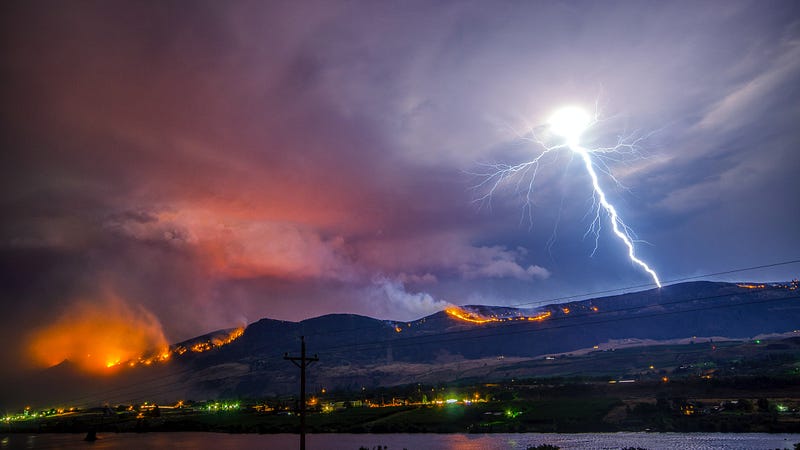
Is lightning a rare phenomenon? Nothing of the sort. Our planet is constantly bombarded by lightning. At any given moment, an average of 2,000 thunderstorms rage over the Earth. Up to dozens of lightning bolts per second can strike from them. It is estimated that every year lightning kills as many as 24,000 people worldwide.
That’s not all. Lightning can cause fires, damage trees and buildings, as well as electrical installations and equipment. They are violent and powerful electrostatic discharges, releasing an energy of about a billion joules in a fraction of a second. This is what makes them literally sow destruction in the place they strike.
How to protect yourself from lightning?
The best way to protect against lightning remains the lightning rod. It was invented back in the mid-1800s by Benjamin Franklin. Its most important part is a sharply pointed metal rod mounted on top of the building it is designed to protect. The device, constructed in this way, intercepts discharges. The current then flows through other parts of the lightning protection system to the ground.
How effective is a lightning rod? It is assumed that it approximately protects an area with such a radius as its height. So a lightning conductor that is ten meters will protect an area with a radius of ten meters. This shows some of the limitations of this device. It will not work where a large flat area is exposed to the danger of being struck by lightning, such as an airport or wind farm.
What is a laser lightning rod?
Scientists have been working for decades on new devices to improve classic lightning rods. One of them has been developed by a consortium that includes several European research centers, including the University of Geneva and France’s École Polytechnique, as well as TRUMPF Scientific Lasers.
That device is a laser lightning rod. The idea is not new: it involves changing the track along which lightning travels, using a laser. Running towards Earth, lightning moves along the path of least resistance. It can be influenced by ionizing the air above the protected area with short but strong laser pulses.
The concept has already been tested in Mexico and Singapore. However, the devices used there failed. Now scientists have gone to the top of Mount Santis in Switzerland. A 124-meter telecommunications tower is located there. On average, lightning strikes it as many as 100 times each year.
Under the tower, the researchers placed a specially designed device, dubbed the Laser Lightning Rod (LLR). When turned on, its beams shot into the air.
“This led to the ionization of nitrogen and oxygen, from which electrons broke off. This is how ionized air was created, which became an electrical conductor”, explains Professor Jean-Pierre Wolf of the University of Geneva, one of the study’s authors. Ionized air offers less resistance, and is therefore an ideal path for lightning.
How was the new device tested?
The terawatt laser used for testing was directed over the top of a tower equipped with a traditional lightning rod. It was tested between June and September 2021. When a thunderstorm passed over Santis, the laser was turned on, shooting ultra-short pulses into the clouds. In doing so, it produced a lingering ionized channel above the tower, pointing upward. This was a potential path for lightning, which should be pulled down with it to the classical lightning rod. The surrounding airspace was closed for the duration of the tests.
It turned out that the lightning managed to intercept four times during the tests. Once it struck when the sky was clear, and scientists recorded it following along the laser. Twelve times the lightning struck the tower when the laser was off.
Did the appearance of the laser enlarge the protected area? — “We determined that the discharge could follow the laser for almost 60 meters before reaching the tower”, Prof. Wolff said as quoted by phys.org. — “Thus, we enlarged the radius of the protected area from 120 to 180 meters”, he added.
It also turned out that the device worked even in difficult weather conditions, such as fog. The researchers’ goal is to enlarge the protected area as much as possible.
Source: phys.org, Nature Photonics
Cool that you made it to the end of this article. I will be very pleased if you appreciate the effort of creating it and leave some claps here, or maybe even start following me. It would be nice if you also left a tip! Thank you!